Without structure, your musical journey is like abstract art—chaotic and confusing. I started where you might be now, staring at the piano wondering about middle C.
Consistency isn’t just about discipline—it’s about making your brain work better. It learns through patterns, not random moments.
Your daily practice plan is like a blueprint for music skills. Without it, you’re just throwing things together and hoping they work. Ten minutes a day is sixty hours a year. That’s a whole week of getting better!
So, are you building a strong base or just making sounds? Find out how the best routines turn random effort into real progress.
Elements of an Effective Piano Routine
Building a piano routine without a plan is like trying to put together IKEA furniture without instructions. You might end up with something that looks like music but has extra parts. The best practicing tips I’ve found are to treat practice like a gourmet meal, not a quick snack.
Each part of your practice has a special role in your musical growth. It’s like the difference between throwing ingredients together and following a recipe from a famous chef.
- Warm-ups with metronome: This isn’t just finger exercises – it’s getting your brain ready. It’s like stretching before a big race, preparing your mind and body.
- Hanon exercises: These aren’t just hard exercises – they help your fingers work together. They’re like the piano version of CrossFit.
- Scale practice: Scales are the basics of music. You wouldn’t start writing a book without knowing the alphabet, right?
- Arpeggio practice: Arpeggios are like the building blocks of music. They help your fingers move on the keyboard with purpose.
- Chord progressions: Chords are like the social network of music. They show how notes work together to create feelings.
- Sight-reading: Sight-reading is like a test of your musical conversation skills. It’s where theory meets real-time playing.
The metronome isn’t just a tool – it tells you the truth about your rhythm. I learned this the hard way, after struggling with rhythm for months.
Chord inversions are not just theory – they’re shortcuts to playing music smoothly. They’re like the secret handshake that lets you into the piano elite.
A good piano routine turns random notes into meaningful music. It’s the difference between noise and art. These practicing tips help you go from struggling to playing smoothly.
The best thing? This structured approach actually saves time. What seems like extra work upfront leads to faster progress later.
Scheduling Your Practice Times
Let’s face it, finding time for piano practice is tough. You either make time or come up with excuses. It’s like that gym membership you always mean to use.
Choosing between morning and evening practice is more than just a preference. It’s a battle for your brain. Morning practice uses your brain’s fresh pathways. Evening practice builds on what you’ve learned, but it can feel like solving math problems after running.
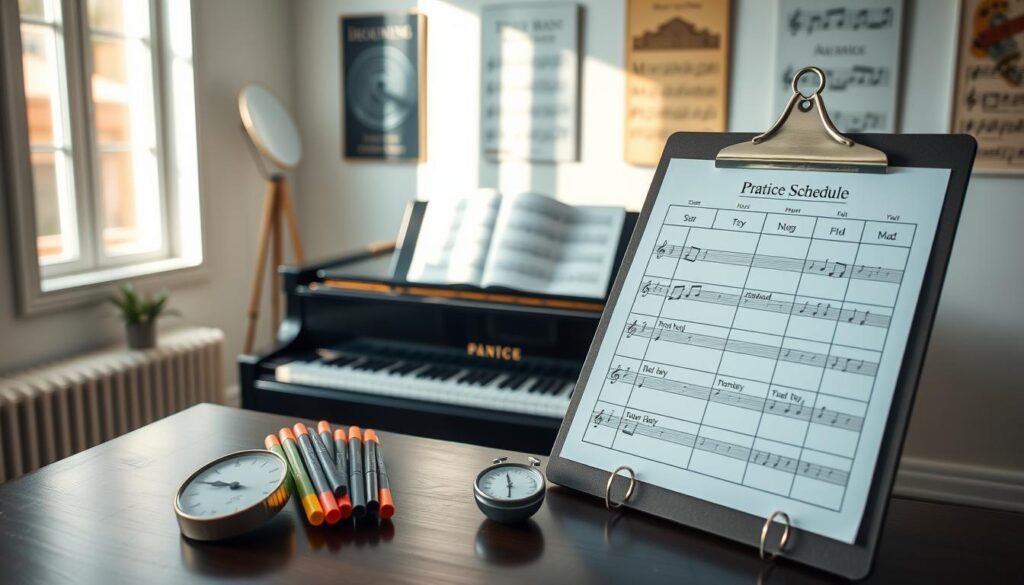
I’ve tried both morning and evening practice. Starting at 6 AM was hard at first but made my brain clear. Evening practice was sometimes tough, but it was worth it. The key is consistency over long practice sessions.
Short, daily practice sessions are better than long, rare ones. It’s like saving money – small, regular amounts add up over time. This approach boosts your musical skills fast.
Looking at student data and talking to parents, here’s what we found:
| Practice Time | Mental State | Effectiveness | Recommended For |
|---|---|---|---|
| Morning (6-8 AM) | Fresh, focused | High retention | Technical exercises |
| Afternoon (3-5 PM) | Alert, creative | Moderate energy | Piece learning |
| Evening (7-9 PM) | Tired, diffuse | Lower concentration | Review and reinforcement |
The best practice time is at least 30 minutes a day. One hour is even better for real progress. But, the most important thing is that you practice, not when.
Your perfect piano schedule is unique to you. It’s about understanding your brain’s rhythm and planning around it. Life’s rhythm waits for no one, but you can learn to keep pace.
Warm-Up Suggestions
Think of piano warm-ups as the intellectual foreplay before the main event – skip them and you’re basically starting cold. I learned this the hard way after months of diving straight into complex pieces. My fingers would stumble like a tourist in a foreign country without a map.
The metronome is your truth-teller here. Set it at a comfortable pace where you make zero mistakes. This isn’t about speed – it’s about precision. Your warm-up should feel like a mindful meditation, not a race against the clock.
Hanon exercises are the cross-fit for your digits. They felt alien at first – like trying to solve a Rubik’s cube with your fingers doing the Macarena. But they build finger independence like nothing else. Start with the first five exercises and watch your technique transform.
Scales are the vegetables of piano practice. Nobody really loves them, but they’re essential for your musical health. Work through all 12 keys systematically. Each key has its own personality and challenges. This isn’t mechanical repetition – it’s exploration of musical geography.
Arpeggios became my secret weapon once I cracked the fingering patterns. White keys versus black keys require different approaches. Master these and you’ll glide through chord progressions like a pro.
Chord practice completes the warm-up trifecta. Work on triads and progressions in different inversions. This builds the muscle memory you need for actual repertoire. It’s like learning the alphabet before writing poetry.
| Exercise Type | Time Investment | Primary Benefit | Pro Tip |
|---|---|---|---|
| Hanon Exercises | 3-5 minutes | Finger independence | Start slow, focus on even tone |
| Scale Practice | 5-7 minutes | Key familiarity | Use consistent fingering patterns |
| Arpeggios | 3-4 minutes | Technical fluency | Practice hands separately first |
| Chord Progressions | 4-6 minutes | Harmonic understanding | Visualize the chord shapes |
Your warm-up sets the musical intention for your entire practice session. It’s the difference between stumbling into practice and entering with purposeful clarity. Think of it as tuning your instrument – except the instrument is your brain and fingers.
Don’t treat these exercises as mindless repetition. Each scale, each arpeggio, each Hanon pattern is building your musical vocabulary. They’re the foundation upon which everything else is built. Skip them at your own peril.
Routine Example Templates
Welcome to the culinary school of piano practice. Here, we focus on structured sessions instead of random playing. These templates help turn chaotic playing into meaningful progress.
Here’s a surprising truth I’ve found: limits can spark creativity. A structured template doesn’t hold back musical exploration. It actually helps bring out new ideas, like sonnet form does in poetry.
The Beginner Template (30 minutes):
- 5 minutes scales (your musical vegetables)
- 5 minutes chord progressions (the protein)
- 10 minutes repertoire (the main course)
- 5 minutes sight-reading (dessert)
- 5 minutes free play (digestion period)
The Intermediate Template (45 minutes):
- 8 minutes scales and arpeggios
- 7 minutes technical studies
- 15 minutes complex repertoire
- 10 minutes sight-reading and harmonization
- 5 minutes improvisation exercises
The Advanced Template (60 minutes):
- 10 minutes advanced technical work
- 15 minutes repertoire mastery
- 10 minutes musical analysis
- 15 minutes improvisation and composition
- 10 minutes performance preparation
| Level | Duration | Core Components | Progression Focus |
|---|---|---|---|
| Beginner | 30 minutes | Scales, chords, basic repertoire | Foundation building |
| Intermediate | 45 minutes | Technical studies, complex pieces | Skill expansion |
| Advanced | 60 minutes | Analysis, improvisation, performance | Artistic development |
Each template acts as a musical progression tracker. It ensures balanced development. The beginner template lays the groundwork. Intermediate builds technical skills. Advanced focuses on artistic growth.
Morning practice fits well with these structures. It’s fresh and perfect for learning new techniques. Evening sessions are great for creative play.
Practice quality is more important than how long you play. Thirty focused minutes are better than two hours of distracted playing. Your progression tracker is about quality, not quantity.
These templates give you structure, but you add the music. They’re like training wheels that help you grow musically.
Setting Practice Goals and Milestones
Goals without milestones are like New Year’s resolutions – they often end up forgotten. I learned this the hard way when my early piano journey felt aimless. It was like a tourist without a map.
But then, I changed my approach. I started treating practice like building a house, not creating art. Instead of vague goals, I set specific targets:
- Weekly: Master C major scale at 100 bpm
- Monthly: Learn three new pieces from method book
- Quarterly: Perform five songs from memory for friends
This new way of practicing made a huge difference. It turned my practice into a focused effort to improve. Learning music is like climbing a spiral staircase, where you keep improving the basics.
Tracking progress is key. Instead of just playing a scale, aim to play it at 120 bpm with the right dynamics. This makes practice feel like a game you can win.
Tracking your progress is like having a personal GPS. Celebrate every milestone, from reading sheet music to mastering scales. It’s the difference between getting lost and following a clear path.
Parents and students often ask about effective piano practice routines. The answer is simple: what gets measured gets mastered.
Your goals should both scare and excite you. Want to master chords in all keys? Break it into smaller goals. Dream of performing? Plan mini-recitals every quarter. The journey is full of steps – just make sure you count them.
Adapting for Busy Schedules
The 5-minute practice session isn’t a compromise; it’s a smart move. It’s like getting a quick snack instead of a big meal. Sometimes, a little bit is enough for our busy lives.
Breaking practice into small bits throughout the day works better than long sessions. Practice while you wait for coffee to brew. Play chords during Zoom calls. These short moments add up to big progress.
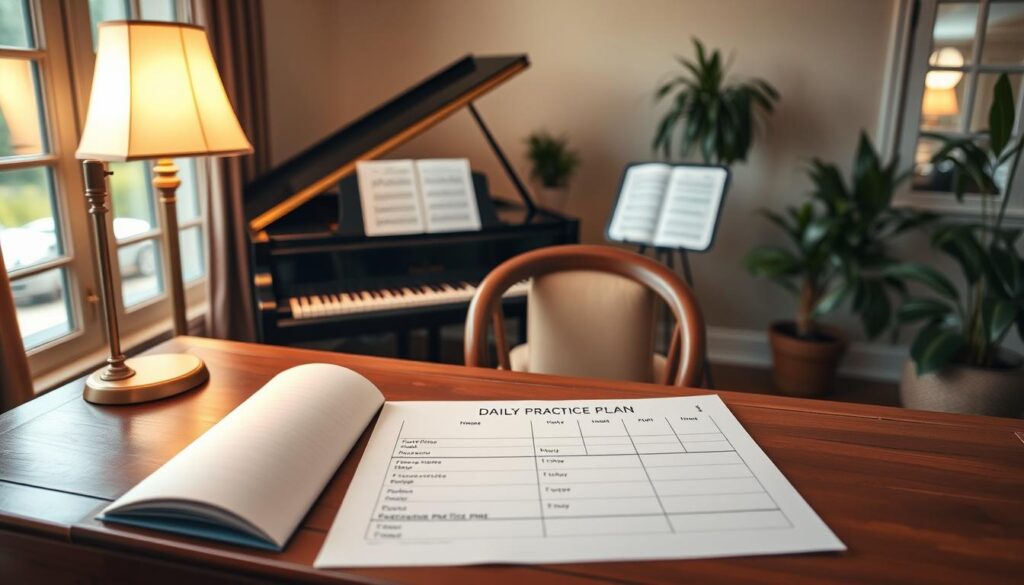
The key is Jerry Seinfeld’s “don’t break the chain” method for piano. Mark each day you practice, even if it’s just five minutes. Seeing your streak grow is a great reward.
It’s not about finding time to practice; it’s about using the time you have better. Swap some social media or TV time for playing piano. Your future self will be grateful.
Change how you think about practice. Count any focused time as practice, even if you’re not playing. The goal is to keep going, not to be perfect.
| Traditional Approach | Micro-Practice Advantage | Time Investment |
|---|---|---|
| 60-minute sessions | Lower mental barrier to start | 5-15 minute blocks |
| Fixed schedule | Adapts to daily fluctuations | Multiple times daily |
| Perfection-focused | Consistency-focused | Flexible timing |
Your daily practice plan should be okay with mistakes. Some days you’ll practice scales during commercials. Other days, you’ll think about it during your commute. The important thing is to keep going.
This way of practicing turns it into a natural part of your day. Piano becomes a part of your daily routine, not something you have to schedule. This is how busy people make progress.
Online Routine Trackers
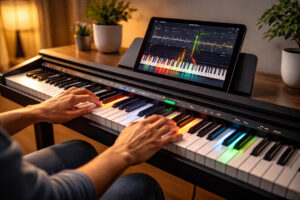
In today’s world, ignoring piano apps is like not using GPS on a trip. You might get there, but it’s harder. Piano trackers mix old music teaching with new science.
Sight Reading Factory is more than an app. It’s endless reading material for pianists. Playground Sessions gives feedback like a pro, thanks to its tracking. Musescore connects you with others, while Liberty Park Music and Piano With Jonny offer structured lessons.
Technology should help your practice, not take over. These tools are like training wheels. I’ve tried them, and the best mix is digital tools with real music.
Make your piano practice better with a mix of old and new. Your piano routine needs a 21st-century boost. It should keep you on track while keeping music exciting.