Congratulations. You’ve conquered the hardest part: deciding to learn music. Now you face a modern dilemma that would baffle Mozart.
You’re staring at a sea of plastic, wood, and silicon, all claiming to be your musical soulmate. Is it a digital piano? Is it a keyboard? Is there even a real difference, or is this just clever marketing designed to separate you from your cash?
Let’s cut through the noise. This isn’t just about picking an instrument. It’s a philosophical inquiry into the nature of sound itself.
One path involves hammers and strings—the centuries-old mechanics of an acoustic beast. The other route is built on ones and zeros, triggering a synthesizer with the press of a key. This core piano keyboard difference defines everything about how you’ll learn, play, and feel the music.
We’re about to embark on a forensic comparison. We’ll peel back the layers of marketing to examine the DNA of these instruments. Which choice leads to musical enlightenment for a beginner, and which might be a cleverly disguised dead end?
Strap in. Your first real lesson starts now.
Digital Piano Advantages for Learning
Digital pianos are different from keyboards because they offer real feedback. Every key press tells you how you’re doing. It’s not just fun; it’s a way to learn.
The weighted keys teach you a lot. They don’t just wait for you to press them. They have weight and resist your fingers. Playing well means playing with strength and purpose.
Learning on a digital piano is like getting a PhD in finger strength. You learn about physics and how to play any piano. The hammer mechanism in good digital pianos is like a grand piano’s.
Having 88 keys is important. It lets you learn the whole keyboard from the start. You won’t have to learn it all again when you get a bigger piano.
Playing softly and loudly is key to music. A digital piano helps you learn this. It makes you think about how you play, not just what.
Let’s look at why this is important for learning:
| Feature | How It Helps Learning | Real-World Benefit |
|---|---|---|
| Weighted/Graded Keys | Builds proper finger strength and technique through realistic resistance | Skills transfer directly to acoustic pianos; no retraining needed |
| Full 88-Key Range | Teaches complete keyboard geography and hand positioning | No limitations on repertoire; ready for advanced pieces immediately |
| Dynamic Response | Develops touch sensitivity and expressive control | Creates musical, not just mechanical, playing from the start |
| No Tuning Required | Provides consistent pitch and tone for ear training | Focus remains on playing, not instrument maintenance |
Learning on a basic keyboard is like boxing on a pillow. It feels good but doesn’t teach you much. A digital piano is like a heavy bag. It teaches you to play with real technique.
Playing a digital piano also trains your brain. You learn about cause-and-effect, fine motor skills, and hearing differences. It’s like getting smarter while playing music.
Not having to tune your piano means you can focus more. You won’t lose practice time to fixing your instrument. This helps you get better faster.
Playing on a digital piano is harder than on a light keyboard. But that’s what makes it good. It turns wanting to play piano into actually being a pianist. The difference is huge.
When a Keyboard Might Be Better
If you live in a small space, a keyboard might be the better choice. It’s perfect for saving room. You can put it on a desk, under a bed, or take it with you.
It’s not just about saving space. It’s about living a certain way. If you’re always on the move, a lightweight keyboard is ideal. It’s great for those who need to be flexible.
Keyboards offer more than just piano sounds. They have drums, synthesizers, and more. This makes them perfect for exploring different sounds and styles.
For composers and producers, keyboards are like a playground. They come with many sounds and features. This makes learning fun and engaging, even for beginners.
Keyboards are also affordable. They’re a great choice if you’re on a tight budget. They’re perfect for kids or anyone who’s not sure if they’ll stick with music.
Young learners will appreciate the lighter keys. They help prevent frustration and fatigue. It’s like having a special tool for growing musicians.
Think about your goals. Do you want to play in a band or produce music? Keyboards are great for these things. They’re easy to take with you and have lots of sounds.
In short, keyboards are not just a backup choice. They’re a smart pick for those who value space, budget, or electronic music. They offer a unique way to learn and explore music.
Key Weight and Touch Sensitivity
Imagine typing on a laptop versus an old typewriter. That’s the difference between keyboard and piano keys. One is easy and silent. The other needs effort and gives satisfying feedback.
This difference is key for beginners. On a piano, a hammer hits a string. Your finger’s speed controls the sound. Most keyboards can’t match this.
Key actions vary in how well they communicate. At the bottom are unweighted keys. They’re simple, press and sound, but lack nuance.
Semi-weighted keys offer a bit more. They have a light resistance. It’s better than nothing but not like a real piano.
Weighted keys feel real. They have mass, making playing feel more like a piano. This is a good start for serious practice.
Hammer action is the best. It mimics a piano’s feel, with keys weighted and responding like a real piano. It lets you play softly or loudly.
Why does this matter? Music is in the dynamics. The way you play changes the emotion of a piece. A good keybed trains your fingers to express this.
| Key Action Type | Mechanism | Feel & Response | Best For |
|---|---|---|---|
| Hammer Action | Graded, individual weights with lever mechanism mimicking acoustic piano hammers. | Heavy, realistic inertia. Excellent dynamic control and expressive range. | Serious beginners committed to piano technique; classical players. |
| Weighted Keys | Uniform weights attached to each key, often using metal or dense plastic. | Substantial, consistent resistance. Good for building finger strength and basic dynamics. | Beginners focused on piano skills who need a budget-friendly realistic option. |
| Semi-Weighted | Spring mechanism with minimal added weight for slight resistance. | Light, synth-like with a hint of pushback. Limited dynamic sensitivity. | Players who split time between piano and synth/organ sounds; portability seekers. |
| Unweighted/Spring-Loaded | Simple spring returns key to position; no added weight. | Very light, fast, and clicky. No velocity-based dynamic control. | Electronic music production, controlling software synths, absolute beginners on a tight budget. |
Choosing the right keys affects your learning. Unweighted keys limit your expression. Switching to a real piano later feels like starting over.
Modern keyboards are improving. They offer touch sensitivity, where sound changes with force. But, they lack the real feel of a piano.
When choosing, press the keys and feel them. Ask if they respond to your touch. Can you play softly and loudly on the same instrument? Your answer will guide you to the right tool.
Sound Quality Comparison
At the heart of the debate between digital pianos and keyboards is a key question: do you want to copy perfection or create something new? It’s not just about how loud or wide the sound is. It’s about what you want to express.
A top digital piano is like a master forger. It has “ghosts” of famous instruments like Steinways and Yamahas. It uses advanced technology to make sounds that feel real, even to those who don’t know much about music.
On the other hand, a keyboard is more like a sonic architect. It’s great at making a wide range of sounds. You might find sounds from a Hammond B3 organ, a Moog synthesizer, and a string section all in one. It’s not about copying a piano perfectly. It’s about making new sounds.
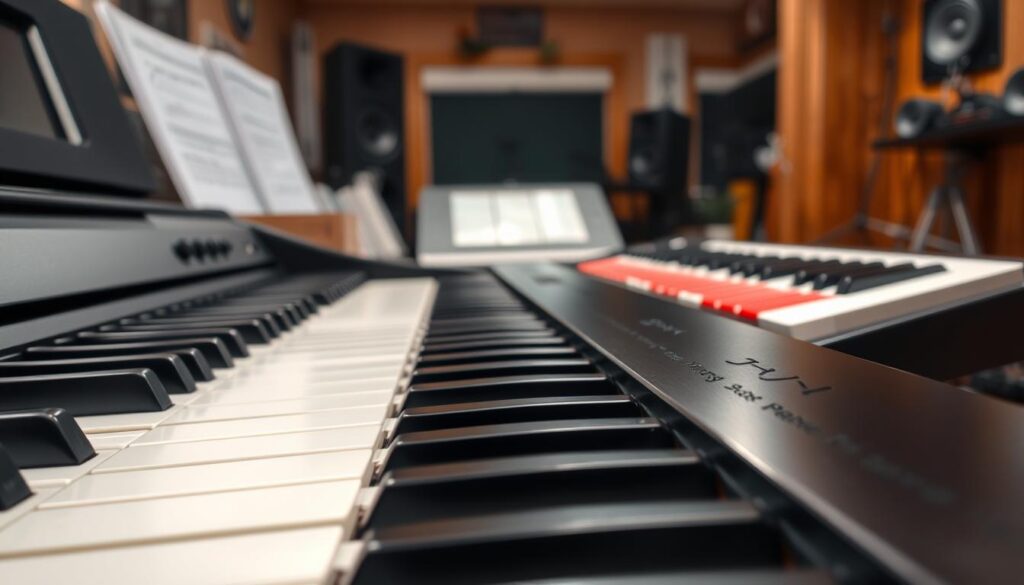
Weighted keys are very important. They let you play a digital piano like a real one. You can make notes sound just right, like on an acoustic piano. But trying to do this on a keyboard with light keys is hard. It’s like trying to paint with a broom.
Looking at the technical specs, we see some differences. Digital pianos can play many notes at once, which is great for complex music. Keyboards can play different sounds at the same time, which is great for making new music.
So, who wins in terms of sound quality? It’s a tie, but with different wins. Digital pianos are best for playing traditional piano music. Keyboards are better for making new and different sounds. Your choice depends on what kind of music you want to make.
| Feature | Digital Piano | Keyboard |
|---|---|---|
| Sound Generation | High-fidelity sampled acoustic pianos | Synthesized & sampled various instruments |
| Primary Goal | Authentic acoustic piano reproduction | Versatility and new sound creation |
| Typical Polyphony | High (128 to 256 notes) | Varies (32 to 128 notes) |
| Multitimbrality | Often limited (1-2 parts) | Usually high (16+ parts common) |
| Ideal For | Classical, jazz, solo performance | Pop, rock, electronic, songwriting |
Remember, some keyboards can make piano sounds as good as digital pianos. But they do it in their own way. A digital piano is like a tribute. A keyboard is like a tool that can do many things, including making piano sounds. For more on this, see our full keyboard vs digital piano comparison.
Sound quality is tied to how the keys feel. The right weighted keys bring out the emotions in a digital piano’s sounds. But on a keyboard, heavy keys might not be needed for some sounds. Choose the right tool for your music.
Learning Curve Differences
Learning an instrument is like choosing between a scenic highway and a mountain trail. The keyboard is like the highway, easy and quick. The digital piano is like the mountain trail, challenging but rewarding.
The keyboard is easy to start with. It has lights and sounds that help you play right away. You feel good about your playing quickly, which keeps you wanting more.
But, the keyboard’s ease can stop you from learning more. You might think you’re good when you’re not. This can make you feel like you’re not really learning.
The digital piano is different. It tells you right away if you’re playing it right. You learn about touch and sound, not just songs.
This hard start is good for you. It helps you play better on any piano. You learn to control your playing and express yourself.
So, which one is better? It depends on what you want to do. If you want to play pop songs fast, the keyboard is good. But if you want to play classical or jazz, the digital piano is better.
| Aspect | Electronic Keyboard | Digital Piano | Impact on Learning |
|---|---|---|---|
| Initial Experience | Fun, engaging, immediate results | Challenging, requires focused effort | Keyboard builds confidence faster; piano builds foundation |
| Short-term Progress | Rapid advancement with features | Slower, technique-focused development | Keyboard feels more rewarding initially |
| Long-term Development | Plateaus around intermediate level | Continuous growth possible | Piano offers unlimited ceiling for improvement |
| Technique Building | Limited finger strength development | Comprehensive technical training | Piano skills transfer to acoustic instruments |
| Musical Understanding | Pattern-based learning | Principles-based mastery | Piano develops deeper musical intelligence |
The keyboard is like a bunny slope, easy and fun but limited. The digital piano is like climbing Everest, hard but rewarding. Both are good for different reasons.
Think about where you want to go in music before you choose. Do you want a quick trip or a long journey? Your choice will help you learn better.
Space and Portability Factors
Your available square footage might just be the ultimate referee in the match between a keyboard’s nomadic spirit and a digital piano’s settled sovereignty. This piano keyboard difference isn’t just about inches and pounds. It’s about how music inhabits your life.
Keyboards are the minimalists. Think of that sleek Casio or Yamaha portable. It’s just a casing with keys—a musical laptop. You can tuck it under an arm, slide it into a gig bag, and vanish. For band rehearsals, dorm rooms, or that corner of a chaotic living room, it’s perfect. This portability isn’t a bonus feature. For musicians who play with others, it’s the main event.
Digital pianos tell a different story. Yes, they’re smaller than their acoustic ancestors. But don’t confuse compact with portable. Many models, like the furniture-style Yamaha Clavinova, are pieces of cabinetry. They declare, “I live here.” They demand a dedicated spot—a musical hearth. This fundamental piano keyboard difference is about commitment versus convenience.
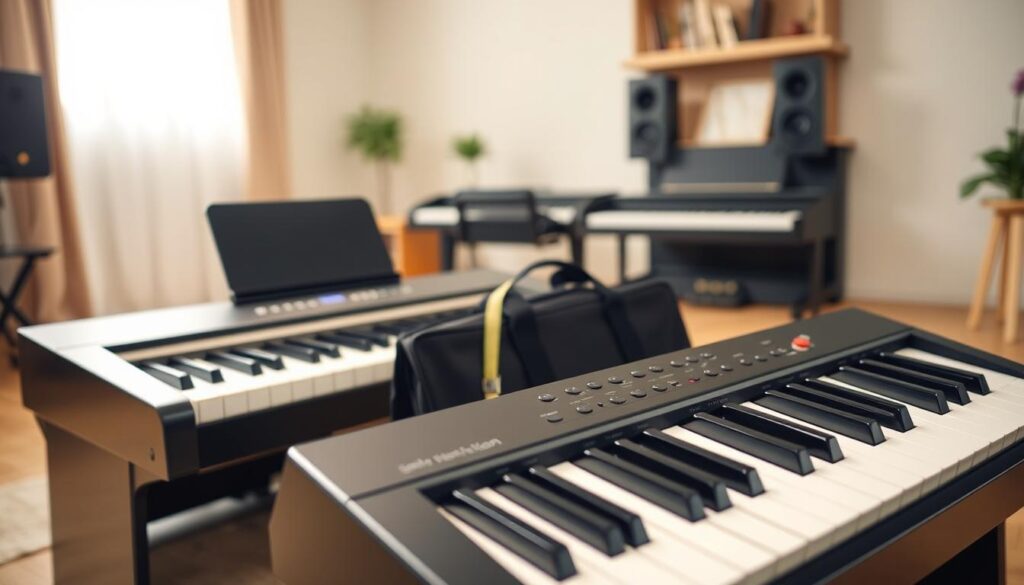
Your lifestyle casts the deciding vote. Are you a digital nomad, needing an instrument that follows your whims? Or are you a settled sentinel, building a permanent musical command center? The keyboard offers a casual relationship with space. The digital piano proposes marriage to a specific corner of your home.
| Factor | Keyboard | Digital Piano |
|---|---|---|
| Typical Form | Lightweight casing | Console or cabinet style |
| Portability | High (easy to transport) | Low to None (stationary) |
| Space Required | Minimal (can be stored) | Dedicated footprint |
| Ideal For | Gigs, small apartments, students | Home studios, dedicated music rooms |
| Commitment Level | Low (flexible placement) | High (fixed location) |
Synthesizers, often lumped in with keyboards, share that go-anywhere ethos. But true digital pianos? They’re not coming to the party unless the party comes to them. This spatial piano keyboard difference is your practical manifesto. One instrument is a tiny house of music—functional and mobile. The other is a permanent addition to your home’s architecture. Choose based on how much ground you’re willing to cede.
Price Point Analysis
Let’s talk about money—the financial reality check that separates keyboard fantasies from piano commitments. The entry-level keyboard market starts where impulse buys live. We’re talking about the cost of a surprisingly nice dinner for two, or a pair of tickets to a mid-tier concert.
For around $150, you can have a plastic box that makes piano-like sounds. It’s the musical equivalent of a fast-food burger: satisfying the immediate craving without much nutritional value for your skills.
Cross the $500 threshold, and you enter the realm of the considered purchase. This is digital piano territory, where prices mirror those of premium smartphones or high-end tablets. Suddenly, you’re not buying a toy. You’re investing in a practice instrument.
The price jump isn’t arbitrary. You’re funding engineering. You’re paying for the mechanical marvel of weighted keys. That satisfying thunk, the graded resistance, the way the key rises after you press it—this all costs real money to simulate.
Think of it as the difference between a poster of the Mona Lisa and a museum-quality reproduction. One gives you the basic image. The other attempts to deliver the texture of the paint, the crackle of the aged varnish, the heft of the original frame.
Here’s the brutal breakdown:
- The Appetizer ($100-$300): Basic keyboards. Portable, fun, packed with gimmicks. Perfect for testing interest.
- The Main Course ($500-$1,500): Serious digital pianos with proper weighted keys and sound engines. This is where most committed beginners land.
- The Chef’s Tasting Menu ($1,500-$4,000): High-end digitals with acoustic-piano actions, premium materials, and studio-quality sound.
- Buying the Restaurant ($4,000+): The acoustic piano world. A different financial universe entirely.
Don’t overlook the second-hand market. A used digital piano from a reputable brand can offer 70% of the performance for 50% of the price. It’s the smart person’s hack. Just ensure those weighted keys are in good condition and the electronics aren’t outdated.
Your budget, then, answers the essential question: Are you sampling an idea or building a habit? The former is a $150 experiment. The latter requires a bigger investment. The good news? In music, the most expensive part of the journey isn’t the instrument—it’s the consistent time you invest in it.
FAQ
Q: What is a learning instrument?
A: A learning instrument is a tool or device designed to help individuals learn new skills or knowledge. It can be a physical object, a software program, or even a digital platform.
Q: How can I choose the right learning instrument for my needs?
A: When selecting a learning instrument, consider your goals, preferences, and the type of content you want to learn. Look for instruments that align with your learning style and provide the necessary features and functionalities to support your learning journey.
Q: What are some examples of learning instruments?
A: Examples of learning instruments include textbooks, online courses, educational apps, language learning software, and interactive simulations. These tools provide different approaches to learning and can cater to various subjects and skill levels.
Q: How can I integrate learning instruments into my daily routine?
A: To incorporate learning instruments into your daily routine, set aside dedicated time for learning and use tools that fit into your existing schedule. Choose instruments that offer flexibility and convenience, such as mobile apps or online platforms that can be accessed anywhere, anytime.
Q: What are the benefits of using learning instruments?
A: Learning instruments offer several advantages, including personalized learning experiences, increased engagement, and improved retention of information. They provide interactive and immersive learning experiences that cater to individual learning styles and preferences.
Q: How can I stay motivated and engaged while using learning instruments?
A: To maintain motivation and engagement, set achievable goals, track your progress, and reward yourself for milestones achieved. Choose learning instruments that offer interactive and engaging features, such as gamification, quizzes, and interactive simulations.
Q: What are some popular learning instruments?
A: Some popular learning instruments include language learning apps like Duolingo, online course platforms like Coursera, educational apps like Khan Academy, and interactive simulations like 3D models and virtual labs.
Q: How can I choose the right learning instrument for my needs?
A: When selecting a learning instrument, consider your goals, preferences, and the type of content you want to learn. Look for instruments that align with your learning style and provide the necessary features and functionalities to support your learning journey.
Q: What are some examples of learning instruments?
A: Examples of learning instruments include textbooks, online courses, educational apps, language learning software, and interactive simulations. These tools provide different approaches to learning and can cater to various subjects and skill levels.
Q: How can I integrate learning instruments into my daily routine?
A: To incorporate learning instruments into your daily routine, set aside dedicated time for learning and use tools that fit into your existing schedule. Choose instruments that offer flexibility and convenience, such as mobile apps or online platforms that can be accessed anywhere, anytime.
Q: What are the benefits of using learning instruments?
A: Learning instruments offer several advantages, including personalized learning experiences, increased engagement, and improved retention of information. They provide interactive and immersive learning experiences that cater to individual learning styles and preferences.
Q: How can I stay motivated and engaged while using learning instruments?
A: To maintain motivation and engagement, set achievable goals, track your progress, and reward yourself for milestones achieved. Choose learning instruments that offer interactive and engaging features, such as gamification, quizzes, and interactive simulations.
Q: What are some popular learning instruments?
A: Some popular learning instruments include language learning apps like Duolingo, online course platforms like Coursera, educational apps like Khan Academy, and interactive simulations like 3D models and virtual labs.