You’ve learned the keyboard’s layout. Your hands now work together. Congratulations. Now, let’s explore the footwell.
For new players, the pedals are a mystery. They’re often overlooked. But, they’re key to adding color to your music.
This guide will clear up the mystery. We start with the sustain pedal. What does it do? And what doesn’t it do? (Spoiler: It’s not a volume knob. That would upset Debussy.)
We’ll dive into its mechanics with detail and humor. By the end, you’ll see why Rubinstein called it the “soul of the piano.” You’ll be eager to use it more.
When to Add Pedal: After LH Lands, Phrase Ends
The sustain pedal is like the ultimate audio effect. Used wrong, it messes up your music. But used right, it brings your notes to life. The key is timing.
Don’t press the pedal with the key. That’s for beginners. It makes your sound muddy and unclear.
The pro way is to delay the pedal. It’s called legato pedaling. It’s all about the smooth transition.
The Golden Rule: Play First, Pedal After
Here’s the rule: play the note first, then pedal. This small delay is critical.
It lets the note’s attack be clear before the pedal sustains it. This keeps your music sharp and connected.
Try it with a simple chord. Play a C major chord. Then press the pedal. Listen to how it changes after the fact. That’s the sound you want.
Lifting for Punctuation: The Phrase End
Pedaling is not just starting sound. It’s also ending phrases. Music phrases are like sentences.
Your foot adds punctuation. At the end of a phrase, lift the pedal. This clears the sound for the next idea.
Then, start again: play the first note, let it land, pedal. This rhythm is key to expressive playing.
It’s not about how fast you can pedal. It’s about timing for your ears and feet. This turns the pedal into a tool for shaping legato lines and silences.
Simple Pedal Patterns for First Pieces
Starting with the sustain pedal is like getting a learner’s permit. You begin in a simple place, not on the busy roads. For piano, that place is a basic chord progression.
Your first task is to automate your playing. We’re creating a path in your brain. This lets your foot move with your hands.
The basic pattern is your pedal kata. Start with a chord, then press the pedal down briefly. As you move to the next chord, lift your foot just as your fingers press new keys. Then, press it down again.
This pattern is the heart of sustain pedal basics. It connects harmonies smoothly, avoiding the “blur.” Your brain learns to focus on different tasks at once.
Your First Practice Loops
Choose music that’s so simple, it’s almost dull. This helps you focus on the foot-hand coordination.
The C-F-G-C progression is great for beginners. Each chord gets one measure, with the pedal changing with each chord. It’s a simple loop that helps you learn timing.
Other good songs for beginners include “Heart and Soul” or a basic 12-bar blues in C. Their simple nature is perfect for practicing your pedal pattern.
Patterns in the Wild: A Beginner’s Guide
Simple songs often need slight changes to the basic kata. Here’s how to handle common beginner pieces.
| Piece / Progression | Pedal Pattern | Focus Point | Why It Works |
|---|---|---|---|
| C-F-G-C Loop | Change on every chord (1 pedal per measure in 4/4 time). | Foot lifts AS the new chord sounds. | Builds the fundamental lift-press muscle memory in a predictable loop. |
| “Heart and Soul” (Chord Part) | Change with each bass note (often every 2 beats). | Listening for the bass line to move. | Teaches you to pedal with harmonic changes, not just on a timer. |
| Simple Blues in C | Pedal each new chord in the 12-bar pattern. | Keeping the rhythm steady during chord shifts. | Applies the pattern in a familiar, musical structure that feels like a real song. |
| Slow, Single-Note Melody | Pedal down on the first note of a phrase, up at the end. | Connecting melodic notes, not chords. | Introduces the concept of using pedal for legato and atmosphere, not just harmony. |
The aim is to make the action automatic. When you don’t think about lifting and pressing, but your foot just responds, you’ve made progress. You’ve laid the groundwork for more in your sustain pedal basics journey.
Then, the simple tasks become more complex. You’re ready for the next steps.
Clean Changes vs “Blurry” Sound (Ear Training)
Learning to hear the difference between clear and muddy sounds is key. This skill is essential for mastering the sustain pedal basics. It helps you move from playing simple notes to creating beautiful music.
Using the sustain pedal wrong is a common mistake. It can make your music sound like a mess. This is called “the blob.” It’s like trying to see through a fog.
To avoid this, you need to make clean pedal changes. This means lifting the pedal all the way up. It stops the strings from vibrating, making room for the next sound. It’s like hitting a reset button between notes.
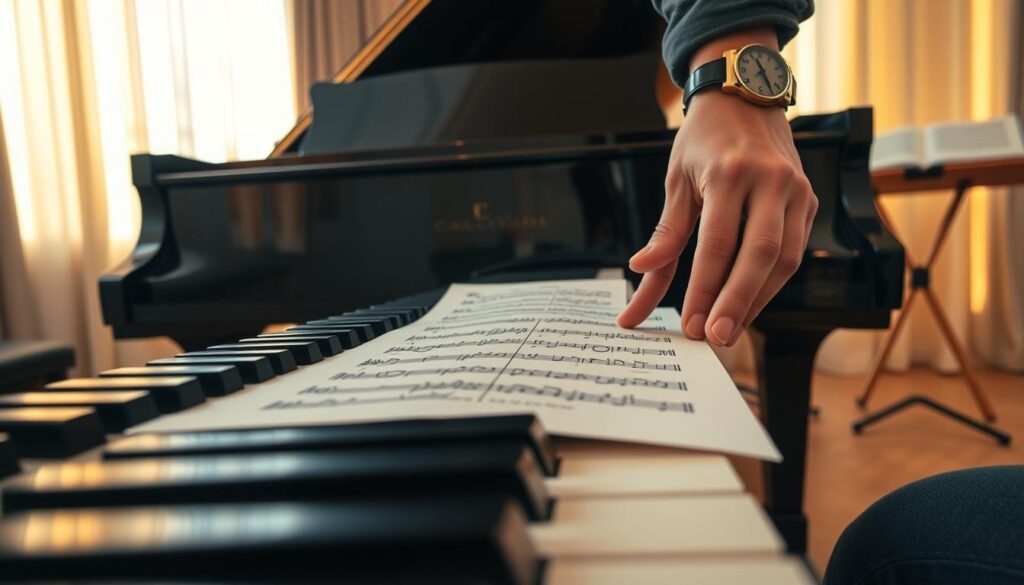
Ear training is your best tool for this. Record yourself playing a simple chord progression. First, play it with the pedal down. Then, play it again with precise lifts.
Listen to the recordings. The first one will sound crowded. The second one will be clear and purposeful. Compare it to a professional recording to learn about articulation.
But what about the soft, misty sound in Impressionist music? That’s a special effect. It’s an artistic choice. The key is knowing when to use it.
Half-pedaling is a technique for advanced players. It means lifting the pedal halfway. This creates a soft blend of sounds, not a complete wipeout. It’s like adjusting the focus of a camera.
Let’s look at the differences clearly. You need to know when to use each technique.
| Technique | How It Sounds | When To Use It | The Foot Action |
|---|---|---|---|
| Clean Pedal Change | Crisp, clear, defined. Each harmony has its own space. | Classical melodies, hymn-style pieces, any passage requiring precise articulation. | Full down, then full up in sync with harmonic change. |
| Blurry Overuse (The Mistake) | Muddy, congested, noisy. Melodies get lost in a wash of sound. | Never intentionally. It’s the result of lazy pedal technique. | Pedal held down constantly, never fully clearing. |
| Artistic Half-Pedaling | Warm, blended, atmospheric. A subtle connection without clutter. | Creating a seamless legato in slow, expressive passages or Impressionist music. | Pedal depressed, then lifted only halfway to partially engage dampers. |
Mastering this table is your homework. It shows how the physical action affects the sound. True legato on the piano is about teamwork between your hands and foot. The pedal shapes the sound between notes, adding depth to your music.
Your ears are the final judge. Train them to seek clarity first. Then, you can experiment with softening the sound. Know the rules before you break them.
Dynamics: From p to f with Weight, Not Force
Think stomping the sustain pedal makes your playing louder? That’s a common mistake. It’s like trying to change a TV channel by yelling at the remote. Let’s look at the physics behind this.
The sustain pedal changes duration, not how loud a note is. It lets quiet notes sound as long as loud ones. Real dynamics—from soft piano to loud forte—come from how you play the keyboard. Your feet adjust the lighting, but your hands are the stars.
To create a crescendo, use weight, not force. Think of pushing a key versus dropping into it. Your arm weight, through relaxed shoulders and wrists, shapes the tone. Force, on the other hand, makes noise.
Your Secret Weapon: The Soft Pedal
Get to know the left pedal, or una corda. It’s not just for quiet moments. It changes the sound’s color. When you use it, the sound becomes softer, but also richer.
Using the soft pedal for pianissimo moments adds a special touch. It’s like moving from a loud microphone to a whispered secret. This is where true control over dynamics comes in—by blending touch and sound.
| Dynamic Approach | Physical Mechanism | Resulting Sound |
|---|---|---|
| Playing with Force (Common Error) | Tensing fingers, hammering keys from knuckles | Harsh, brittle tone with inconsistent volume |
| Playing with Weight (Correct Technique) | Relaxed arm weight transfer through shoulder to fingertip | Rich, singing tone with controlled crescendos |
| Using Sustain Pedal for “Volume” | Depressing right pedal harder/longer | Muddy texture, no actual dynamic variation |
| Using Soft Pedal (Una Corda) | Left pedal shifts hammers to strike fewer strings | Softer, veiled tone with intimate character |
| Combined Weight + Pedal Technique | Arm weight control with selective pedal for resonance | Expressive, colorful phrasing with clear articulation |
The table shows a clear truth: weight beats force. Your crescendo should feel like a wave, not a sudden change.
When you see pp or ff in your music, think about weight, not pedal pressure. Your dynamics tell the story. The pedals just set the mood. Forget about foot force. Focus on finger weight to make quiet powerful and loud gentle.
Articulation: Legato vs Staccato in One Piece
Think of articulation as musical punctuation. Legato is like a flowing cursive, while staccato is sharp and clear. Your fingers are the pen, and the piano is the paper. The sustain pedal is like an editor, adding depth or changing the whole piece.
Legato means “tied together” in Italian. It’s like a smooth sentence where each word flows into the next. Your fingers do this by overlapping, releasing one key only after the next sounds. It’s emotional and deeply human.
Staccato means “detached.” These are the sharp, clear notes. Think of a tap dancer or the rhythm of a typewriter. Each note is distinct and proud.
The sustain pedal is your friend with legato phrases. It adds resonance, making the sound smooth and singing. It’s like the reverb in a recording studio that makes vocals shimmer.
But use the pedal with staccato and it’s disaster. The crisp attack gets lost in sustain, making a muddy mess. It’s like whispering in an echo chamber—the intent gets lost.
When a piece has both articulations, it’s a challenge. Most interesting music falls into this gray area. You must conduct a dialogue between your hands and foot.
For legato, use the pedal to enhance the connection. For staccato, keep your foot off to preserve crispness. Sometimes, a quick tap adds just the right touch.
This balance creates real musical dynamics. It’s not just about loud and soft. It’s about connected and detached, sustained and percussive. Your right foot is part of a dance with your fingers.
Try this: play a piece that mixes both articulations. Play it once focusing on finger articulation. Then play it again with the pedal where it helps. Notice how the character changes. Staccato notes become more authoritative, and legato lines warmer.
This dialogue transforms you from playing notes to shaping phrases. You’re interpreting musical language with all its nuance. The pedal is your collaborator in this articulate conversation.
Demo: Upgrade a Simple Melody with Pedal + Dynamics
Let’s dive into the magic of pedal and dynamics on a simple melody. We’re taking “Twinkle, Twinkle, Little Star” from a basic tune to a powerful piece. It’s not about new notes. It’s about feeling the spaces between them.
First, we play it straight. No pedal, no dynamic changes, just a mechanical beat. It’s useful but lacks emotion. This is our starting point, the musical foundation we’ll bring to life.

Phase 1: The Breath of Legato
Now, we use the sustain pedal wisely. Press it down just after playing each new note or chord. Lift it at the start of the next change.
This makes “Twinkle, Twinkle” flow smoothly. It goes from plinking to singing. The notes blend into a flowing line. This is legato through the pedal, not just fingers. The melody breathes, feeling more human.
Phase 2: Painting with Light and Shadow
Next, we add dynamics. Start the first phrase softly, using arm weight. Let the second phrase grow louder. Make the third phrase the peak before softening for the end.
This creates a story. The tune has ups and downs, tension and release. It’s no longer just notes. It’s a journey of sound.
Phase 3: The Color of Contrast
For the final touch, use the soft pedal. On the final repeat, add the left pedal. The sound becomes soft and intimate.
This contrast is key. You’ve turned a simple nursery rhyme into a journey. It starts clear, grows, and ends softly. You’ve added meaning through tools.
The Self-Critique Lab
Record yourself playing the melody three ways. First, the robot version. Second, with pedaled legato. Third, with full dynamics and pedal.
Listen closely. The difference is clear. It’s like the difference between typing and speaking. The recording shows where you need to improve.
This demo shows expressive playing is for everyone. You can practice articulation and color on any piece. Pedal and dynamic control turn notes into stories.
Your task? Apply this to “Ode to Joy.” Start with a stark version, then connect the notes, and shape the sound. Listen to the story come alive. That’s where your music truly begins.
Practice Drills: Half‑Pedal, No‑Pedal Contrast
These drills are like your first steps in learning to drive a manual. They help you move from theory to muscle memory. You’ll learn to control the sound like a photographer controls light.
Remember, perfect practice makes permanent, not just practice. We’re focusing on drills that create new connections in your brain. This way, your foot, fingers, and ears work together better.
Here’s your plan: three five-minute sessions that improve specific skills. It’s like interval training for your right foot.
Drill 1: The Clean Transition (5 minutes)
This drill is your starting point. Play a simple C major scale or arpeggio without the pedal. Focus on clear finger articulation. Each note should be distinct.
Then, add the sustain pedal after your left hand moves to the new chord. Listen for a clean sound without any overlap. This drill helps you develop precise timing.
Drill 2: The Half-Pedal Scale (5 minutes)
Now, play the same scale with the sustain pedal only halfway down. This creates a warmer sound, like adding reverb. But each note should remain clear. You’re aiming for a sound that’s atmospheric yet defined.
Drill 3: The Contrast Calibration (5 minutes)
In this drill, alternate between crisp, no-pedal staccato and blurred, half-pedal legato. The sudden change is jarring at first. Your goal is to make the transition intentional.
This drill is not just for your foot. It’s about fine-tuning your hearing. You’re learning to control the sound’s clarity on demand.
Why is this control important? It’s what sets a casual player apart from a nuanced performer. It’s like going from black and white to a full spectrum of gray. With these drills, you’re not just using the pedal. You’re orchestrating with it.
Begin with these focused sessions. Listen more than you play. Your foot will learn its weight, and your music will gain depth. That’s when your songs don’t just sound, they sing.
Troubleshooting Common Pedal Mistakes
The sustain pedal is like salt in music. Too little, and it’s bland. Too much, and it’s overwhelming. Every pianist has a story about pedal mistakes. Mine was like playing in a washing machine.
Let’s find the usual problems. You need to listen like a musician and think like a mechanic. The issues usually come down to three main symptoms with simple fixes.
Symptom 1: The Sonic Soup. Your music sounds like a mess. Notes blend together. Diagnosis: You’re “riding the pedal.” You’re holding it down too long.
To fix it, lift the pedal on the beat. Even if the music doesn’t need it yet. This builds the skill of release. It’s key in sustain pedal basics.
Symptom 2: The Harmonic Car Crash. Chords clash because you lift the pedal too late. Diagnosis: Your foot and hands are out of sync.
Practice with a metronome. Play simple chords and lift the pedal on the beat. This keeps harmonies separate.
Symptom 3: The Murky Mud. Bass notes overpower the melody. Diagnosis: It could be your technique, instrument, or environment.
First, check your technique. Make sure you lift the dampers fully. Second, your piano might be the problem. Sticky dampers or uneven regulation can cause issues.
Lastly, think about your room. Hard surfaces and small spaces can make bass notes too loud. Sometimes, it’s not your skill, but your environment.
Claude Debussy said using the pedal wrong is often a sign of poor technique. Ouch. But he was right. Control is key, not hiding behind the pedal. For more, check out our guide on common sustain pedal mistakes.
Improving your pedaling starts with awareness. Listen to your sound. Is it clear or muddy? Is each note distinct? These questions are at the heart of sustain pedal basics. Start by fixing one problem at a time. Your music will clear up.
Performance Tips: Room, Bench, and Foot Setup
Do you think your performance starts with the first note? It actually begins when you sit down. Your physical setup controls your dynamics and pedal control.
The height of your bench is key. Sitting too low means you’ll play with too much force. Your forearm should be parallel to the floor. This is about touch, not just comfort.
Next, your feet are important. Keep your heels on the floor. This is essential for control. Your big toe should line up with the pedal. Use your foot’s ball, not your arch or toes.
Play by pivoting at your ankle, not your knee. This technique, explained in guides on proper piano pedal technique, helps you play clearly.
Your room also affects your sound. A small, empty space can ruin your pedal work. A thick rug under the piano can help control the sound.
Mastering your bench, feet, and room setup is key. It’s not just getting ready to play. It’s the first step in your performance.