Learning piano often starts with a lot of wobbles. Then, suddenly, we find balance. My teacher taught me to play by dropping my fingers on the keys. My brothers tease me about it.
But there’s a deeper truth. That silly way of playing helped my nervous system. It made playing piano easy and free of tension. This is what real technique is all about.
Forget the old ways of playing piano. We’re moving away from cramped finger exercises. Instead, we focus on building a strong foundation. It’s about using your body in a smart way.
We’re on a journey to find the right hand position. It’s not about forcing your fingers. It’s about letting your body play music naturally. We’ll learn five-finger patterns, scales, and arpeggios together.
Healthy Hand Shape: Relaxed Curve, Low Shoulders
The piano bench isn’t an interrogation chair, yet many beginners play like it is. They hunch their shoulders and spread their fingers, as if confessing to music crimes. This isn’t drama—it’s bad ergonomics with serious consequences.
Dr. Julie Hague’s research reveals the “Middle C method” trap. Students focus too much on the central key, bending their wrists unnaturally. This is called ulnar deviation, similar to typing with your elbows stuck to your ribs.
Why does this matter? A cramped hand can’t flow smoothly. It stutters. When you tackle a fluid C major scale, a twisted foundation makes every run stumble. The goal is to move with the keyboard, not just hit notes.
Let’s break down the two commandments: relaxed curve and low shoulders.
First, the curve. Imagine holding a tennis ball. Now remove the ball but keep the shape. Your knuckles should be rounded, not collapsed. Fingers should be curved, ready to spring, not clawed.
This natural arc lets each finger work independently. Neuroscience shows your brain allocates more space to your index finger. A tense, flat hand mutes this natural hierarchy, causing all fingers to fight for control.
Second, the shoulders. Tension often moves upward. You focus on a tricky passage, and your shoulders rise. This tension strangles tone and speed.
Low shoulders mean freedom. They allow arm weight to transfer naturally through your curved fingers into the keys. This is the secret to dynamic control, essential for a C major scale.
Here’s a quick checklist to self-audit your posture:
- Writs: Are they level with the keyboard, not angled up or down?
- Knuckles: Do they form a gentle dome, not a sharp peak or valley?
- Thumb: Is it relaxed under your palm, not sticking out like a hitchhiker?
- Shoulders: Can you take a deep breath without them rising?
Think of this setup as calibrating your instrument—your body. A sculptor doesn’t attack marble with a clenched fist. They use tools with precision and grace. Your hand is that tool.
Getting this right from day one builds muscle memory. It programs fluency instead of friction. When we later layer on five-finger patterns and scales, your technique will have a solid, supple foundation. No bomb-defusing required.
Five‑Finger Patterns in C, G, F (Both Hands)
Learning music is like getting to know a city’s layout. It’s essential for understanding the keyboard. Five-finger patterns are like kinaesthetic haikus, teaching your hands their place.
Research shows teaching these patterns by rote first is best. Don’t look at the page. Let your fingers explore the keys. It’s about feeling the keys, not just memorizing notes.
We start with C, G, and F major for good reasons. C is all white keys. G introduces one black key, making it easier. F major adds another black key, changing the hand’s position.
The table below shows what makes each pattern unique. It also explains how to practice them. Remember, each hand has its own way of doing things.
| Key Pattern | Right Hand Fingering (C to C) | Left Hand Fingering (C to C) | Unique Characteristic | Practice Tip |
|---|---|---|---|---|
| C Major | 1-2-3-4-5 (all white) | 5-4-3-2-1 (all white) | The reference point. Pure topography without pitch variation. | Focus on even tone and relaxed wrist. Listen for consistency. |
| G Major | 1-2-3-4-5 (F♯ on finger 4) | 5-4-3-2-1 (F♯ on finger 2) | Introduces black key with finger 4 (RH) and 2 (LH). Teaches adjustment. | Feel the different key depth. Don’t reach—let the hand adapt naturally. |
| F Major | 1-2-3-4-5 (B♭ on finger 4) | 5-4-3-2-1 (B♭ on finger 2) | Black key in different position. Creates distinct hand shape. | Notice how B♭ changes the hand’s angle. Embrace the asymmetry. |
Practicing each hand separately is important. Your hands are unique, like siblings. The right hand often plays the melody, while the left plays harmony.
Black keys are important landmarks. They teach your fingers about depth and texture. This helps you feel comfortable on the keyboard.
Turn these patterns into expressive exercises. Play them smoothly, then short and sharp. Focus on feeling the keys, not just moving fast.
Faber’s Scale and Chord Book 1 supports this method. It helps you learn major and minor scales. Start with small patterns and build up to bigger ones.
Remember, these exercises are more than just finger work. They’re your hands’ first conversations with the piano. Make them meaningful, not just mechanical.
Beginner Scale Mechanics (C Major, 1 Octave)
Scaling the piano keyboard is more than just finger strength. It’s like a parkour athlete’s spatial intelligence. The old way was to plant your hand like a tree and pump your fingers. Now, it’s about moving your whole arm like a dancer.
Watching a beginner play C-D-E-F-G-A-B-C is like seeing a typewriter. It’s called “mindless drilling.” Their fingers move, but their body is frozen. It’s not music; it’s typing.

Experts say the key is a “three dimensional approach.” Your wrist and forearm move freely. Playing a C Major scale is like a smooth glide. Your elbow leads your hand, and your wrist adjusts to keep fingers on keys.
This isn’t about being strong. It’s about moving efficiently. Using only your fingers creates tension. You need to use your whole arm to play well.
Here’s the shift in perspective:
- Old Way: Isolated finger action, static arm, thumb as an awkward obstacle.
- New Way: Coordinated arm glide, active wrist, thumb as a seamless pivot point.
The thumb cross-under is now natural. Your hand rotates smoothly, thanks to your forearm’s movement. It’s not a jarring event anymore.
This new way of thinking makes practicing scales interesting. It’s like solving a physical puzzle. For a structured approach, try these 5 major scale exercises daily. They focus on large arm movements and gestures.
Mastering this single octave engages your whole body. It’s not just playing notes. It’s a physical journey your body understands.
Thumb Cross‑Under Made Easy (RH/LH separately)
Most books teach the thumb cross-under as if it’s the same for both hands. But, it’s not. Your right and left hands work differently. This is why beginners often struggle.
The real problem is the name “cross.” It suggests a big, dramatic move. But, it’s actually a preparatory tuck. Think of it as your thumb quietly getting ready, not taking over your hand position.
When the cross is done wrong, everything goes wrong. The elbow sticks out, the wrist twists, and the music stutters. We want to keep the wrist steady, like we discussed before.
Let’s learn this trick, one hand at a time.
The Right Hand (RH) Cross-Under: The Understudy’s Entrance
For the right hand going up, your thumb tucks under to play the next note. Don’t let the whole hand swing out. Instead, as your middle finger plays, your thumb slides smoothly under the fingers.
This is a trick. The listener should only hear the smooth music, not see the prep. Keep your wrist level. Check if your fingers 2, 3, and 4 fit well on their new keys. If they don’t, your tuck was off.
The Left Hand (LH) Cross-Under: The Different Beast
For the left hand going down, the thumb tucks under too. But, it feels different. As your middle finger plays, your thumb moves across the palm, not just under. There’s a slight forearm rotation, but not a wrist drop.
Keep your wrist steady. Imagine a shelf like the fallboard. Your wrist moves along that shelf. This is key for a good hand position during the shift.
This simple approach is at the heart of a minimalist fingering philosophy. Every movement should have a purpose. The cross-under is about connection, not showy moves.
| Aspect | Right Hand (Ascending) | Left Hand (Descending) |
|---|---|---|
| Primary Motion | Thumb slides inward under the palm. | Thumb moves across the palm. |
| Wrist Action | Stays level, parallel to fallboard. Minimal lateral shift. | Stays level, parallel to fallboard. Allows slight forearm rotation. |
| Common Error | Elbow juts out, hand twists outward. | Wrist drops down, creating a “bump” in the scale. |
| Visual Cue | Fingertips of 2,3,4 point forward, not sideways. | Back of hand remains relatively flat, not angled sharply. |
| Practice Tip | Practice the tuck silently: play with 3, tuck thumb, check wrist. | Practice on a table: glide thumb under, keeping knuckles level. |
Forget the “cross.” Think tuck. Think preparation. Practice each hand separately, focusing on a quiet, level wrist. The smooth music you hear is the reward. The real effort is in that smooth, invisible shift.
Mini Arpeggio Shapes for Harmony Awareness
Welcome to the next step in your piano journey. We’re moving from scales to harmony. Scales are like rivers, and arpeggios are the bridges that connect them. They’re not just finger exercises; they introduce you to the chords that make your favorite music.
We’re starting with the basics. Forget about four-note chords for now. Instead, let’s look at the simple triads hidden in the C major scale. These are C-E-G, F-A-C, and G-B-D. They’re the foundation of Western harmony.
These triads are the heart of the C major scale. Playing them as broken chords, one note at a time, is called “mini arpeggio shapes.” It’s like adding depth to your playing, moving beyond scales.
This practice is a two-in-one deal. You’re improving your hand control and learning music theory. You’ll start to see how songs are built, not just as melodies but as chords too. It’s like learning music theory without realizing it.
Practice these broken chords slowly and with a relaxed hand. Focus on a smooth sound. Start with the right hand, then the left, playing each triad separately. This builds awareness of space, sound, and structure.
Think of it as learning music’s grammar while exercising your fingers. You’re not just playing notes; you’re uncovering the music’s hidden structure. Start with the C major scale’s primary triads, and you’ll soon hear the hidden framework in all kinds of music.
Coordination: Contrary Motion Patterns
Playing piano with both hands can feel like a puzzle. Contrary motion patterns are your key to solving it. This technique drill turns chaos into harmony. One hand goes up, the other goes down, creating a beautiful mirror image.
Your brain loves patterns, and contrary motion provides a perfect one. It’s like a zen garden for your piano playing. This method builds connections between your hands faster than any other exercise.
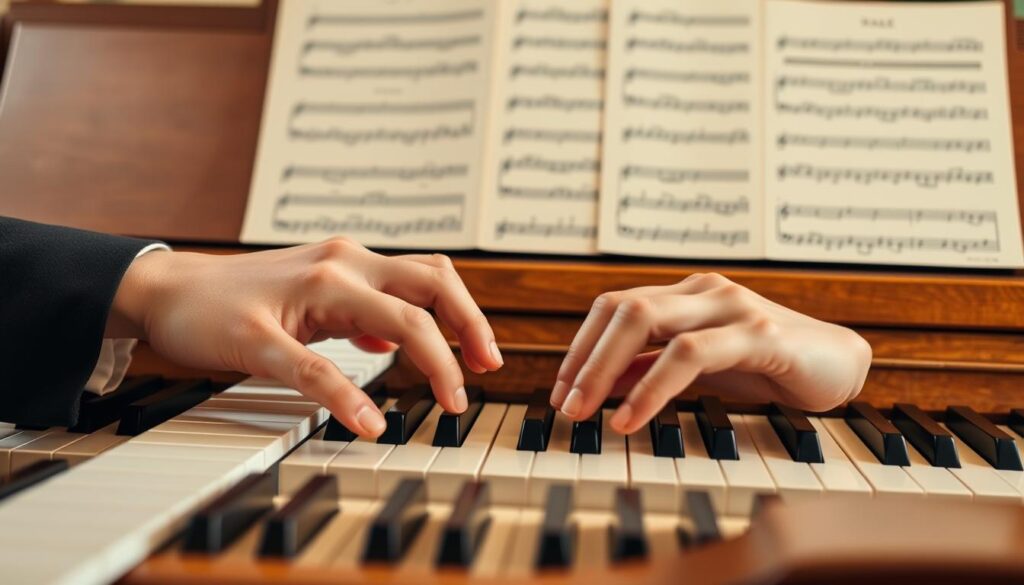
Try something radical: play with your eyes closed. This isn’t just a trick—it’s science. Without sight, your kinaesthetic sense takes over.
Your hands start to talk to each other through touch. They learn to work together without your eyes watching every move. This creates strong muscle memory that helps during performances.
Here are some basic steps to get started:
- Start with both thumbs on middle C
- Right hand plays C-D-E-F-G upward
- Left hand plays C-B-A-G-F downward
- Return to middle C together
- Keep movements fluid and relaxed
The magic is in the mirroring. When your right hand’s third finger plays E, your left hand’s third finger plays A. This creates mental shortcuts that speed up learning. Your brain quickly understands the pattern, and both hands know their part.
This isn’t just a technique drill. It’s brain training through piano. You’re teaching your hands to think and move together. The symmetry helps correct mistakes, guiding your hands to stay in sync.
Make this a part of your daily practice. Start slow and focus on the mirroring. Increase the speed only when both hands move confidently. The beauty of contrary motion is its ability to self-correct, showing you when something’s off.
Mastering this technique unlocks a powerful tool for coordination. It’s the technique drill that keeps giving. Your hands will develop independence, making every piece you play better. They’ll have a sophisticated conversation without needing translation.
Technique Trackers: Tempo, Evenness, Relaxation
Let’s debunk the myth of just relying on finger strength. Instead, focus on three smarter metrics: your Technique Trackers. They act as your practice’s dashboard. Just like you wouldn’t drive without checking the speedometer and fuel gauge, don’t practice piano without tracking your progress.
Having raw power at the keyboard is impressive but short-lived. True technique comes from using your body efficiently and staying relaxed. This is what separates a skilled sprinter from someone who just clenches their muscles.
Your three main gauges are Tempo, Evenness, and Relaxation. Master these, and you build skill on a solid foundation, not sand.
The Tempo Tracker: Slow is the New Fast
Speed is a reward, not a goal. The rush to play fast often leads to sloppy fingers and a frantic mind. Your tempo tracker asks: Can I play this perfectly at half-speed with a flowing, easy motion?
If the answer is no, you shouldn’t rush. This is where the “Tree Frog” bounce mentality applies. Each note should spring from a relaxed hand, not be forced out by tense knuckles. Slow practice is not a chore but a way to perfect your movements.
The Evenness Tracker: From Bumpy Road to Pearl Strand
Listen closely. Is your scale smooth like a strand of pearls, or bumpy like a dirt road? Evenness is key to control. It means every note, whether loud or soft, has the same quality and rhythm.
Hammer blows and hiccups reveal where your finger independence or coordination needs work. Track this by playing very softly. Any unevenness is more noticeable when the volume is low. A smooth sound is proof your mechanics are working together.
The Relaxation Tracker: Your Body Doesn’t Lie
This is the most critical dial on your dashboard. Aim for an efficient and relaxed use of your wrist and arm. Do a five-minute check-in.
Are your forearms and shoulders soft and pliable? Or do they feel like they’ve been hauling bricks? Your body’s sensations guide you. Pain or stiffness is a warning, not a badge of honor.
True power is a quick, coordinated snap, not a sustained clench. If you finish a session more tense than you started, you practiced the wrong thing.
| Technique Tracker | The Goal | Your Check-In Question | Common Pitfall |
|---|---|---|---|
| Tempo | Perfect control at slow speed, creating a foundation for accuracy. | “Can I play this flawlessly, with flow, at half my target speed?” | Rushing to meet a speed goal before the motions are clean and automatic. |
| Evenness | A uniform, consistent sound across all notes and dynamics. | “Does my scale sound like a single fluid line, or a series of separate, bumpy notes?” | Focusing only on the loud notes and letting the weaker fingers create rhythmic dips. |
| Relaxation | Using arm weight efficiently, ending practice with less tension than you started. | “Are my forearms and shoulders soft, or hard and fatigued, after five minutes?” | Mistaking localized finger force for power, leading to stiffness and soreness. |
Monitoring these three elements turns mindless repetition into conscious refinement. You stop just playing notes and start building a system. The trackers give you objective data, moving you from “I think that was better” to “I know this is right.”
It’s the difference between hoping you’re getting stronger and knowing you’re getting smarter.
Avoiding Tension and Soreness (Stretching Tips)
In the hustle culture, we often think pain means we’re getting better. But soreness is a warning sign. If your hands or forearms hurt after playing, you’re building tension, not music. This section is your guide to avoiding that.
Good technique is all about being free. Playing smoothly without forcing is key. My teacher, who knew Alexander Technique, always said, “Use yourself well.” It’s wise advice. Remember, your main instrument is your body, not just the piano.
Think of these stretches as essential care. They help keep your wrists, forearms, and shoulders ready for the right hand position.
- Wrist Rolls: Hold your arm out, make a fist, and roll your wrist in circles. Do five clockwise and five counterclockwise. It’s like oiling your wrist’s hinges.
- Forearm Stretch (Prayer & Reverse Prayer): Hold your palms together in front of your chest, fingers down. Then, flip it and press the backs of your hands together. This stretches the muscles that press keys.
- Lion Paw Release: Place your hand on a tabletop and let it go limp, like a heavy paw. Then, lift from the wrist, letting your fingers dangle. This helps your arm support your hand position without gripping.
- Shoulder Rolls & Neck Releases: Shoulder hunching is a sign of tension. Roll them back slowly. Let your head drop gently from side to side. Your shoulders support your entire arm. Keep them relaxed.
Listening to your body is more important than following the metronome. Pain is a clue. It shows where you’re forcing or holding on too tight. The goal is to play smoothly, not to force it.
Let’s look at two ways to practice. One leads to smooth playing, the other to trouble.
| Practice Habit | The Effective Approach (Fluency) | The Ineffective Approach (Tension) |
|---|---|---|
| Focus During Drills | Focus on ease and evenness. Feel the weight transfer. | Try to play fast or loud at all costs. Think “no pain, no gain.” |
| Body Awareness | Take breaks to check your posture, jaw, and breathing. | Stay stiff from start to finish. Forget to breathe. |
| Response to Soreness | Stop right away. Stretch and figure out the cause. | Ignore it or play through it. See pain as a necessary evil. |
| View of Technique | See it as a way to express music efficiently. It’s a long-term investment. | See it as a challenge to overcome. It’s a short-term effort. |
| Result after 6 Months | You’ll play smoother, with more endurance. Your technique will feel sustainable. | You might hit a plateau, face injuries, and get frustrated. |
The right hand position means nothing if you’re tense. It needs to be supported by relaxed muscles. Do these stretches before and after playing. Your future self will be grateful for this care.
Linking Technique to Real Songs
So you’ve mastered the five-finger patterns and the thumb tuck. Now, it’s time to see these shapes in real music. Think of your drills as learning the alphabet. Knowing the letters is key to reading a book.
The C major scale is more than a warm-up. It’s the foundation of many melodies. Play the start of “Ode to Joy.” Your right hand follows a simple pattern in C. This exercise now has a purpose.
Methods like Piano Safari connect technical exercises to real pieces. That thumb cross-under you practiced? It’s in a simple folk tune, waiting for you to notice.
Your mini arpeggio shapes create the harmony of beginner songs. When you see a broken chord, your hand already knows it. These drills are no longer just exercises. They’re the hidden structure of your music.
Practice becomes a discovery, not a chore. You’re not just reading notes; you’re speaking music. The patterns are your words, and a relaxed hand shape is your accent. Look for these connections in every simple song you learn.