Starting your musical journey with a simple tune is a great way to begin. “Mary Had a Little Lamb” is a classic song that is perfect for beginners. It was written by Sarah Josepha Hale and is a key part of learning piano.
This song is easy to learn because of its simple structure. It uses just four notes and mostly moves in a straightforward way. There’s only one jump in the melody.
It’s the perfect song for beginners. It helps you get used to the keyboard and improve your finger skills. Learning this song is a big accomplishment for a beginner.
Learning this song makes practicing fun and keeps you motivated. Experts say it’s a great way to build skills little by little. Knowing how the song is structured, like its tonic solfa foundation, helps you learn it quickly.
Keyboard Setup and Finger Numbers
Setting up your keyboard right and knowing your finger numbers are key to learning any piece, like “Mary Had a Little Lamb.” A good pre-performance routine helps avoid bad habits that slow you down later. This step is essential for learning efficiently.
Start with the right seat. It should let you sit straight, with your arms parallel to the floor and elbows slightly forward. Your feet should be flat on the ground for balance. This setup helps you move freely and keeps your shoulders and wrists relaxed, important on smaller keyboards.
The finger numbering system is a universal guide for both hands. Each finger is numbered from one to five, with the thumb as one and the pinky as five. This system is used everywhere in piano music and helps with reading and muscle memory.
Next, map the notes of “Mary Had a Little Lamb” to specific finger numbers. This turns abstract notes into real actions. Using the same finger for each note helps you play automatically, letting you focus on rhythm and coordination.
It’s important to practice hand positions from the start. Doing this correctly from the beginning avoids the need for hard corrections later. Learning one line or phrase at a time helps you build confidence and ensures each part is mastered.
Getting your setup and finger number knowledge right is an investment in your future playing. It lays the foundation for the melody and accompaniment. Skipping this step can cause problems, slowing your progress from beginner to confident player.
Find the Starting Notes by Landmark
Learning to find notes on the piano starts with a key landmark. This skill helps beginners avoid mistakes. Middle C is a great landmark to start with.
Middle C is right in the middle of a standard piano. It’s the white key next to the two black keys in the middle. Finding Middle C helps you locate all other notes.
When playing “Mary Had a Little Lamb” on piano, the tune starts on “mi.” This note is E, two white keys up from Middle C.
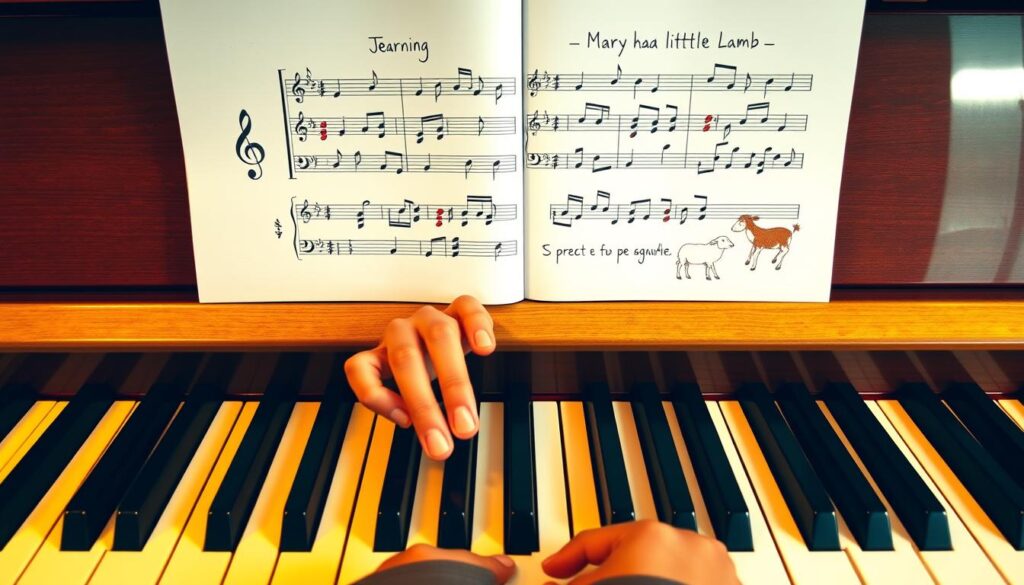
To find your starting note, start by placing your right thumb on Middle C. Then, count up the white keys: C, D, E. Your third finger should land on E. This is where the melody begins.
This method uses the piano’s layout to guide you. The pattern of black keys helps you find your way. You can always find your starting point by yourself.
Learning to navigate the keyboard builds your confidence. It helps you learn new songs on your own. Knowing where to start is key to playing “Mary Had a Little Lamb” on piano correctly.
Right‑Hand Melody in 4 Short Phrases
Learning a new song is easier when you break it down into smaller parts. This method is based on teaching the right-hand melody first. It helps you play smoothly before adding more complexity.
“Mary Had a Little Lamb” breaks down into four phrases. Learning each phrase well before moving on helps your brain remember it better.
- Phrase One: Start with Mi, Re, Do, Re (m, r, d, r). This sets the tone and should be played evenly.
- Phrase Two: Repeat Mi three times (m, m, m). Keep your fingers and tone steady.
- Phrase Three: Go down with Re, Re, Re (r, r, r). Move your right-hand fingers smoothly back up.
- Phrase Four: End with Mi, Re, Do, Re (m, r, d, r), just like the start. It brings everything together.
Breaking the song into parts makes it easier to learn. Each part should be practiced until it feels automatic. Then, you can move on to the next part.
This method is key for beginners. It helps you get better at playing more songs. Mastering the right-hand part first makes it easier to add the left-hand part later.
For more on beginner songs, check out this link.
Left‑Hand Options: Single Bass Notes → Fifths
Teaching piano starts with the left hand playing simple notes. This helps build coordination and understanding. It’s done in a way that avoids frustration.
Beginners start with playing one left‑hand bass note per measure. This is like the simple patterns in easy songs. It helps the right-hand melody sound clear.
This method makes it easier to focus on timing and hand control. Getting good at this makes the player feel more confident and in rhythm.
Then, students learn to play intervals of a fifth. This adds depth to the sound. It’s also easy for beginners to learn.

Playing a fifth means using the thumb and little finger together. They play the root and fifth of the chord. This makes harmony feel real.
Adding solfa, or scale degrees, to chord knowledge helps. It connects the physical act of playing to understanding music theory. This makes practice more meaningful.
Increasing complexity in steps is key in teaching piano. Going from single notes to fifths is a careful process. Each step builds on the last, creating a strong foundation.
This approach avoids overwhelming beginners. It turns the left hand into an active part of the music. This makes the music sound fuller and more enjoyable from the start.
Hands‑Together Method: Slow Merge Steps
Learning to play the piano with both hands is a big step. For Mary Had a Little Lamb, a step-by-step plan helps. Start with one hand, then add the other slowly to avoid getting frustrated.
This method is called the slow merge. It starts with playing very slowly. The goal is to get the hands to play together perfectly, one note at a time.
The steps are designed to make it easier. You won’t try to play the whole song at once. Instead, you’ll learn it bit by bit.
- Measure‑by‑Measure Isolation: Play one measure with both hands until it feels natural.
- Phrase‑by‑Phrase Expansion: Link two measures together to form a phrase. Make sure it’s smooth before moving on.
- Section Consolidation: Put together all the phrases you’ve mastered to play the A section.
- Full‑Piece Integration: Slowly play the whole song, linking all sections together.
This way of learning helps with hand coordination. It’s not just about playing the song, but about getting the hands to work together. Each small success builds confidence and strengthens your skills.
Here’s a sample practice plan for the slow merge:
| Practice Stage | Focus Area | Success Metric |
|---|---|---|
| Initial Merge | Notes 1‑4, Right Hand & Left Hand | 5 consecutive perfectly aligned repetitions |
| Phrase Mastery | First Complete Phrase (Measures 1‑4) | Play without hesitation, maintaining steady pulse |
| Section Mastery | Entire A Section (Measures 1‑8) | Seamless flow, zero corrective pauses |
| Full Piece Run‑Through | Complete Mary Had a Little Lamb Piano Piece | Accurate alignment throughout at slow tempo |
Following this plan helps you play with both hands confidently. It teaches patience and precision, skills that help with harder songs. The slow merge method is a proven way to master playing with both hands.
Rhythm and Tempo: Metronome Targets
A metronome is key for learning piano. It helps you keep a steady beat. For playing “mary had a little lamb piano,” rhythm is everything.
Start by feeling the beat. Clap or tap along with the melody’s rhythm. This helps you get a sense of timing before you play.
Begin with the metronome at 60 beats per minute (BPM). This slow pace helps you focus on playing each note right. Remember, getting it right is more important than playing fast.
Here’s a plan to improve your timing and rhythm. Follow this step-by-step approach to avoid bad timing habits.
| Stage | Tempo (BPM) | Focus Goal | Minimum Practice Duration |
|---|---|---|---|
| 1. Foundation | 60 | Note accuracy and hand coordination with the click. | 2 days |
| 2. Consolidation | 70 | Smooth transitions between phrases without hesitation. | 1 day |
| 3. Development | 80 | Even tone and dynamic consistency at a conversational pace. | 2 days |
| 4. Refinement | 95 | Preparing for performance speed with maintained clarity. | 2 days |
| 5. Performance | 110-120 | Confident, steady tempo suitable for playing for others. | Ongoing |
Move on only when playing feels easy and right. Don’t rush. If you make mistakes, go back to a slower tempo to practice more.
Learning this rhythm makes playing “mary had a little lamb piano” a lesson in discipline. This skill will help you with other songs too.
Mini Variations: Simple Harmony and Ending Tag
An easy arrangement of a simple melody can be made more interesting with professional techniques. These mini variations turn basic note-playing into a more polished musical performance. They add artistic depth beyond just playing the tune.
One technique is to add simple harmonic notes with the right hand. Pianists can play a third or a fifth interval above certain melody notes. This makes the sound fuller and more resonant. For example, adding an E above the C in “Mary had a little lamb” adds depth right away. This method requires little extra finger movement.
Changing the left-hand bass pattern adds another layer of variation. Instead of a single bass note, use fifths. Playing the root note and its fifth together strengthens the harmony. This change adds depth without making the piece harder to play.
A good ending tag brings the performance to a close. A short, effective cadence tells the listener the piece is finished. One way is to slow the final two measures. Another is to resolve the harmony to the tonic chord with a slight pause. This final touch is key for a satisfying finish.
These mini variations are strategic tools for improving musicality. They help the player move from just playing to interpreting the music. Adding just one variation can make a big difference. This shows how a simple piece can grow into a platform for artistic expression.
Here are some ideas for your own easy arrangement:
- Right-Hand Harmony: Add a third interval above melody notes on strong beats.
- Left-Hand Fifths: Replace single bass notes with the root and fifth played together.
- Ending Cadence: Conclude with a slowed tempo and a final C major chord.
Mastering these elements deepens your connection to the music. It builds skills useful for more complex pieces. The journey from playing notes to shaping music starts with these deliberate variations.
Practice Plan: 7‑Day Schedule + Play‑Along Track
Practicing every day for 15 to 20 minutes is better than long, random practice sessions. This method helps build muscle memory and improve your ability to recall music. It’s more effective than long, irregular practice times.
A seven-day plan helps you make progress every day. It turns learning into a clear plan. Each day focuses on a specific skill, helping you go from playing a melody to playing with both hands.
This schedule has clear goals for each day. Using a play-along track is key for improving timing and endurance. It helps you move from practicing parts to playing smoothly.
| Day | Daily Focus | Key Skills | Recommended Duration |
|---|---|---|---|
| 1 | Right-Hand Melody Mastery | Learn the four phrases; ensure clean fingering and note accuracy. | 15 minutes |
| 2 | Rhythm and Phrasing | Apply steady tempo with a metronome; shape musical phrases. | 20 minutes |
| 3 | Left-Hand Foundation | Introduce single bass notes; practice coordination independently. | 15 minutes |
| 4 | Hands-Together Integration | Begin slow merge steps; focus on alignment, not speed. | 20 minutes |
| 5 | Consolidation and Tempo | Use the play-along track; gradually increase speed to target. | 20 minutes |
| 6 | Variations and Expression | Incorporate simple harmony and ending tag; add dynamics. | 15 minutes |
| 7 | Performance Run-Through | Play the complete piece from memory multiple times. | 20 minutes |
Follow the table’s daily practice sequence. The first three days focus on basic skills. Days four and five are for integrating hands.
Start using the play-along track from Day 5. It’s a great practice loop for keeping rhythm. It helps you get the piece’s structure right through repetition.
Using this loop improves timing and endurance. It also helps reduce stage fright. The track gives you a steady beat, letting you focus on playing well.
Sticking to this plan helps you learn skills step by step. The mix of small goals and the practice loop makes learning powerful. By the end of the week, you’ll play “Mary Had a Little Lamb” with confidence.
Troubleshooting: Stumbles, Tension, and Memory Aids
Playing “Mary Had a Little Lamb” on piano smoothly needs fixing common problems. Find and fix specific issues to improve.
Stumbling on the same part means you need to focus on it. Practice that part slowly until you get it right. Then, slowly speed up.
Physical tension can make playing hard. Check your posture and breathing often. Let your arms relax on the keys for better sound.
Forgetting parts can mess up your playing. Use tricks like remembering chord patterns or visualizing the keyboard. Learn more about music memorization strategies to help.
Recording yourself helps find mistakes. Listen for any rhythm or sound issues. Use this to improve your playing.
Fixing problems makes you better at playing. Each fix brings you closer to a great performance. Aim for a mix of confidence and musicality.