That first look at music notation can feel overwhelming. It’s like staring at the Matrix code. All those dots, lines, and squiggles look like ancient hieroglyphics.
But it’s not a puzzle. It’s a map. Think of it like learning the alphabet, but with notes from A to G and then starting over. It’s not about dry rules for a school exam.
It’s about gaining a superpower. The ability to translate symbols into sound. To go from listening to commanding the notes. We’re trading intimidation for intellectual curiosity.
Forget the overwhelm. We’re here to crack the code, not be intimidated by it. This is your first step from musical spectator to musical architect.
Sound to Symbol: Why Notation Helps You Grow
If sound were pure emotion, notation would be its constitutional framework—complete with checks, balances, and legislative branches. This isn’t about stifling creativity with bureaucracy. It’s about giving your musical ideas a permanent address where they can receive mail.
Think about it. Without notation, music exists only in the moment, like a brilliant political speech that vanishes into the air. With notation, that speech gets recorded in the Congressional Record. Future generations can study it, debate it, and maybe even improve upon it.
Enter the twin chambers of this musical congress: the treble clef and bass clef. They’re not just squiggles on paper. They’re entire systems of governance for different frequency districts.
The treble clef—that flamboyant, swirling G-clef—presides over the upper house. It’s the domain of soprano voices and your right hand on the piano. When you see this clef, you’re dealing with the higher registers, the melodies that carry the tune. It’s the musical equivalent of the Senate, deliberating on the finer points of policy.
Then there’s the bass clef, the stoic F-clef with its two dots flanking the fourth line. This is the lower house, the foundation upon which everything rests. It handles the basso profundo, the left hand’s territory, the harmonic bedrock. If the treble clef is the Senate, the bass clef is the House of Representatives—closer to the ground, dealing with the fundamental elements.
Together, connected by a brace, they form what’s called the Grand Staff. This isn’t a divided government. It’s a bicameral system designed for checks and balances. Your right hand might be debating in the treble clef Senate, while your left hand is legislating in the bass clef House.
Why does this matter for your growth? Three reasons:
- It externalizes thought: Notation turns internal musical intuition into external, analyzable data. You’re not just feeling the music—you’re reading its legislation.
- It enables communication: Like a legal document, notation lets you share complex ideas with anyone who knows the system, across time and space.
- It builds structural thinking: Understanding the treble clef/bass clef division teaches you to think in layers, like a constitutional scholar understanding federal vs. state powers.
The piano keyboard spans both clefs seamlessly. Middle C is the diplomatic corridor connecting them—the musical equivalent of the Capitol Rotunda where both houses meet. When you grasp this split personality, you stop being a tourist in the land of music. You become a citizen with voting rights.
Most beginners approach the treble clef and bass clef as separate, intimidating alphabets. That’s like trying to understand American government by memorizing the Senate rules without studying the House. The real power comes from seeing them as complementary systems in a single, elegant structure.
This notation system has survived centuries not because it’s perfect, but because it’s functional. It’s the musical equivalent of a constitution that’s been amended but never wholly replaced. Your job isn’t to worship it. Your job is to learn its language so you can eventually propose amendments of your own.
The Grand Staff: Treble, Bass, Middle C Bridge
The grand staff is like a city map, with staff lines marking different pitch areas. It’s not just music notation; it’s a blueprint for sound. The five lines and four spaces are the basic grid for all musical ideas.
Higher lines mean higher pitches. It’s like real estate, where top-floor notes have better views. The grand staff combines the treble and bass clefs into one big city.
The treble clef controls the high notes, where melodies live. The bass clef handles the low notes. For years, beginners saw these as separate worlds.
Then, Middle C came along. It’s like the musical equator, sitting between the clefs. Knowing how the treble and bass staff meet at Middle C makes everything clearer.
Staff lines act like latitude markers. Each line and space has a specific pitch. Knowing this pattern lets you navigate any octave. It’s a system that scales well.
| Feature | Treble Staff (G Clef) | Bass Staff (F Clef) | Middle C Bridge |
|---|---|---|---|
| Primary Range | Higher pitches (right hand piano) | Lower pitches (left hand piano) | Central pitch C4 (261.6 Hz) |
| Line Notes (bottom to top) | E, G, B, D, F | G, B, D, F, A | Sits on ledger line between |
| Space Notes (bottom to top) | F, A, C, E | A, C, E, G | Anchors both clef systems |
| Visual Anchor | Clef circles G line (second line) | Clef dots F line (fourth line) | Ledger line through middle |
| Common Instruments | Violin, flute, trumpet, right hand piano | Cello, bassoon, trombone, left hand piano | All instruments reference point |
The table shows the beauty of symmetry. The bass staff’s top line meets the treble staff’s bottom line at Middle C. It’s not just rules; it’s a system that works together.
The staff lines follow a simple rule: notes move alphabetically. From E to F to G, it’s a pattern that works for both clefs. Middle C is where this pattern shifts.
Understanding this helps you read music better. You’re not memorizing 88 keys. You’re learning a system that repeats in octaves. The grand staff with Middle C is your guide.
So, when you see staff lines, don’t see barriers. See a musical city, with Middle C as the key hub. Your task is to navigate this single landscape, not two separate worlds.
Line/Space Mnemonics (and Better Landmark Method)
If “Every Good Boy Deserves Fudge” was your piano lesson anthem, you’re not alone. There’s a better way. Mnemonics are like music flashcards. They help for a while.
They’re like phonetic spelling for kids. “All Cows Eat Grass” helps with bass clef spaces. “FACE” works for treble clef spaces. But, you’re decoding, not reading directly.
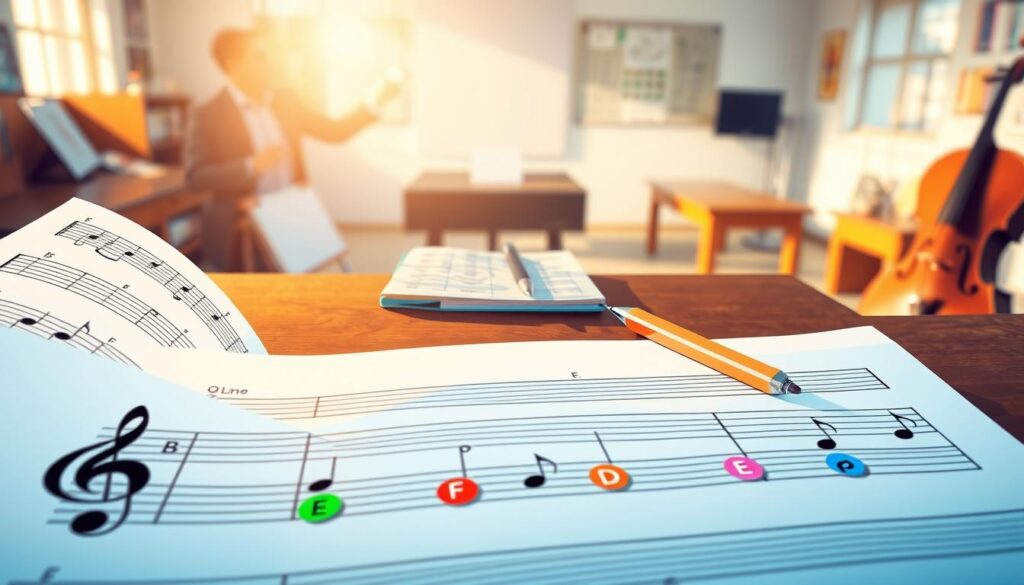
The Landmark Method is a game-changer. It moves from memorizing to using spatial intelligence. Instead of memorizing all street names, focus on key landmarks.
Start with these three musical landmarks:
- Treble G: The note on the second line of the treble clef. It’s the curl of the clef itself, literally hugging that line.
- Bass F: The note on the fourth line of the bass clef. The two dots of the clef frame this line.
- Middle C: The bridge between the staves, sitting on its own ledger line.
Memorize these positions viscerally. Know them like your favorite coffee shop. From these anchors, every other note is just a step or a skip away.
This is where real note reading starts. You’re navigating, not reciting. See a note on the third space of the treble clef? That’s one step up from your landmark G. Instant recognition. No mnemonic needed.
The science behind this is elegant. Mnemonics use verbal memory. The Landmark Method uses spatial and visual memory. These are faster and more intuitive for recognizing patterns.
Why does this matter for fluency? When you sight-read, you don’t have time for internal narration. “Every Good Boy… okay, that’s B…” is a speed bump. Seeing “that’s a step above G” is smooth.
This method turns the staff into a connected map. It’s the foundation for using intervals and landmark notes effectively—the next level of musical literacy.
So, retire the childhood flashcards. Not with disdain, but with gratitude. They served their purpose. Now, build your network of musical safehouses. Learn the landmarks. Your brain’s spatial reasoning is waiting for the assignment, and it’s far more capable than you’ve been led to believe.
The result? Note reading becomes fluid, not forced. It becomes a skill of perception, not recall. And that’s when the symbols on the page start to sound like music in your head, without the intermediate translation.
Stepwise vs Skips: Eye Movements That Save Time
Imagine trying to read note reading like War and Peace letter-by-letter. You’d give up before reaching page two. Many beginners struggle with sheet music, seeing it as a secret code.
But, there’s a better way. It’s not about learning more notes. It’s about seeing less. Your brain already knows how to do this with words. You see shapes, not individual letters.
Music notation works the same way. Steps and skips are the basic patterns. A step moves to the next line or space. A skip jumps over a pitch, from line to line or space to space.
Let’s dive into the details. A third always looks like line-line or space-space. Once you know the first note, the second is easy to guess. This cuts your work in half.
A fourth follows its own rule. Spotting these patterns helps you read faster. It’s like having a superpower for note reading.
Students change when they understand this. They stop guessing notes and start seeing patterns. A line of steps might be a scale. Your eyes start to read groups of notes like words.
This is where speed comes from. It’s like your musical predictive text. Your brain anticipates patterns. This makes reading music faster and easier.
Try this drill: Scan a measure and label the intervals. Is it stepwise or a skip? This changes how you see music. You’re not just reading symbols; you’re understanding a language.
This method gets better with practice. You start to see bigger patterns like arpeggios and chord outlines. Your note reading becomes more about recognizing patterns than identifying individual notes.
This isn’t just theory. I’ve seen students improve their speed and confidence. They focus more on expression and less on guessing notes. The notes become the means, not the end.
So, when you face sheet music, play detective. Look for steps and skips. Circle the thirds. Your goal is to see music as patterns, not puzzles. This is the real secret to fast note reading.
Rhythm with Notes: Ties, Dots, and Rests Review
Learning rhythm is like understanding music’s time grammar. Notes, dots, and rests are like punctuation. Pitch tells us what to play, while rhythm tells us when.
Rhythm is music’s time structure. It’s what keeps everything in sync. Without it, you just have random sounds. With it, you get Mozart, Beyoncé, or catchy tunes.
Let’s explore the world of durations. Each note value is a specific time slot. The system is both mathematically precise and easy to grasp.
The Note Value Hierarchy
Note values are like a family tree of time. The whole note is the oldest. It gets four beats in common time. All others are based on this.
Here’s the family tree:
- Whole note: The big, sustained idea. It fills a whole measure in 4/4 time.
- Half note: Two halves equal one whole note. They’re the thoughtful pauses.
- Quarter note: The workhorse of rhythm. Most beats are counted in quarters.
- Eighth note: Twice as fast as quarters. They create motion and energy.
- Sixteenth note: The rapid-fire footnote. Four fit in a single beat.
Each division has a corresponding rest. Rests are the silence that shapes the sound.
Time Signatures: The Rulebook
Time signatures tell you how to parcel out time. They’re the top and bottom numbers at the start of a piece. The top number shows how many beats per measure. The bottom number tells what kind of note gets one beat.
4/4 time is the most common. It’s used in most pop songs, classical themes, and national anthems. 3/4 gives us waltzes. 6/8 feels like a gentle lilt.
Time signatures create expectation. They’re the metrical contract between composer and listener. Break this contract, and you get syncopation. That’s where the fun begins.
| Note Value | Visual Appearance | Duration in 4/4 Time | Equivalent Rest |
|---|---|---|---|
| Whole Note | Hollow oval, no stem | 4 beats | Whole rest (hangs from line) |
| Half Note | Hollow oval with stem | 2 beats | Half rest (sits on line) |
| Quarter Note | Solid oval with stem | 1 beat | Quarter rest (squiggly symbol) |
| Eighth Note | Solid oval with stem and flag | ½ beat | Eighth rest (single curl) |
| Sixteenth Note | Solid oval with stem and double flag | ¼ beat | Sixteenth rest (double curl) |
The Dot: Procrastination as Policy
A dot after a note is music’s way of saying “and then some.” It adds half the note’s value again. It’s elegant procrastination built into the system.
A dotted half note gets 3 beats (2 + 1). A dotted quarter gets 1½ beats. Dots create lingering. They stretch time like taffy.
Dotted rhythms have character. They’re less mechanical than straight divisions. They swing. They breathe. They feel human.
Ties: Philosophical Connections
Ties are the smooth operators of rhythm. They connect two notes of the same pitch across bar lines or within measures. Tied notes are held for their combined value.
Why use ties instead of a longer note? Sometimes the rhythm crosses a bar line. Sometimes the composer wants emphasis on the second note. Sometimes it’s just cleaner notation.
Ties teach an important lesson. Music exists in continuous time, even when our notation chops it into measures. The tie reminds us of this continuity.
Rests: The Power of Silence
Rests are not empty space. They’re active silence. A well-placed rest creates tension. It sets up the next phrase. It lets the music breathe.
Different rests have different personalities. The whole rest can feel like a dramatic pause. The sixteenth rest is a quick intake of breath.
Counting rests is key. Many beginners play through them. Don’t be that person. Honor the silence. It’s half of what makes music meaningful.
Practical Rhythm Reading
Reading rhythm isn’t about counting like a metronome. It’s about feeling the architecture. Start by tapping the pulse. Then identify the longest notes. They’re your landmarks.
Group shorter notes visually. Beams connect eighth and sixteenth notes. These groups move together. Read them as units, not individual notes.
Watch for patterns. Rhythm is often repetitive. Our brains love patterns. Spot them, and you’ll read faster.
Remember, rhythm notation works the same everywhere on the staff. Whether notes sit on lines, spaces, or ledger lines, their rhythmic value remains constant. A quarter note on a high ledger line gets the same beat as one in the middle of the staff.
Practice with a simple routine. Clap rhythms before playing them. Say rhythm syllables (ta, ti-ti). Use a metronome, but don’t become its slave.
Rhythm gives music its life. Master these symbols, and you master time itself. Well, musical time at least. The other kind is a mystery.
Ledger Lines Without Fear: Expanding Your Range
Ledger lines are like exit ramps in music notation. They appear when notes go beyond the staff’s lines and spaces. They’re not a glitch, but a feature.
Ledger lines are a clever solution in music notation. They let us notate pitches beyond the staff without new symbols. It’s like having the freedom to build up or dig down in your apartment.
Don’t see each ledger line as a puzzle. View them as part of a pattern. Remember Middle C as your guide when exploring these new territories.
For the treble clef, notes above the staff follow a simple rule. Middle C is the first ledger line below the staff. A is the first line above. Count up or down from these points using the same pattern you know.
Practice naming notes in pieces with ledger lines. Start with notes on one ledger line. Then move to two. Your brain will quickly learn the pattern.
The landmark method makes ledger lines easier. Knowing that the second ledger line above the treble staff is high C helps. It makes everything else relative, like celestial navigation.
This skill lets you play a wider range of music. You can play that high flute solo or the deep bassoon notes. The whole piano keyboard or vocal range is now open to you.
Practice reading ledger lines in both directions. Look at bass clef notes going down and treble clef notes going up. Your eyes will get used to it fast. The brain loves patterns, and ledger lines are just that.
Ultimately, ledger lines give you freedom. They show you how to explore beyond the staff. Master them, and you can read any note on any instrument. Not bad for a few tiny dashes.
Sight‑Reading Routine (30‑60 seconds/day)
Learning to read music doesn’t need endless hours. It’s about making small, focused efforts every day. This changes how your brain works.
Long practice sessions are like running a 10K once a month. You won’t get in shape. Instead, short, daily practice builds your skills. Aim for 30 to 60 seconds each day.
This isn’t about cramming. It’s like saving money for your musical skills. A minute today, another tomorrow, and soon you’ll be fluent. It’s like brushing your teeth for your bass clef skills.
So, what’s this daily routine? It’s easy. Choose a piece of music that’s a bit hard. Set a timer for 60 seconds. Play or tap as much as you can, even with mistakes.
When the timer goes off, stop. No more practice. No guilt. This daily practice is key.
Focus on the clef that’s hard for you. Start with the bass clef and its lines. Change it up each day. It’s not a chore; it’s refreshing.
This method is based on “marginal gains.” A small improvement each day adds up. Your 60-second effort is that small step.
Don’t feel bad about not practicing enough. This routine makes sight-reading a daily habit. It’s the way to truly improve, one minute at a time.
Tools: Flashcards, Apps, and DIY Drills
Finding the right tool for reading staff lines is all about what tricks your brain. We have many options today, from old-school to high-tech. Let’s look at them without the hype.
Paper flashcards are simple and effective. They don’t distract you with notifications or algorithms. They make you remember by touch, like old-school homework.
Apps, on the other hand, make practice fun. They track your progress and give you rewards. It’s like playing a game.
Some apps, like the Complete Music Reading Trainer, offer structured learning. But, don’t confuse fun with real skill. Just tapping screens doesn’t mean you’re mastering music.
DIY drills are a hidden gem. You create your own practice. Write notes, play games with cards, or compose music to challenge yourself. This method helps you understand music deeply.
Let’s compare the tools:
- Paper Flashcards: Pro—Focus, no distractions. Con—Stays the same, can’t change with you.
- Apps: Pro—Adapts, keeps you motivated. Con—May make you too reliant on screens.
- DIY Drills: Pro—Personal, builds creativity. Con—Needs effort to set up.
The best tool is one you enjoy using. Consistency is key, not complexity. An app you use daily is better than perfect flashcards that sit idle.
Think of tools as scaffolds, not the building itself. They help you connect your eyes, brain, and instrument. Choose what works for you, whether it’s old-school, digital, or DIY.
Experiment and mix methods. Use apps for daily drills but paper on weekends. Your practice should be as varied as the music you want to read.
Tracking Progress: WPM (Notes/Min) Goals
We measure words per minute for reading text. For reading music, why not notes per minute? It’s not just about numbers. It’s about getting feedback.
Abstract “improvement” turns into real data. Did your method improve your bass clef skills? Did interval practice make sight-reading faster? Tracking notes per minute gives you answers.
Think of it as your personal analytics dashboard. That tricky passage with ledger lines becomes a data point. Your range beyond the staff gets measured. You stop guessing and start knowing.
Start with a simple baseline. Use a metronome and a page of music. Count how many notes you read in sixty seconds. Do this weekly. Watch your number go up as your brain learns patterns.
The goal is to read music well and fast. The end result is playing what you want, when you want. Notes per minute shows you’re not just learning. You’re getting better at it.