Ever stared at those 88 polished rectangles and wondered if you’re looking at an instrument or an elaborate psychological test? Let me reassure you – it’s both. Those 52 white and 36 black keys represent what I call “music’s most elegant pattern recognition system.”
Here’s the beautiful conspiracy: you’re not actually facing 88 individual notes. You’re confronting the same 12-note pattern repeating across seven octaves – like a cultural meme that just won’t quit. Whether you’re playing a compact 49-key keyboard or a full concert grand, the architecture remains stubbornly consistent.
The real magic happens when you stop counting keys and start recognizing patterns. It’s less about memorization and more about understanding the elegant mathematics behind the music. Consider this your decoder ring for the world’s most sophisticated pattern game.
White vs. Black Keys
The piano keyboard layout is a study in contrast and cooperation. It’s like musical bipartisanship, where both sides are essential but play different roles. This makes music-making a grand legislative process.
The white keys represent the natural notes, A through G, the foundation of Western music. They’re the reliable ones who always show up. The black keys, on the other hand, are the sharp and flat notes. They can swing votes, depending on which party they’re with.
The design of the black keys is brilliant. They’re not scattered randomly. Instead, they’re organized in precise groupings that create the piano’s navigation system.
Notice the alternating groups of two and three black keys. The group of two always has C to its left, a loyal constituency. The group of three marks where F resides, another anchor point.
This pattern is not just decorative. It’s functional genius. It turns note-finding into pattern recognition, like recognizing political alliances.
The distance between each key, whether white or black, is a semitone. Moving from any key to the next is a half step. This is the building block of scales, chords, and everything that makes music sound intentional.
| Feature | White Keys | Black Keys | Musical Function |
|---|---|---|---|
| Note Type | Natural notes (A-G) | Sharps and flats | Foundation vs. alteration |
| Visual Pattern | Continuous row | Groups of 2 & 3 | Navigation reference points |
| Positioning | Front position | Raised position | Ergonomic differentiation |
| Frequency Ratio | 7 per octave | 5 per octave | 12-tone equal temperament |
This system lets you find any note by understanding its relationship to black key landmarks. It’s like the difference between needing GPS and understanding city planning. One makes you dependent, the other empowers you.
The piano keyboard layout shows how brilliant design makes complex systems accessible. It’s democracy in action, where different elements work together to create something greater than their parts.
Octaves
If you thought piano keys were just random black and white rectangles, get ready for a math surprise. Octaves show the piano’s true genius. It’s the same 12-note pattern repeating across the keyboard, like a fractal.
This pattern is like nature’s favorite algorithm. It’s the same musical DNA at different pitches. This creates octaves – notes that sound similar but at different frequencies.
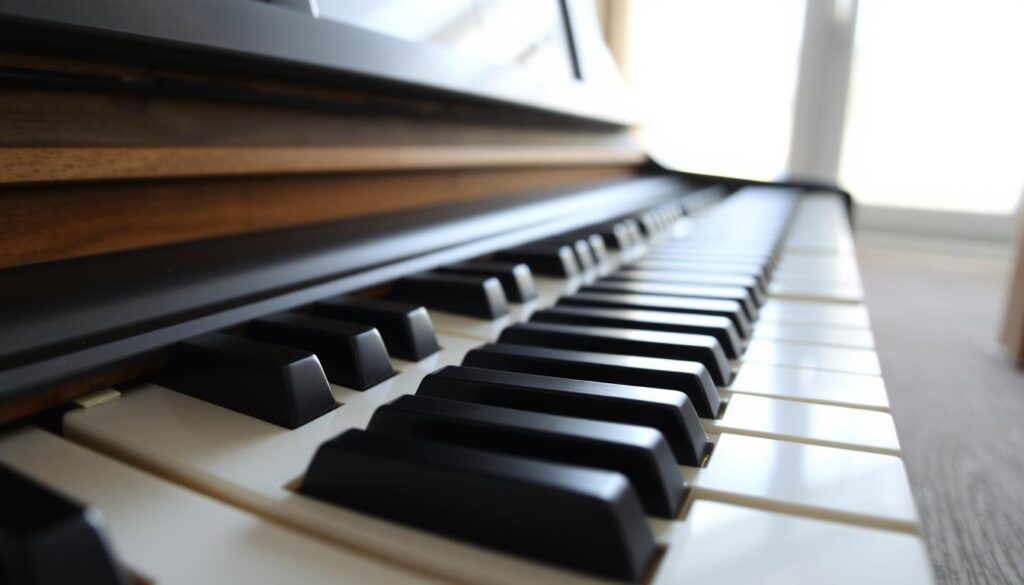
Different keyboards have different octave ranges. It’s like political districts designed for musical representation:
| Keyboard Size | Octave Range | Number of C Notes | Total Keys |
|---|---|---|---|
| 49-key | C to C | 5 | 49 |
| 61-key | C to C | 6 | 61 |
| 76-key | E to G | 6 | 76 |
| 88-key (Full) | A to C | 8 | 88 |
The 76-key model has an E to G range. It’s like a state that doesn’t vote predictably. The full 88-key keyboard offers the full range from A to C.
Then there’s Middle C – the keyboard’s swing state. It’s not exactly in the middle, but close enough. On acoustic pianos, it’s under the logo, for brand positioning.
“Middle C is the Rosetta Stone of piano notation – it connects the treble and bass clefs while giving beginners a tangible starting point.”
This note is your musical home base. It’s your anchor and compass. When learning intervals and octaves, Middle C is your reference point.
For beginners, understanding octaves is like seeing political parties repeat the same arguments at different volumes. The pattern stays the same, whether playing high or low notes.
The beauty of this system? Learning one octave means you’ve learned them all. It’s like “learn the rules once, apply them everywhere” – a concept that would make any strategist smile.
Visual Reference Guides
Ever feel like you’re decoding hieroglyphics when staring at those 88 keys? Welcome to visual literacy bootcamp – where we turn chaos into elegant patterns.
The black keys aren’t just decorative accents. They’re your visual GPS through the musical landscape. Those groups of two and three black keys? They’re the piano winking at you, saying “hey, over here!”
Here’s the cheat code nobody tells you:
- C sits patiently left of the two-black-key group
- F lounges casually left of the three-black-key trio
- The entire piano keyboard layout repeats every 12 notes
Labeled keys are your training wheels – not cheating, but strategic pattern reinforcement. Multi-colored diagrams reveal the Matrix code behind the music. Suddenly, what looked random becomes mathematical poetry.
This isn’t about memorization. It’s pattern recognition becoming muscle memory. The piano keyboard layout transforms from intimidating to intuitively beautiful once you see the repeating sequences.
Hands-On Practice Ideas
Enough theory – let’s get our fingers dancing. Or at least, slightly coordinated. This is where abstract knowledge becomes physical reality. Your brain and hands start speaking the same language.
First exercise: find every set of two black keys. Play them. Notice how they feel like twin peaks on a miniature mountain range. Now find every set of three black keys. Congratulations – you’ve just mapped 80% of the keyboard’s navigation system without reading a single manual.
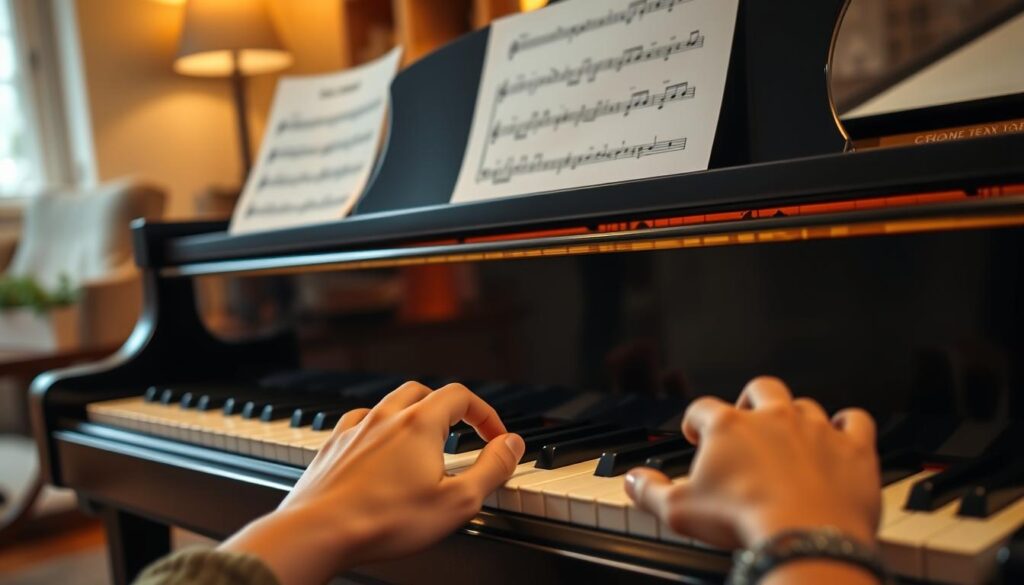
Next mission: locate every C note. On a 61-key keyboard, that’s 6 C’s playing hide-and-seek. On an 88-key? That’s 8, including the rebel at the far right that breaks positioning rules – the musical equivalent of that one cousin who never shows up for family photos.
Then there’s Middle C – find it, play it, make friends with it. This isn’t just busywork; it’s neural pathway construction. You’re building what I call “keyboard geography” – the spatial awareness that separates piano players from piano strugglers.
The magic happens when you realize you’re not learning 88 individual keys; you’re learning one elegant pattern that repeats across the keyboard. It’s the difference between memorizing every word in War and Peace and simply understanding the alphabet.
Here’s your practice blueprint:
- Daily two-minute black key scavenger hunt
- C-note mapping on your specific keyboard size
- Middle C recognition drills (blindfold optional but dramatic)
- Pattern repetition exercises across octaves
Remember: you’re not just pressing buttons. You’re building mental maps that will eventually let you play without looking – the musical equivalent of touch-typing while actually paying attention to what you’re saying.
The fingers must learn what the mind already knows.
This physical practice transforms theoretical knowledge into something your hands understand instinctively. It’s how you go from thinking about beginner piano keys to simply playing them.
The pattern recognition you develop here becomes the foundation for everything else. Scales, chords, melodies – they all build on this fundamental spatial understanding of your instrument.
So go ahead – get those hands dirty. Or at least, slightly sweaty from actual practice. Your future self, effortlessly navigating the keyboard while impressing friends at parties, will thank you.
Quiz Your Knowledge
Before you call yourself a keyboard expert, let’s check your pattern skills. It’s not just about memorizing – it’s about getting the piano keyboard layout. Think of it as an open-book test with 88 keys of music.
Question 1: How many unique notes make up the basic pattern across the keyboard? (Hint: It’s not 88 – that’s like counting all the floors in a skyscraper when you only need to understand one floor plan).
Question 2: Which white key is next to the two-black-key duo? If you said C, you’ve found a key landmark in this musical world.
Question 3: How many times does the 12-note module repeat on a standard concert grand? The answer shows why piano makers chose 88 keys instead of 100 – sometimes, less is more.
Question 4: Where would an acoustic piano place Middle C relative to the logo? This question isn’t just about music theory – it’s about how business shapes instrument design.
If you realized these questions test pattern recognition, you’ve already won. Mastering the piano keyboard layout means seeing patterns, navigating by black keys, and using Middle C as your anchor.
This approach turns the keyboard into a logical, easy-to-navigate system. It’s like knowing a city’s grid system instead of every street. Once you see the patterns, you’re not just playing notes – you’re exploring a beautifully designed musical world.
The piano keyboard layout is not random – it’s carefully planned repetition. Your skill in recognizing these patterns shows if you’re just pressing keys or truly making music. So, how did you do? If you spotted the patterns, you’re enlightened. If not, there’s always time to read those terms and conditions.
Conclusion
So, what’s the final say on this complex instrument? The piano keyboard layout is actually quite elegant once you understand it.
The 88 keys are not separate puzzles but part of a beautiful pattern. Learning piano is like learning an alphabet, not every word. Patterns are key, not just memorizing.
The black keys guide you, octaves repeat, and Middle C is your anchor. Different pianos have different sizes, but the layout stays the same.
Learning piano isn’t about memorizing everything. It’s about recognizing one pattern that repeats. It’s like seeing a forest instead of just trees.
Now, you can face any piano with confidence. The skills you’ve learned today help you see order in complexity. Go find a piano and use what you’ve learned.