Ever stare at those 88 keys like they’re hieroglyphics from another dimension? You’re not alone. That blank musical canvas can feel more intimidating than a tax form on April 14th.
Here’s the brutal truth: talent means nothing without structure. I’ve watched promising musicians quit because they treated practice like wandering through a musical IKEA without instructions.
The solution isn’t more hours. It’s smarter organization. A proper beginner piano practice routine acts as your musical GPS – it won’t shorten the journey, but it definitely prevents getting lost in scale purgatory.
Think warm-ups, technique drills, and actual song work. This three-part formula transforms overwhelming mountains into manageable molehills. Because let’s be real – nobody wants their musical journey to end with missing pieces and frustration.
Components of an Effective Routine
Ever wonder why some people’s piano practice actually works while others just make noise? It’s not about hours logged – it’s about strategic design. Think of it like building IKEA furniture: follow the right steps in the right order, and you get something beautiful. Skip the instructions, and you’re left with extra screws and existential dread.
The magic happens when three elements work together: warm-ups that matter, technique that doesn’t suck, and song work that actually progresses. Forget the musical treadmill – this is how you actually get somewhere.
First, warm-ups that connect to your music. Most beginners treat warm-ups like musical broccoli – something you choke down because it’s “good for you.” But what if your warm-up actually tasted good? Instead of mindless Hanon exercises, use the actual chords and patterns from your current piece. It’s like warming up for basketball by actually shooting hoops.
This approach does double duty: you’re preparing your fingers while reinforcing the musical concepts you’ll use later. Smart, right?
Next, technique practice with musical context. Scales alone are about as exciting as watching paint dry. But scales with backing tracks? Suddenly you’re making music, not just noise. It’s the difference between eating plain broccoli and broccoli with cheese sauce – same nutritional value, completely different experience.
This transforms technical work from tedious repetition into something that actually sounds good. You’re building skills while enjoying the process – a revolutionary concept in piano practice for beginners.
Lastly, focused song work in small chunks. Here’s where most beginners crash and burn. Playing through entire pieces and stopping when it falls apart is the musical equivalent of repeatedly crashing your car into the same tree. Instead, work in manageable sections – sometimes just two or three measures at a time.
It’s like eating an elephant (though I don’t recommend actual elephant consumption). One bite at a time makes progress inevitable.
Before all this, consider a moment of meditation or light stretching. It’s not woo-woo nonsense – it’s about preparing your mind and body for focused work. Even two minutes of breathing exercises can shift you from scattered to focused.
These components create a practice routine that actually works. Each element supports the others, creating momentum instead of frustration. That’s how you build skills that last.
Example 20/30/60-Minute Routines
Marathon practice sessions aren’t the only way to master a skill. Our brains can only focus for about 20-30 minutes before needing a break. These routines are based on how our brains learn, not how we wish they did.
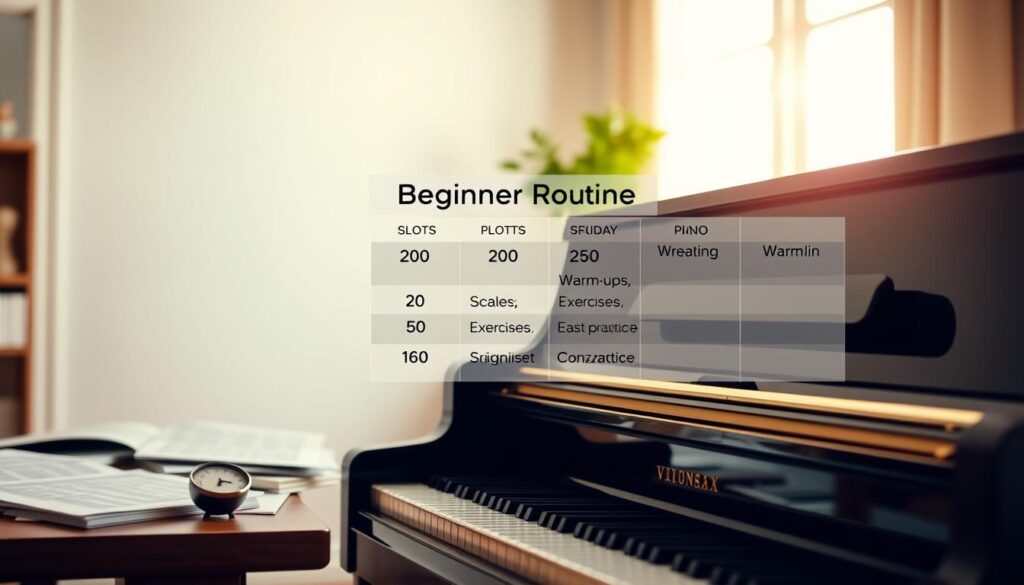
The 20-minute daily piano routine is a quick and effective option. It’s great for before work or during lunch. Start with five minutes of warm-up, then practice scales with backing tracks for five minutes. Spend the last ten minutes on specific parts of your song that need improvement.
Thirty minutes gives you a bit more time while keeping the focus sharp. Begin with five minutes of warm-up, followed by ten minutes of technique practice. Then, spend the last fifteen minutes on your song, divided into three five-minute sessions.
The 60-minute routine is a full workout for your piano skills. Start with ten minutes of warm-up and physical preparation. Spend twenty minutes on technical exercises, and twenty-five minutes on your song. Don’t forget the five-minute “play time” segment for muscle memory.
Here’s a truth your teacher might not share: consistency beats long practice sessions. Practicing 20 minutes daily creates more neural pathways than a long, one-day session. Your brain learns through repetition, not exhaustion.
The key isn’t watching the clock but focusing during practice. Each routine emphasizes focused attention over long practice. Your fingers don’t care about the time; they care about the quality of practice.
Setting and Tracking Goals
Let’s face it – many practice routines fail because they lack clear goals. It’s like going to Target without a list. You might find something nice, but it’s not what you needed.
The key is specific practice habits with clear goals. Instead of “get better at guitar,” aim for “master the F# minor chord progression at 80 bpm by Friday.” This makes a big difference between aimless playing and real progress.
- Specific: Exactly what you’re working on
- Measurable: Numbers don’t lie (bpm, error counts)
- Achievable: Be ambitious but realistic
- Relevant: Connects to your bigger musical picture
- Time-bound: Set deadlines like your musical career depends on it
My practice journal tracks everything, from tempo breakthroughs to trouble spots. It shows patterns in your practice habits you’d miss without it.
Philip Johnston’s “error quota” system is a game-changer. It sets a limit on mistakes per repetition. Suddenly, you focus like you’re playing musical Mario Kart with limited lives.
Celebrate small wins! Nailing a tricky measure after 20 tries is worth a mental high-five. These small victories build momentum through tough times.
Your tracking system doesn’t have to be complex. A simple notebook works great. Reviewing your progress weekly reveals patterns. You’ll see when you practice best, which techniques need work, and how fast you’re improving.
This isn’t about making a spreadsheet hell. It’s about creating practice habits with direction and results. Knowing you’re getting better keeps you motivated.
Balancing Technique & Songs
Have you ever felt like grammar drills and real conversations are two different languages? That’s what learning piano can feel like. You have scales and arpeggios, which are like grammar rules. Then, you have songs to play, which are like having real conversations.
It’s all about mixing both. Your beginner warmups should help you learn new songs. That C major scale is like the DNA of your Mozart sonata. Those chord progressions are the blueprint of your Beatles song.

- Match your technical work to your repertoire’s key signature
- Design exercises that tackle specific trouble spots in your pieces
- Make scales musical by varying dynamics and articulation
- Approach songs as technical etudes in disguise
I suggest spending 40% of your time on technical exercises and 60% on songs. But here’s the catch: make your technical practice musical, and your song practice focused on technique. It’s not two separate things. It’s one system where each part strengthens the other.
This way, even the most basic exercises become meaningful. Your beginner warmups become the key to unlocking your music. They turn from chores to discoveries. For more tips on balancing practice, check out these practice piano effective techniques used by pros.
The best part? This method keeps practice exciting. When everything connects, every moment at the piano is meaningful. You’re not just learning skills; you’re gaining understanding. And that’s where the real magic of music happens.
Tools to Enhance Practice (Apps, Journals)
Practicing piano shouldn’t be hard. Your smartphone can help make it easier.
Piano Marvel is like having a patient teacher. It helps you get better at sight-reading. You get feedback right away, but it’s always kind.
Modacity is like a sports analyst. It lets you record and review your playing. You can see where you go wrong.
Dr. Josh Wright’s ProPractice gives you insights like a Juilliard professor. It’s like having a top teacher in your pocket.
Practice journals are more than just for writing down your mistakes. They help you focus on what you need to work on. It’s like training for a race, not just running.
Why keep a journal? Here are three reasons:
- Pattern recognition – Find out when you play best
- Progress tracking – See how you’re getting better
- Accountability – Face your excuses
Apps make learning scales fun. It’s like playing a game. Mastering a scale can feel as rewarding as winning a game.
But remember, these tools should help your practice, not replace it. The goal is to make music, not just use apps.
Choose tools that fit how you learn. Do you like data, pictures, or competition? There’s an app for you.
Even the best app can’t replace the joy of playing. Use them to help, not to do all the work.
Troubleshooting Habits
Ever nailed a piece at home but bombed it at the lesson? Welcome to the “I played it better at home” syndrome. It’s not a moral failing; it’s just data.
Philip Johnston has a toolkit for you. “The Lap” is like a musical emergency drill. You mess up, then recover from a random spot—no do-overs. “The Ledger Assessment” shows you the truth: if you got it right once out of ten tries, you practiced it wrong nine times. That hurts.
“The Seven Stages” (originally “The Seven Stages of Misery”) is tough. It makes your piece strong. Think of it as stress-testing your routine like a tech startup tests its app.
Plateaus aren’t failures; they’re feedback. Your job is to listen. The best pianists aren’t those who never struggle. They’re the ones who treat struggle as intel. So, when your routine hiccups, don’t panic. Diagnose. Adapt. And maybe laugh at the misery—it’s all part of the process.