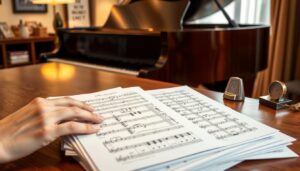
Before a song becomes a polished production—with layers of guitars, drums, and effects—it often starts in a much simpler place.
For many of the biggest artists in modern music, that place is the piano.
From The Beatles’ “Let It Be” (1970) written by Paul McCartney to Adele’s “Someone Like You” (2011), the piano has consistently been the starting point for songs that go on to define generations. It’s not a coincidence. The instrument offers something uniquely powerful: clarity, structure, and emotional control.
Understanding why so many iconic songs begin on piano reveals a lot about how music is actually created—and how you can approach learning and playing more effectively.
The Piano As A Complete Musical Tool
Unlike many instruments, the piano allows you to play melody, harmony, and rhythm at the same time.
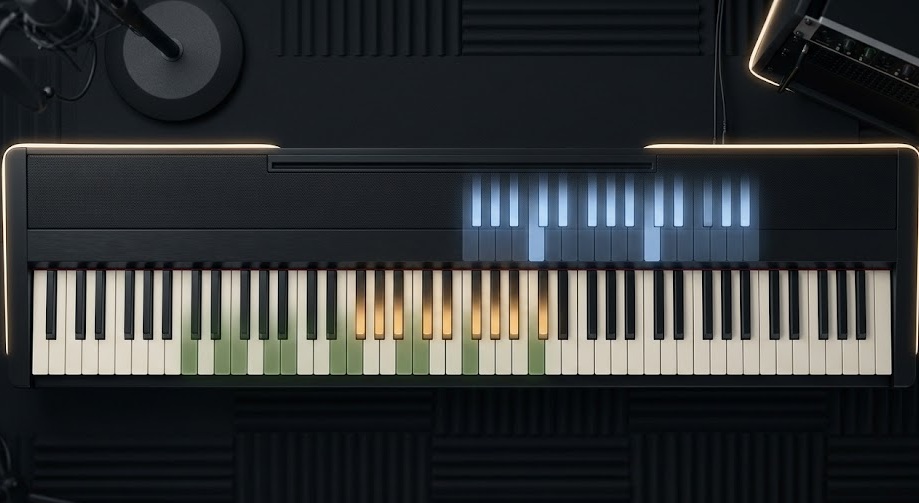
This makes it an ideal songwriting platform.
When a musician sits at the piano, they can immediately explore:
- chord progressions
- melodic ideas
- bass movement
all in a single moment. There’s no need to rely on multiple instruments or production layers to understand how a song works.
That’s why artists like Elton John, who wrote classics like “Your Song” (1970), and Billy Joel, known for “Piano Man” (1973), built entire careers around piano-based composition.
The instrument naturally encourages a holistic understanding of music, which often leads to stronger, more cohesive songs.
Why Piano Helps Create Stronger Melodies
One of the key reasons songs start on piano is melodic clarity.
On guitar, chords can sometimes mask the melodic structure. On piano, the layout is visual and linear, making it easier to:
- see intervals between notes
- experiment with phrasing
- adjust melodies in real time
This clarity helps songwriters focus on what matters most: the vocal line or main musical idea.
A great example is Lady Gaga’s “Shallow” (2018), which was developed around piano before being arranged into a full production. The core melody remains strong because it works independently of the arrangement.
Simplicity Leads To Better Song Structure
Another advantage of writing on piano is simplicity.
Without the distraction of production elements, songwriters are forced to rely on:
- chord progression strength
- lyrical structure
- emotional pacing
If a song works on piano alone, it usually translates well into any arrangement.
This is why many producers and artists test songs in stripped-down piano versions before finalizing them.
In fact, a look at songwriting history shows a consistent pattern:
| Song | Artist | Year | Piano Role |
|---|---|---|---|
| Let It Be | The Beatles | 1970 | Written and structured on piano |
| Someone Like You | Adele | 2011 | Built entirely around piano |
| All Of Me | John Legend | 2013 | Piano-driven composition |
| Clocks | Coldplay | 2002 | Iconic piano riff foundation |
These songs succeed because their core musical structure is solid before production begins.
Emotional Expression Comes Naturally On Piano
The piano is uniquely suited for emotional expression.

With its wide dynamic range, players can move from soft, intimate passages to powerful, dramatic chords instantly. This makes it easier to shape the emotional arc of a song.
That’s one reason ballads and emotionally driven songs are often written on piano first.
Even in modern pop and film scoring, composers rely on piano to sketch ideas because it allows them to feel the music as they create it, not just assemble it.
The Role Of Piano In Modern Songwriting
Despite advances in digital production, the piano remains central to songwriting in 2026.
Many contemporary artists still begin with:
- a piano or MIDI keyboard
- a basic chord progression
- a melodic idea
From there, the song evolves into a full arrangement.
You can explore how piano continues to influence modern songwriting through songs written on piano, where many unexpected hits reveal their piano-based origins.
Even producers working entirely in digital audio workstations often use piano-style interfaces to build tracks.
What This Means For Piano Learners
For learners, this trend has practical implications.
Learning piano isn’t just about playing existing songs—it’s about understanding how music works at a fundamental level.
When you practice piano, you develop:
- awareness of harmony and chord movement
- control over melody and phrasing
- the ability to structure musical ideas
This makes it easier to not only play music, but also to interpret and even create it.
For example, working through simple pieces like <a href=”https://kaygranger.advision-dev.com/ode-to-joy-piano-tutorial/” >Ode to Joy tutorial</a> helps build the foundational skills needed to understand how melodies interact with chords.
Piano Vs Other Instruments In Songwriting
While many instruments can be used for songwriting, the piano offers a unique balance.
| Instrument | Strength | Limitation |
|---|---|---|
| Guitar | Portable, intuitive chords | Limited visual layout |
| Piano | Full musical range, clear structure | Less portable |
| DAW Software | Unlimited possibilities | Can overwhelm beginners |
The piano sits in the middle—it provides structure without complexity.
That balance is what makes it such a reliable starting point for songwriters across genres.
Why This Still Matters In 2026
Even as music production becomes more digital and technology-driven, the fundamentals of songwriting haven’t changed.

A strong song still depends on:
- clear melody
- solid harmony
- emotional connection
The piano supports all three.
That’s why, decades after “Let It Be,” artists continue to return to the same starting point.
A Timeless Starting Point For Modern Music
The fact that so many major songs begin on piano isn’t a trend—it’s a reflection of how music works at its core.
The instrument provides clarity, flexibility, and emotional depth in a way few others can match.
For listeners, this explains why piano-driven songs often feel more direct and authentic.
For players, it offers a powerful insight:
learning piano isn’t just about playing—it’s about understanding music itself.
And that’s why, even in 2026, the piano remains at the heart of how great songs begin.