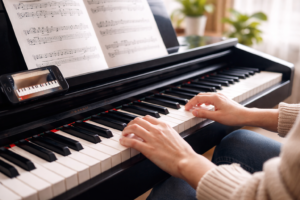
For years, the standard advice for piano practice was simple: repeat the same passage until it improves. While repetition still plays a role, modern research is reshaping how musicians approach learning.
In 2026, one method is gaining particular attention: interleaved practice.
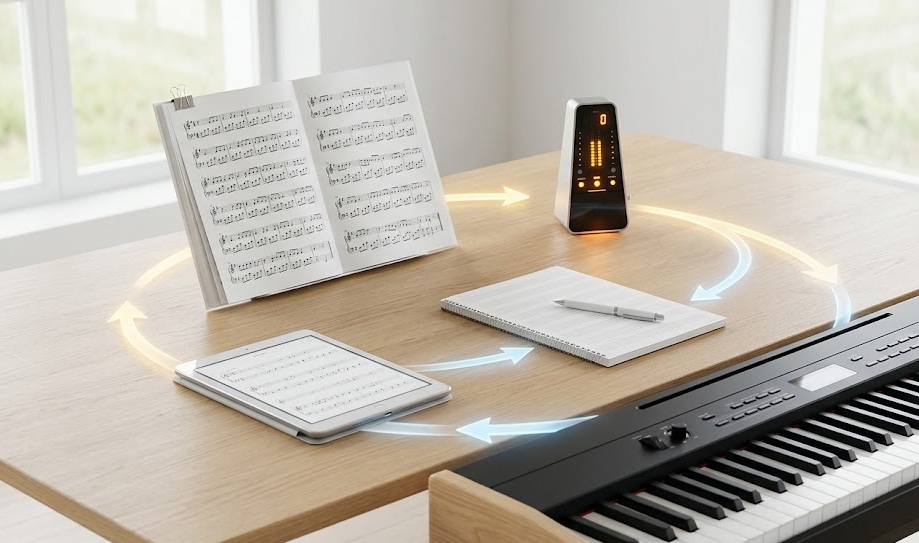
Instead of focusing on one skill or piece at a time, interleaved practice involves switching between different tasks within a single session. It may feel less comfortable at first, but studies show it leads to stronger retention, better adaptability, and more consistent long-term progress.
For pianists, this approach is changing not just how practice sessions are structured—but how improvement actually happens.
What Interleaved Practice Actually Means
Interleaved practice is based on a simple idea: mixing different types of material forces the brain to stay engaged.
Rather than practicing one scale for 10 minutes straight, you might rotate between:
- scales
- chord progressions
- short pieces
- technical exercises
The key difference is that you’re constantly switching contexts, which requires the brain to reprocess each task instead of operating on autopilot.
This method has been widely studied in learning science and motor skill development. Research shows that while blocked repetition can improve short-term performance, interleaving leads to better long-term mastery.
Why Traditional Repetition Has Limitations
Repetition feels productive because it produces quick results. When you play the same passage repeatedly, it becomes smoother within minutes.
However, that improvement is often temporary.
The brain adapts quickly to repetition, reducing the level of active thinking required. As a result, players may:
- rely on muscle memory without understanding
- struggle to reproduce results later
- plateau in technical development
Interleaved practice introduces a level of difficulty that prevents this kind of passive learning.
The Science Behind Interleaved Learning
The effectiveness of interleaving comes from what researchers call “desirable difficulty.”
By making practice slightly more challenging, the brain is forced to:
- retrieve information repeatedly
- adapt to changing contexts
- strengthen neural connections
Studies in skill acquisition and music education have shown that interleaving improves transferability, meaning skills can be applied more easily in new situations.
You can explore broader insights into learning methods through modern piano learning research, where structured and adaptive practice systems are becoming central to progress.
How Interleaved Practice Looks In Real Piano Sessions
In practical terms, interleaving doesn’t mean random practice—it means intentional variation.
A 20-minute session might look like this:
| Time Block | Focus |
|---|---|
| 5 minutes | Scales and finger exercises |
| 5 minutes | Section of a current piece |
| 5 minutes | Chord transitions or arpeggios |
| 5 minutes | Different piece or rhythm work |
The goal is not to master each section immediately, but to build flexibility and recall across multiple skills.
This approach mirrors real performance conditions, where players must constantly adapt rather than rely on repetition alone.
Why It Feels Harder—But Works Better
One reason many pianists avoid interleaved practice is that it feels less effective in the moment.
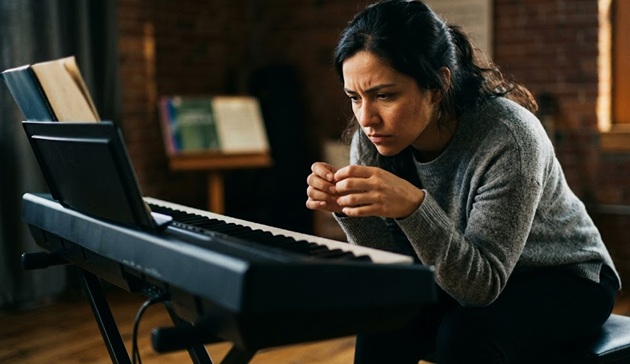
Switching between tasks creates:
- more mistakes
- slower short-term progress
- a sense of instability
However, these challenges are exactly what make the method effective.
By interrupting repetition, interleaving forces the brain to rebuild understanding each time, strengthening long-term memory.
The Impact On Technique And Musical Control
Interleaved practice has a noticeable effect on technique.
Because players are constantly resetting their focus, they become more aware of:
- finger placement
- timing accuracy
- transitions between movements
This leads to cleaner execution over time, especially in areas that require adaptability.
For example, combining interleaving with structured technical work like piano arpeggio technique helps reinforce both precision and flexibility, rather than isolated repetition.
When To Use Interleaved Practice
Interleaving is not meant to replace all practice methods. Instead, it works best when integrated strategically.
It is particularly effective for:
- building consistency across multiple pieces
- improving recall during performance
- avoiding mental fatigue from repetition
However, there are moments when focused repetition is still useful—especially when learning a completely new passage.
The key is balance: using repetition for initial familiarity, and interleaving for long-term retention and control.
Interleaved Practice Vs Block Practice
Understanding the difference between these two approaches highlights why interleaving is gaining popularity.
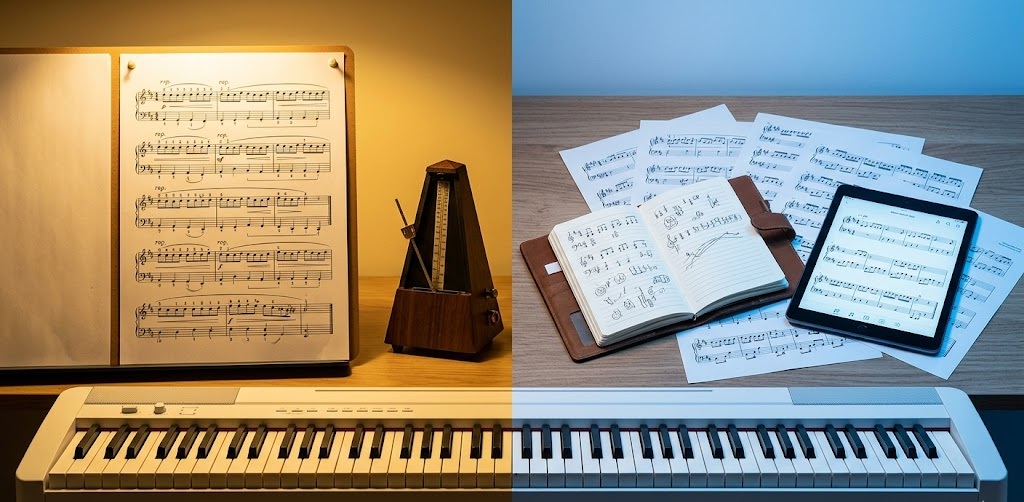
| Method | Strength | Limitation |
|---|---|---|
| Block Practice | Fast short-term improvement | Weak retention |
| Interleaved Practice | Strong long-term learning | Slower immediate results |
In 2026, more teachers and learning platforms are shifting toward interleaving because it produces more reliable performance over time.
What This Means For Modern Piano Learning
As piano education evolves, methods like interleaved practice are becoming more widely adopted.
They reflect a broader shift toward:
- efficiency over repetition
- understanding over memorization
- adaptability over routine
For learners, this means practice sessions are becoming more intentional and structured, even when they feel less predictable.
A Smarter Way To Practice
Interleaved practice challenges traditional assumptions about how improvement works.
Instead of repeating until something feels easy, it encourages players to embrace difficulty as part of the learning process.
The result is not just faster progress, but more durable skill.
For pianists in 2026, that shift represents a more intelligent approach to practice—one that aligns with how the brain actually learns.
And once you experience the difference, it’s hard to go back to practicing the same way again.