Arpeggios are one of the most essential technical elements in piano playing. From classical repertoire to modern film scores, these flowing broken chords appear in countless musical passages. When played well, arpeggios create a sense of movement and elegance that can dramatically shape the character of a piece.
However, mastering arpeggios requires more than simply playing chord notes quickly. Concert pianists focus on even tone, efficient hand movement, and relaxed finger control to ensure that every note remains clear at high speeds.
Developing these skills takes consistent practice with exercises designed to strengthen finger coordination and refine motion across the keyboard.
Understanding The Structure Of Piano Arpeggios
An arpeggio is created by playing the notes of a chord individually rather than simultaneously. This technique allows harmony to unfold gradually, producing a smooth and flowing sound.
For example, a simple C major arpeggio includes the following notes:
| Chord | Arpeggio Notes |
|---|---|
| C Major | C – E – G – C |
| A Minor | A – C – E – A |
| F Major | F – A – C – F |
Unlike scales, which move step by step, arpeggios involve larger intervals between notes. This means the hand must travel more across the keyboard, requiring precise coordination between fingers and wrist.
Because of these wider movements, arpeggios are often used to develop keyboard navigation and technical flexibility.
Why Arpeggios Build Advanced Technique
Arpeggio practice strengthens several core piano skills simultaneously. The wide note spacing encourages smooth hand movement, while repeated patterns help improve rhythmic stability.
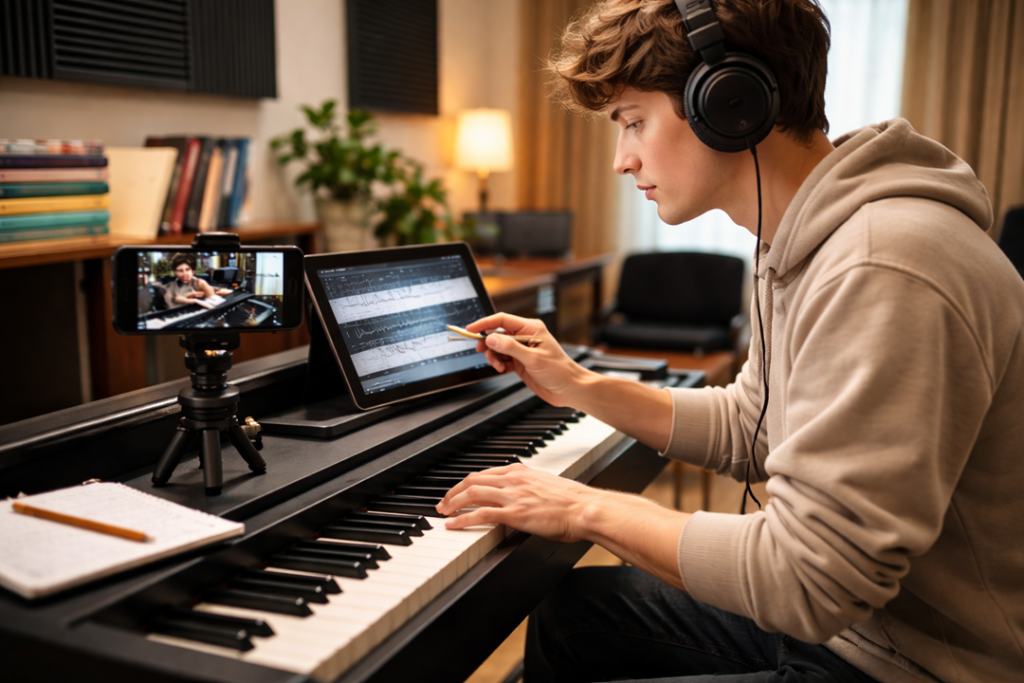
Professional pianists use arpeggios to develop:
- Finger independence
- Smooth wrist transitions
- Even tonal balance
- Efficient keyboard movement
When practiced carefully, arpeggios help players move across the keyboard with confidence rather than hesitation.
Many advanced compositions rely heavily on arpeggio patterns, making this technique essential for performing complex repertoire.
The Importance Of Hand Position And Rotation
One common mistake when practicing arpeggios is attempting to reach every note with rigid finger movement. This approach creates tension and slows down playing.
Concert pianists instead rely on subtle wrist rotation and hand shifts to guide the fingers naturally toward each note.
As the hand moves through an arpeggio pattern, the wrist gently adjusts its angle to support the fingers. This motion reduces strain while keeping movement fluid.
Developing this coordination allows arpeggios to feel effortless even at higher tempos.
Foundational Arpeggio Exercise For Control
A reliable way to build arpeggio accuracy is to practice broken chords slowly before increasing speed.
Start with a simple C major arpeggio:
| Right Hand | Left Hand |
|---|---|
| C – E – G – C | C – G – E – C |
Focus on playing each note evenly and maintaining a relaxed hand position.
Once the pattern feels comfortable, gradually expand the exercise across multiple octaves. This helps develop spatial awareness of the keyboard.
Practicing slowly ensures that the fingers learn the correct movement before tempo increases.
Building Speed Through Rhythmic Variation
Rhythmic variation is a powerful technique for strengthening finger coordination during arpeggio practice.
Instead of playing each note evenly, alternate between long and short rhythmic patterns.
| Pattern | Example |
|---|---|
| Long–Short | C (hold) – E (quick) – G (hold) – C (quick) |
| Short–Long | C (quick) – E (hold) – G (quick) – C (hold) |
This method challenges the fingers to maintain control under changing rhythmic conditions.
When returning to even rhythm afterward, the passage often feels noticeably easier.
Expanding Arpeggios Across The Keyboard
Once basic patterns are comfortable, advanced practice involves extending arpeggios across multiple octaves.
Extended arpeggios require the thumb to pass under the hand smoothly as the fingers continue upward.
| Movement | Technique |
|---|---|
| Ascending | Thumb passes under after third finger |
| Descending | Third finger crosses over thumb |
This crossing motion allows the hand to continue moving across the keyboard without interruption.
Smooth thumb transitions are essential for maintaining both speed and clarity.
Maintaining Even Tone In Fast Arpeggios
Speed often causes certain notes to sound louder than others. Uneven tone disrupts the musical line and makes passages feel uncontrolled.
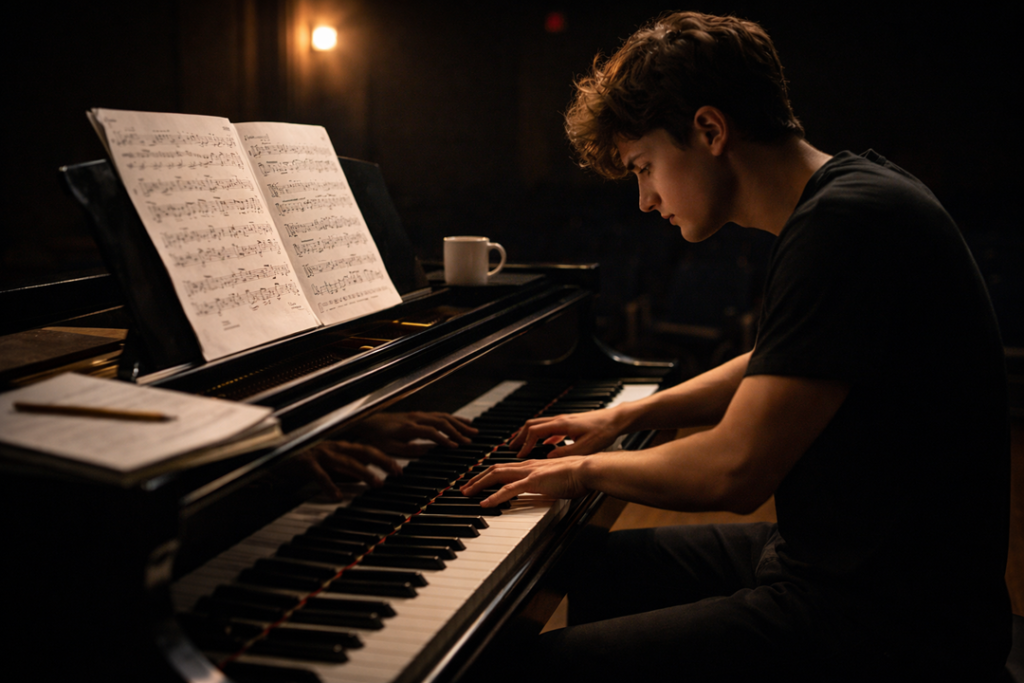
To maintain balance, pianists focus on consistent finger pressure and relaxed movement.
Recording practice sessions can help identify uneven articulation. Listening carefully allows players to adjust finger strength and refine tone production.
If you’re still developing finger control, exploring beginner piano hand coordination exercises can also strengthen the independence required for smooth arpeggio playing.
Practicing Arpeggios In Musical Context
Technical exercises become more meaningful when connected to real music. Many classical works incorporate arpeggio passages that test both speed and musical expression.
For example, arpeggios appear prominently in works by composers such as Chopin, Liszt, and Debussy.
According to Yale University’s introduction to musical harmony, arpeggios reveal the harmonic structure of a piece by presenting chord tones sequentially rather than simultaneously.
Practicing arpeggios with attention to phrasing and dynamics helps transform them from technical drills into expressive musical gestures.
Turning Technical Exercises Into Musical Fluency
Arpeggios are not merely mechanical exercises. When mastered, they allow pianists to navigate the keyboard with fluidity and confidence.
By practicing slowly, maintaining relaxed hand movement, and gradually increasing speed, pianists develop the control needed to perform complex passages with clarity.
Over time, these exercises build the technical foundation required for advanced repertoire. The combination of precision, balance, and efficient movement ultimately allows arpeggios to become a natural extension of musical expression.