Let’s figure out the issue. You adore the piano, but your timing is all over the place. You’re not the only one.
I’ve been there too. Sometimes I play too fast in the easy parts and too slow in the hard ones. It’s not just about missing notes. It’s about missing the point.
Music without a steady beat is like a story without a plot. That steady pulse is essential. It’s the heartbeat of every great piece.
Experienced players know this struggle. They’ve conquered uneven timing. Their secret? A strong, drummer-like sense of rhythm.
We’re shifting from rhythmic mess to becoming the conductor of our own time. From simple clapping to complex piano. The journey begins with understanding why that steady beat is key, not just hitting every note right.
Why Metronome? Building Internal Pulse
The metronome isn’t here to punish you; it’s here to reveal what your ears have been politely ignoring. Think of it less as a robotic taskmaster and more as your musical fact-checker. Every time you rush a chorus or drag a verse, that steady click stands as an impartial witness. It doesn’t judge. It just states the rhythmic truth.
Without this external anchor, you’re relying on an internal clock that’s notoriously unreliable. It’s like navigating by a sundial at midnight. Your sense of tempo fluctuates with excitement, fatigue, or difficulty. This is where serious metronome practice begins: not to enslave you to a machine, but to calibrate your biological metronome.
The goal isn’t mechanical perfection. The goal is sovereignty. You want to internalize that pulse so completely that you could anchor a jazz trio or drive a rock band. We’re talking about moving from needing external validation (the obedient click) to achieving internal authority (your own impeccable time).
The real magic of metronome practice happens when the click stops being an external command and starts feeling like your own heartbeat. It’s the difference between following a map and knowing the terrain. That steady tick-tock takes on the rhythmic responsibility of a drummer, providing the consistent repetition your playing craves.
One source calls the metronome “your best friend” for developing precise timing, and they’re not wrong. This friendship involves practicing subdivisions—hearing the spaces between beats—and even working with silent beats. Can you feel the pulse when the click disappears for a measure? That’s the test.
Through consistent metronome practice, you build what musicians call “internal time.” It’s that unshakeable thrum beneath your fingers, the steady river that carries your phrases. Your playing moves from being rhythmically “ungrounded” to being able to “hold a rhythm” against any distraction.
This transformation is subtle at first. You’ll notice you stop speeding up during easy sections. Your pauses become intentional, not hesitant. The space between notes feels measured, not accidental. You’re not playing to the click anymore; you’re playing with it, as an equal partner.
That’s the alchemy of metronome practice: turning an external, mechanical sound into your own internal, living pulse. It’s how you graduate from keeping time to being time.
Choosing an App: Features to Look For
Forget the mahogany pyramid. Your smartphone is now the temple of tempo. But don’t just download any app. You need a tool, not a toy. A digital drill sergeant for your rhythm.
The market is flooded with options that promise orchestral sounds and rainbow visuals. Ignore them. You’re not here for a light show. You’re here to forge an ironclad internal clock. This requires a specific set of features—a Swiss Army knife of temporal torture.
Let’s break down the non-negotiables.
A Clear, Unflinching Visual Pulse is your anchor. When the audio click gets lost in the music, your eyes need a beacon. A bold, blinking light or a sweeping pendulum on screen keeps you grounded. It’s the difference between guessing and knowing.
Next, Complex Time Signature Mastery. 4/4 is just the gateway drug. Can your app handle 7/8, 5/4, or 12/8 with ease? Real music, and real challenge, lives in these asymmetrical grooves. If an app stumbles here, delete it.
Now, the crown jewel: The “Mute” or “Silent Bar” Function. This is not a gimmick. This is the forge where true timing is tempered. The app plays a click for three bars, then goes silent for one, forcing you to carry the pulse internally. It’s the musical equivalent of a samurai striking in the dark. Master this, and you own the time.
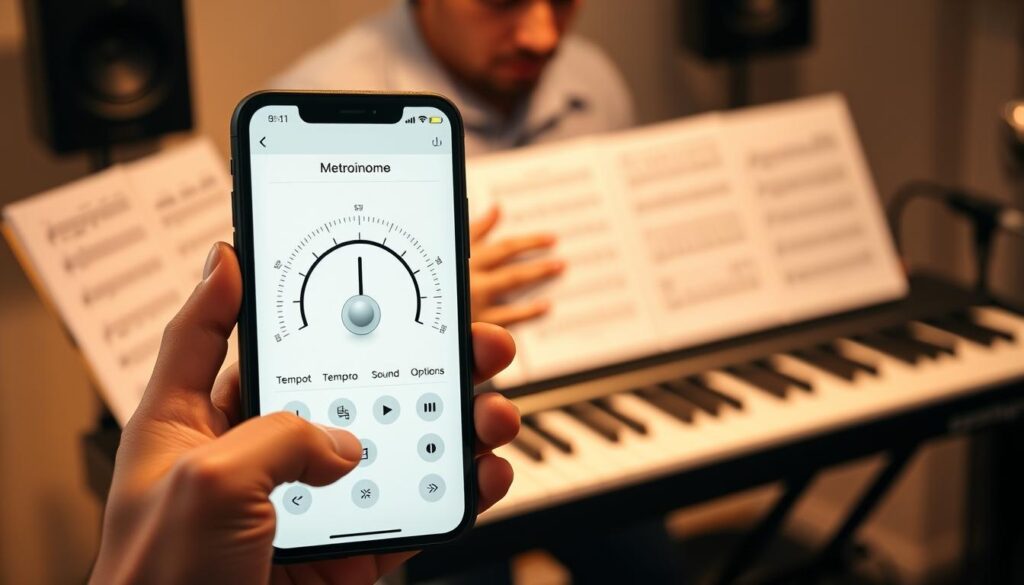
So, which apps actually deliver this toolkit? Based on recommendations from working musicians, two stand out for being powerful, reliable, and free.
| App Name | Platform | Key Feature for Timing Exercises | The Sage’s Verdict |
|---|---|---|---|
| Metronome Online | Web Browser | Dead-simple interface, robust time signature options, always accessible. | The pure, no-frills workstation. Perfect for a focused session at your computer. |
| Pro Metronome by EUM Lab | iOS / Android | Extensive silent bar programming, customizable visual pulse, a powerhouse in your pocket. | The elite trainer. Its silent bar options make it the go-to for advanced internal pulse drills. |
Your choice depends on your dojo. Need a quick, focused session at the piano? Fire up the browser. Want to practice silent bar drills on the go? The mobile app is your companion.
The goal isn’t to find the prettiest app. It’s to find the most ruthless architect of your timing exercises. One that challenges you, betrays you with silence, and ultimately, makes you stronger.
Step 1: Silent Counting → Clicks Only
The first rule of metronome club? Shut up and listen. Seriously.
Before you start playing, you need to listen deeply. Set your metronome to 60 BPM. This is one click per second, like a resting giant’s heartbeat.
Your task is to listen quietly. Count silently in your head: “one… two… three… four…” Make sure each internal number matches the click exactly. This is where true tempo control starts, in your mind’s ear.
Why silent counting? It helps you feel the space between clicks. This space is where your rhythm will live. It’s like studying negative space in art.
This exercise makes rhythm a felt experience. You’re not just learning tempo; you’re feeling it in your body.
Common mistakes to avoid:
- Don’t tap along. Your body wants to move. But this is ear training.
- Don’t increase the tempo. 60 BPM feels slow, but that’s the goal.
- Don’t multitask. Give it two minutes of your full attention.
Think of it as rhythmic meditation. The metronome is your mantra. The click is your focus. When your count wavers, you’ve lost the beat. When it’s steady, you’ve mastered the first step of tempo control.
Master this before moving to clapping or speaking. It’s the foundation for everything else. Get it wrong, and everything else will be shaky. Get it right, and you’re ready to play steadily.
FAQ
Q: What is a metronome?
A: A metronome is a tool used to help musicians keep a steady tempo while practicing. It provides a consistent beat that musicians can follow to improve their timing and rhythm.
Q: How does a metronome help with timing and rhythm?
A: By using a metronome, musicians can develop their timing and rhythm skills. The metronome provides a steady beat that musicians can follow, helping them to improve their ability to play in time and maintain a consistent rhythm.
Q: What are the benefits of using a metronome?
A: Using a metronome can have several benefits for musicians. It helps improve timing and rhythm, enhances musical accuracy, and aids in the development of musicality. By practicing with a metronome, musicians can refine their skills and become more precise in their playing.
Q: How can I use a metronome for metronome practice?
A: To use a metronome for metronome practice, start by setting the desired tempo on the metronome. Then, practice playing along with the metronome, focusing on maintaining a steady tempo. Gradually increase the tempo as you become more comfortable and proficient.
Q: What are some tips for effective metronome practice?
A: To make the most of metronome practice, it’s important to practice regularly and consistently. Start with slower tempos and gradually increase the speed as you become more comfortable. Focus on maintaining a steady tempo and pay attention to your timing and rhythm.
Q: How can I incorporate metronome practice into my daily routine?
A: To incorporate metronome practice into your daily routine, set aside a specific time each day to practice with a metronome. It can be as simple as playing along with the metronome for a few minutes each day. Consistency is key to improving your timing and rhythm.
Q: What are some common mistakes to avoid when using a metronome?
A: Some common mistakes to avoid when using a metronome include rushing or slowing down the tempo. It’s important to focus on maintaining a steady tempo and avoid deviating from the metronome’s beat. Practice regularly to develop your timing and rhythm skills.
Q: How can I choose the right metronome for my needs?
A: When choosing a metronome, consider the features that are important to you. Look for a metronome with adjustable tempo, a clear and audible sound, and additional features such as a built-in tuner or practice modes. Read reviews and compare different metronomes to find the one that best suits your needs.
Q: What are some additional tips for improving timing and rhythm?
A: In addition to using a metronome, there are other techniques you can use to improve your timing and rhythm. Practice playing along with recordings of professional musicians, focus on developing your sense of rhythm through exercises and activities, and experiment with different time signatures and tempos to challenge yourself.
Step 3: One Hand on Keys, Simple Five‑Note Patterns
Congratulations. You’ve moved past clapping like a seal. Now, it’s time to touch the keys of an instrument. This is where your sense of rhythm meets the real world.
Put one hand over five white keys, like C to G. Your task is simple: play each note in order, one per click. Play C on 1, D on 2, and so on. This isn’t about melody. It’s about instrumental precision.
The task is simple, but that’s the point. Every mistake is clear. Is your note landing *on* the click with authority? Or is it early or late?
This is your first real timing exercise. You’re not just counting time. You’re making it. Pressing a key must match the metronome’s click perfectly.
This is like a test for your rhythm. The five-note pattern is like a lie detector. Any mistakes will be clear here, not in a Mozart sonata.
| Mental Focus Point | Clapping/Tapping Phase | Five-Note Keys Phase |
|---|---|---|
| Primary Concern | Aligning body motion with sound. | Syncing mechanical action (key press) with sound. |
| Error Visibility | Fairly clear; a late clap is obvious. | Extremely high; even a millisecond’s drift is audible. |
| Skill Developed | Internal pulse and subdivision. | Rhythmic consistency in performance context. |
| Next Step Prepared For | Adding physical instrument interaction. | Handling more complex patterns and off-beats. |
Start very slow. Use a tempo of 60 BPM. Your goal is to make each note perfect with the click. Listen to the space between notes too. It should feel even and calm.
These exercises build your rhythm muscle. They teach your fingers what steady time feels like. When you can play five notes in a row perfectly, you’re ready for more. The advanced stuff comes later. This is the foundation.
Step 4: Off‑Beat and “Every 2 Bars” Click Challenges
This is where we push you to the next level. You’ll learn to control your rhythm without constant help. It’s time to test your tempo control in new ways.
First, change your metronome to click only on beats 2 and 4. This means beats 1 and 3 are just in your head. Can you keep a steady beat when the clicks come every other time?
This exercise improves your tempo control and helps with syncopation. Try clapping or tapping quarter notes against the sparse clicks. Then, play syncopated patterns where your notes fall between the clicks.
Next, set your metronome to click once every two full bars. For seven beats, you’ll rely only on your internal rhythm. The clicks act like a beacon, checking if you’re on track.
This is the ultimate tempo control challenge. It’s like being in a sensory deprivation tank and trying to tell time. The “silent beat training” mentioned in advanced pedagogy reaches its peak here.
Begin with a simple exercise: play a five-note scale pattern, but leave bar 2 silent. Then, start again on beat 1 of bar 3. Did you rush or drag? This shows how accurate your internal clock is.
Mastering these challenges is the top of tempo control. Your internal metronome becomes incredibly precise. Playing steadily against sparse clicks or through silences shows you’re rhythmically independent.
This skill changes how you play with others. You’ll play in tune with confidence, as your rhythm doesn’t need external help. You become the steady center that others count on. This is the true power of advanced metronome work.
Tempo Ladders: Slow → Medium → Performance Speed
Your performance speed is not a goal to rush to. It’s the top of a building you build one brick at a time. Most metronome beginner piano plans fail because of impatience, not because they’re too hard.
Begin with a speed so slow it seems too easy. For example, start at 40-50 BPM for a scale you can play at 120. This slow pace lets you check every detail. You’re making sure every movement is perfect.
The rule is simple but often ignored: Nail it perfectly. Then, and only then, add 5-10 BPM. You must be able to play it right three times in a row. This slow increase is your tempo ladder.
Think of each BPM increase as adding a new floor to your musical building. If you rush, the whole thing shakes. But if you build it slowly, you own it. Your skills become strong and reliable.
Here’s how to design your personal ladder for any piece:
- Establish Your “Insultingly Slow” Baseline: Find the tempo where you can play the passage flawlessly with zero tension. This is your ground floor.
- Practice Subdivisions Here: Before climbing, solidify the foundation. Clap eighth notes, then triplets, against the slow click. This builds rhythmic resolution.
- The 5-BPM Rule: Increase by only 5 BPM after three perfect repetitions. If you stumble, drop back down 5 BPM and reconquer that level.
- Mark Your Milestones: Note the BPM where you first feel slight strain. That’s your current “ceiling.” Practice there until it becomes your new floor.
This isn’t about talent. It’s about making your neural pathways stronger. You’re slowly raising the energy state of your brain until the right rhythm is the only choice for your hands. The best learning systems know this: mastery is built, not inspired.
The biggest mistake? Trying to jump from “I got it once at 60” to “let’s try 90” right away. That’s not practice—it’s risking your skills. The shaky foundation always shows up, usually when you least expect it.
Your tempo ladder turns anxiety into a solid structure. Each small step makes your skills predictable. When you reach that performance speed, you’ll feel confident. You’ll know you can play it because you built a strong foundation.
Fixing “Speeding Up in Easy Parts”
We’ve all been there. You’re playing smoothly, then suddenly, you hit a simple part. Your brain gets bored and your fingers start rushing. It’s like speeding up after driving through the city.
This isn’t just a skill issue; it’s a focus problem. Your internal rhythm gets lazy when the music is simple. The key to good metronome practice is to stay focused, even when it’s easy.
The trick? Think small. Instead of focusing on the main beats, break them down. This makes it harder to rush.
Here’s how it works. Set your metronome to a steady beat. Then, for each beat, say “1-e-and-a, 2-e-and-a” in your head. This fills the space between beats with mental markers.
Start by tapping your foot on the beat and saying the subdivisions out loud. Make “1-e-and-a” as steady as the metronome. This turns a long, boring stretch into a precise grid. Your brain stays busy, keeping time perfectly.
| The Problem (Autopilot) | The Solution (Subdivision) | The Mental Shift |
|---|---|---|
| Focus is on the “big” beats only. | Focus is on the spaces between the beats. | From watching mile markers to watching every foot of the road. |
| Brain gets bored during simple passages. | Brain is actively engaged in a continuous internal count. | Turns a passive section into an active listening exercise. |
| Rhythm feels loose and ungrounded. | Rhythm becomes locked and granular. | Builds a rock-solid internal timekeeping mechanism. |
Once you’ve got the subdivision down, use it in your music. Play simple parts, but keep counting “1-e-and-a” in your head. This is advanced metronome practice—it builds a strong internal rhythm.
For more challenge, try the “Every 2 Bars” test. Set the metronome to click every two measures. This makes you super aware of time. It’s a test of your internal rhythm.
Mastering this makes you stronger. Parts you used to rush become solid. This discipline makes you embody time, not just follow it. Regular metronome practice builds a strong rhythm that prevents rushing.
Motivation: Track Your “Steadiest Song” Badge
Drilling with a click track can feel like watching paint dry on a humid day. The metronome’s tyranny is real. We need to hack our own psychology. We need a game.
Enter the “Steadiest Song” badge. This isn’t about being a virtuoso. It’s about being consistent. Choose a short piece, like a scale or a chord progression.
Your mission is to play it from start to finish with perfect steadiness. Use your metronome app’s tap-tempo feature or record yourself. Then, analyze the waveform to track your BPM variance week to week.
This turns tempo control into a challenge you can win. It’s about the data, not the drama. You’re not just practicing; you’re conducting a personal experiment in rhythmic integrity.
The goal is to shrink that variance number. This makes tempo control something you can measure. Mastering rhythm is a lifelong journey, not a weekend sprint.
This badge system builds the ritual. You celebrate the process—the incremental win of a tighter, more consistent performance. You stop fighting the click and start collaborating with it. That’s how rhythmic discipline evolves from a daily chore into a refined craft.