Forget the idea of the tortured pianist. The real secret to starting isn’t in complex sonatas. It’s in ignoring one half of the problem.
Playing with one hand is not a compromise. It’s a smart trick. It lets you focus on the melody, the heart of music, without getting tangled in coordination.
This method is your entry point. It helps you learn note reading and rhythm without feeling overwhelmed. It’s perfect for anyone, including those with mobility issues. It connects your thoughts directly to a beautiful sound.
The aim isn’t to show off your skills. It’s to play something you can recognize. Something that brings you joy, not stress.
Think of this as your first step to overcoming fear. Let’s make music with some easy beginner songs.
Song Selection Criteria (Range, Rhythm, Familiarity)
Choosing your debut song is like curating a museum exhibit for your fingers. Only the most accessible pieces make the cut. It’s not about finding the most profound music ever written. It’s about finding the musical on-ramp that’s easy to start with.
We’re looking for melodies that are like well-designed beginner hiking trails. The path should be clear, the elevation manageable, and the view rewarding. Let’s break down the three non-negotiable criteria for your first conquest.
The Range: Your Hand’s Comfort Zone
First, consider the melodic range. A song that fits within a five-finger position (typically C to G with your right hand) is your best ally. This minimizes the frantic hand gymnastics that turn practice into a slapstick comedy routine.
Why does this matter? A narrow range lets your brain focus on finding the correct keys without the added stress of navigation. Songs like “Twinkle Twinkle Little Star” are perfect because they largely hang out in this cozy neighborhood. Your hand sits down and barely needs to move. That’s the goal.
The Rhythm: Keep the Pulse Predictable
Next, examine the rhythm. We’re looking for steady, predictable pulses built from quarter notes and half notes. Think of a calm, walking pace—not a syncopated polyrhythm that would confuse a metronome.
Simple rhythms build your internal clock, the foundational skill for all future music. “Jingle Bells” works brilliantly here. Its “dash-ing through the snow” rhythm is unmistakable and easy to count. Avoid anything that feels like it has musical parentheses or footnotes on the first pass.
The Familiarity: Your Built-in Reference Track
The final, and most psychologically critical, criterion is familiarity. You already know how “Happy Birthday” sounds in your mind’s ear. Your job is simply to map that known melody onto the keyboard.
This internal reference track is your greatest learning aid. It provides instant feedback. Play a wrong note, and your brain’s quality control department sends up a red flag. Choosing a song you can hum in your sleep means you’re not learning the tune and the technique simultaneously. You’re just focusing on the technique.
The Tools: Your Diplomatic Passports
This is where accessible tools become your best friends. If traditional sheet music looks like ancient hieroglyphics, letter notes are your Rosetta Stone. They translate pitches directly to keyboard letters (C, D, E), bypassing staff notation entirely.
Similarily, simple lead sheets offer a minimalist blueprint. They give you the melody line and basic chords—the musical equivalent of an IKEA instruction manual. Think of these tools as diplomatic passports. They let you cross the border into Music Land without needing a full theory visa.
Using letter notes for a song like “Happy Birthday” removes the abstraction. You see “C C D C F E” and you play those keys. It’s direct, tangible, and builds immediate confidence. A basic lead sheet might show the same melody with a “C” chord symbol above it, hinting at harmony without complexity.
So, your mission is clear. Scan the musical landscape for songs that score high in all three categories. The right choice feels challenging but not chaotic. It’s the sweet spot where effort meets achievement, setting the stage for everything that follows.
Song 1–5: Step‑By‑Step (Fingerings, Counts, Tips)
This isn’t just a list of songs. It’s a guide to mastering your first five piano melodies. We’re moving from theory to the real action of fingers on keys. Each song has been carefully chosen for its simplicity and cultural appeal. Let’s dive into each one with precision.
Twinkle Twinkle Little Star is a universal gateway to music. Its pattern is almost math-like. Play it with fingers 1-2-3-4-5 on your right hand, starting with your thumb on Middle C. The rhythm is steady: “1-and-2-and-3-and-4-and.” Each note gets one beat.
The melody is a mirror of itself. Master the first four notes (C-C-G-G), and you’ve learned half the song. It’s like musical copy-paste.
Happy Birthday is your social superpower. The fingering is a bit more adventurous but stays within a five-note range. Start with finger 3 (middle finger) on G above Middle C. The counting trick? The pickup notes (“Hap-py”) are quick. Think “and-1” before landing firmly on “Birth-” on beat one.
The real secret is in the leap to the high note on “you.” Don’t rush it. Savor the anticipation, like a comedian pausing before the punchline.
Let It Be brings a touch of cool, adult-contemporary vibe. The iconic four-note motif is hypnotically simple. Use fingers 1-2-3-5 (skip finger 4) on A-B-C-E. The rhythm is a slow, gospel sway: “1…2…and…3…4.” Hold that first note.
The emotional tip? This melody is about release. Physically relax your shoulders on each phrase. The music should feel like a sigh, not a statement.
Ode to Joy from Beethoven’s Ninth is pure triumphant architecture. Fingering: 3-4-5 on E-F-G with your right hand. The rhythm is a bold, declarative “1-2-3-4.” No frills. The analytical insight? This tune is about resolution.
The final phrase (G-F-E) feels like coming home. Play it like you’re concluding a compelling argument. For a deeper dive into notation, our guide on piano sheet music for beginners breaks down how to read these patterns.
Clocks (Coldplay Riff) is your modern, rhythmic badge of honor. It’s just three notes repeating: E-D#-E. Use fingers 3-2-3. The magic is in the rhythm: a driving “1-and-2-and-3-and-4-and” with the notes falling on the “and” of each beat.
This is called a syncopated rhythm. The pro-tip? Lock your hand position and let your fingers bounce like a piston. Don’t overthink it. Feel the hypnotic pulse.
Each of these beginner songs teaches a different fundamental skill. “Twinkle” teaches repetition and fingering. “Happy Birthday” teaches pickup notes and phrasing. “Let It Be” teaches emotional weight and sustain.
“Ode to Joy” teaches melodic resolution and confidence. “Clocks” teaches rhythmic precision and hand stability. Together, they form a complete first-year curriculum.
Remember, the suggested fingerings aren’t arbitrary laws. They’re ergonomic recommendations born from centuries of playing. They help your hand move efficiently, like using the correct grip on a golf club. If a different fingering feels more natural to you, experiment. The goal is fluidity, not rigid obedience.
These five beginner songs are your foundation. Master them, and you’ve built the neural pathways and muscle memory for hundreds more. You’re not just learning tunes; you’re installing the operating system for piano playing.
Expressive Playing: Dynamics and Phrasing Basics
Playing the right notes is like assembling IKEA furniture; making them sing is the interior design. You’ve conquered the technical puzzle—now let’s discuss the artistry. This is where melody practice evolves from mechanical repetition to emotional communication.
Think of dynamics as your emotional volume knob. Piano (soft) versus forte (loud) isn’t just about decibels—it’s about context. Would you shout “Happy Birthday” at a bedside vigil? Probably not. The same notes convey entirely different stories based on their dynamic delivery.
Here’s a practical exercise for your current repertoire. Take “Twinkle, Twinkle Little Star.” Play it once at a consistent mezzo-forte (medium loud). Now, try this pattern:
- Crescent Moon: Begin piano (soft) on “Twinkle, twinkle”
- Growing Stars: Swell to forte (loud) by “how I wonder what you are”
- Gentle Descent: Return to piano for the final “up above the world so high”
Suddenly, you’re not playing a nursery rhyme. You’re painting a celestial scene. This deliberate dynamic shaping transforms simple melody practice into narrative creation.

Now, let’s discuss phrasing—the musical equivalent of breathing. A melody without phrasing is like a text message without punctuation or emojis. Technically comprehensible, but emotionally flat.
Listen to the opening of “Imagine.” The notes themselves are elementary. The magic lies in the lift after “Imagine all the people,” that slight breath before “living for today.” That’s a musical comma. Your finger should create that same hesitation, that same rhetorical space.
Here’s how to identify phrasing in any simple tune:
- Sing It First: Hum the melody. Where do you naturally take a breath? Where does your voice naturally rise or fall?
- Mark the Peaks: Each musical phrase typically has one high point—a note that feels like the emotional climax of that musical sentence.
- Connect the Dots: Notes within a phrase should feel connected (legato). Between phrases, allow a micro-pause—the musical equivalent of a period or comma.
Apply this to “Someone Like You.” The heartbreaking quality isn’t in the notes alone. It’s in the way Adele leans into “never mind, I’ll find someone like you,” then pulls back with vulnerable softness on “I wish nothing but the best for you.” Your piano key should mimic that vocal sigh.
This approach revolutionizes your melody practice. You’re no longer asking “which key comes next?” You’re asking “what emotion lives here?” Is this phrase a question or a declaration? Should it whisper or proclaim?
The technical foundation you’ve built is your vocabulary. Dynamics and phrasing are your grammar and punctuation. Together, they let you speak—not just spell. Your next practice session shouldn’t just be about accuracy. Make it about storytelling. That’s when melody practice becomes music.
Fixing Stumbles: Looping and Micro‑Sections
That awkward pause when your fingers forget their choreography? It’s not a bug—it’s a sign from your nervous system. Every stumble has a special code telling you which connection needs more practice.
The amateur pianist often makes a common mistake. They hit a tough spot in measure seven and then go back to measure one. They’re practicing what they know while fearing the unknown. It’s like rehearsing only the first scene of a play and hoping the rest fixes itself.
The wise pianist uses a special technique called micro-sectioning. They find the two-measure phrase that’s hard to play. Then, they practice it alone, away from the rest of the music.
- Diagnose the Exact Failure Point: Don’t just say “the middle part.” Find out exactly where you struggle. Is it the C to E transition? Or the rhythm on count three? Be your own forensic analyst.
- Create the Micro-Section: Take 1-4 measures around the trouble spot. This becomes your focus. Practice only this part, without anything else.
- Establish a Glacial Tempo: Play it very slowly. So slow that mistakes are hard to make. This isn’t boring—it’s neurological programming.
- Initiate the Practice Loop: Play the micro-section. Stop. Reset. Play it again. Repeat this until you get it right.
Why does this work? Your brain learns in patterns, not in wholes. By repeating the same sequence, you build a special pathway in your brain. It’s the difference between hoping you get through a section and knowing you own it.
This method turns frustration into progress. Each loop is a small win. The section that once scared you becomes a source of confidence. For more on overcoming skill challenges, check out mastering the messy middle of learning.
Think of micro-sectioning as updating your musical software. You’re fixing the specific problem, not starting over. It’s like patching a line of code in your music program.
Your practice sessions become focused and effective. You stop wasting time on what you already know. You focus all your energy on learning what you need to.
Backing Tracks: How to Use a Metronome/Drone as Support
If music were architecture, the metronome would be the plumb line. That relentless click isn’t a punishment—it’s precision engineering. Think of it as your impartial rhythm coach, the steady heartbeat your melody needs to find its pulse.
Most beginners treat the metronome like a harsh taskmaster. We’re going to reframe that entirely. This tool builds internal consistency, the kind that turns shaky notes into confident phrases.
Start with a painfully slow click. I mean glacially slow. Set it to half the song’s actual tempo. Your job isn’t to race the beat, but to lock each note perfectly into its grid. This is where muscle memory gets built, brick by rhythmic brick.
Gradually increase the speed. Think of it like turning up the treadmill—one notch at a time. Only move faster when you can play the passage cleanly three times in a row. This methodical approach eliminates stumbles before they become habits.
But what about those flowing, ambient pieces where a click feels too mechanical? Enter the drone.
A drone is a sustained note or chord that acts as a harmonic anchor. It creates a sonic canvas for your melody to paint across. Instead of a click, you have a lush, continuous sound that keeps you grounded in the key.
Using a drone teaches you to listen differently. You’re not just counting beats—you’re feeling how your notes interact with a static harmony. It develops your ear while supporting your timing.
Here’s your practical guide to using both tools effectively:
- Metronome for rhythm-heavy pieces: Use it for songs with clear, punchy rhythms. Start at 60 BPM, master the pattern, then increase by 5-10 BPM increments.
- Drone for lyrical melodies: Perfect for flowing, expressive tunes. Set it to the song’s root note or chord. Let it ring while you play, focusing on phrasing over precision.
- The hybrid approach: Use metronome for practice, drone for performance. Build accuracy with the click, then add musicality with the sustained tone.
These aren’t crutches. They’re architectural supports that build rhythmic integrity from the ground up. The metronome gives you discipline; the drone gives you space. Together, they create a practice environment where both precision and expression can flourish.
Your backing track strategy should match your musical goal. Need rock-solid timing? Click away. Want to explore melodic phrasing? Cue up the drone. This isn’t about right or wrong—it’s about using the right tool for the job.
Remember: The click that once felt like a constraint will soon become your liberation. When your internal rhythm matches that steady pulse, you’re not just playing notes. You’re making music.
Performance Checklist: Ready to Play for Family
Playing for family turns your piano into a tool for sharing joy. It’s not about being perfect; it’s about connecting with others. This is a time to make memories, not to impress.
Think of it as hosting a small, cozy event. You’re the host, not the performer. Getting ready for this shift is easier with a checklist. Let’s get started.
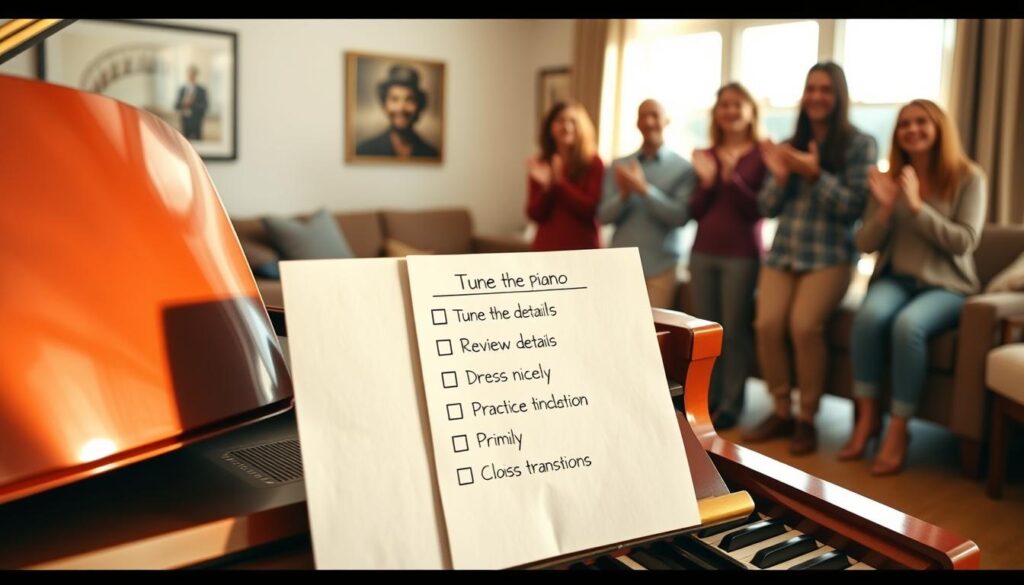
First, set up your space. Dim the lights for a cozy feel. Make sure your seat is comfy and you can see your family easily.
Keep a glass of water nearby. It’s not just for drinking. It’s a way to say, “I’m ready.” Choose a song you know well. Pick one that feels like second nature.
The Mindset: Reframing the Moment
Nerves are just excitement in disguise. Your body can’t tell the difference between fear and excitement. So, let’s turn this energy into music.
Remember, you’re sharing a gift, not being judged. Your family wants to celebrate your effort, not criticize your playing. Don’t worry about making mistakes.
The Performance Checklist
- Song Selection: Your “go-to” piece. The one you’ve played so many times it feels like muscle memory.
- Environment Check: Comfortable seat, pleasant lighting, no distracting background noise (sorry, dishwasher).
- Mental Prep: Take three deep breaths before you start. This isn’t yoga; it’s a neurological reset.
- The Opening Line: A simple, “I’d like to play something for you” works perfectly. No apologies, no disclaimers.
- During Play: If you stumble, keep going. A missed note is less noticeable than a complete halt. Your audience likely won’t even register it.
- The Finish: Hold the final position for a second. Let the sound settle. Then smile. This is the punctuation mark.
This checklist isn’t about being perfect. It’s about creating a positive experience. You’re focusing on enjoying the moment, not just playing.
For birthdays or casual gatherings, this approach makes playing for your family easy. You’re sharing music, not performing for applause. It’s a big difference.
The last thing on your checklist? Enjoying yourself. That’s what your family really wants to hear.
Printable Practice Logs for Each Song
Let’s face it, saying “I practiced for hours” is like saying “the dog ate my homework.” It’s vague and unverifiable. Your brain might think playing for twenty minutes is enough, but it’s not.
The printable practice log changes the game. It’s not about making work. It’s about using science to improve your skills. Think of it as a personal experiment where you’re both the scientist and the subject.
Each beginner song gets its own log. Why? Because songs like “Twinkle, Twinkle” and “Ode to Joy” have different challenges. Tracking them separately gives you precise data.
So, what’s in this magical document? It’s a simple grid that helps you move from vague plans to specific actions. Here’s what you’ll track:
- Date & Duration: The when and how long. No more guessing.
- Target Tempo vs. Achieved Tempo: Did you aim for 60 BPM but only hit 50? The log doesn’t let you forget.
- Micro-Sections Focused On: Instead of “worked on the song,” you write “measures 5-8, right-hand transition.” Specificity is power.
- Dynamics Practiced: Did you remember to play piano (soft) in section B? Check the box.
- Stumbling Points Noted: That tricky fingering in measure 12? You log it today so you can conquer it tomorrow.
This turns your practice into an objective record. You can’t argue with a dated entry showing you’ve improved a section’s tempo by 15 BPM over two weeks. That’s concrete evidence, not a feeling.
Here’s a sample log for “Mary Had a Little Lamb”:
| Date | Focus Area | Tempo (BPM) | Success Metric | Next Session Goal |
|---|---|---|---|---|
| 10/26 | Measures 1-4, even rhythm | 60 → 65 | Played 5x without pause | Add dynamics (mp to mf) |
| 10/27 | Measures 5-8, hand position | 65 → 70 | Smooth transition achieved | Connect measures 1-8 seamlessly |
| 10/28 | Full song, dynamics | 70 steady | Played p and f as marked | Increase to 75 BPM with control |
See the story that table tells? It’s a narrative of progress, written in the undeniable ink of data. The stumbling points column becomes your personal troubleshooting guide. The tempo column is your speedometer. The dynamics checkmarks are your expressiveness audit.
The biggest benefit? Motivation. When you hit a plateau—and you will—you can flip back through your practice logs and see undeniable proof of how far you’ve come. That week where you struggled to play “Jingle Bells” at any speed? Here’s the log showing you now nail it at 80 BPM. That’s better than any pep talk.
These printable practice logs turn the abstract art of “getting better” into a measurable science project. You’re not just practicing; you’re conducting research on your own capabilities. You’re collecting data, analyzing results, and formulating your next hypothesis (tomorrow’s practice goal).
Download them, print them, and stick them on your music stand. Let the blank boxes guilt you into specificity. Let the filled boxes reward you with evidence. This is how you move from saying “I think I’m improving” to knowing it with statistical certainty.
Extend: Transpose Each Melody Starting on G/F
Playing a melody starting on G instead of C is like hearing your favorite quote in another language. The meaning stays the same, but the sound changes. You’ve learned these tunes well in their home keys. Now, let’s explore new places for them.
Transposition isn’t about learning new notes. It’s about seeing old patterns in new spots. It’s like musical geography. You’re not learning a new city; you’re finding your hometown’s twin across the river.
Why G and F? They’re close to C. Your hand position barely changes. The finger relationships you’ve learned stay the same. You’re just moving the whole thing two keys left (to F) or five keys right (to G).
Let’s do a mental exercise. Take “Mary Had a Little Lamb.” It starts on E. To transpose to G, find G and play the same pattern: whole step up, whole step down. The intervals guide you, not the letter names.
This shows you understand music, not just piano keys. You’re thinking in relationships, not locations. It’s like knowing your friend’s address versus knowing how to get to their house from anywhere.
Now, have fun. Once you’ve shifted a melody, play around and see what sounds good. Improvisation is the next step. Try improvising with 3 or 4 notes in one hand over a simple bass loop in your new key.
Stuck? Use this table as your transposition cheat sheet:
| Original Melody (Key of C) | Transpose to G | Transpose to F |
|---|---|---|
| Starts on C | Start on G | Start on F |
| Pattern: C-D-E-D-C | Pattern: G-A-B-A-G | Pattern: F-G-A-G-F |
| Fingers: 1-2-3-2-1 | Fingers: 1-2-3-2-1 | Fingers: 1-2-3-2-1 |
See the pattern? The finger numbers don’t change. The spatial relationships between keys don’t change. Only the starting point shifts. This is pattern recognition at its finest.
This exercise makes you more than a piano-key-pusher. You’re no longer tied to one spot on the keyboard. You can rebuild melodies in different places.
So go ahead. Give each of your five mastered melodies a new home. Start on G. Start on F. Notice how the mood changes with the key. Then, as recommended, experiment. Add a drone note. Loop a section. Discover what happens when you treat these patterns as movable furniture.
What to Learn Next (Two-Hand Versions)
Your journey with one hand was just the beginning. It’s like the training montage in every underdog story. You’ve mastered playing with one hand. Now, it’s time to add the second hand.
Introducing your left hand is not starting over. It’s like adding a new team member to your already skilled unit. At first, it might feel strange. Your brain might worry about handling too much. But this is normal.
Begin with something very simple. Try playing “Let It Be.” Your right hand should play the melody. Then, add a C major chord in the left hand on the first beat of each measure. Just one note per bar. The aim is not to be complex. It’s to create a solid rhythm.
For the “Clocks” riff, use a root-fifth-octave pattern in the left hand. Play it slowly. Your right-hand part should be automatic, like muscle memory. This step is key to developing hand independence.
Start with simple C major scales for two-hand practice. This helps build coordination. Your one-hand practice has given you the finger control needed for this step.
Seeing two-hand playing as the next chapter, not a challenge, is important. Your left hand is now part of the team.
Keep the right-hand melody steady. Add the left hand slowly and deliberately. Use a metronome to help. Celebrate each small success. Your piano practice journey is expanding, with a fuller sound.