Let’s debunk a common piano myth. You’ve likely heard about the hand independence goal. It sounds like each hand is its own nation.
But here’s the truth. Your brain can’t handle two separate tasks at once. Try patting your head and rubbing your stomach. It’s not about being independent. It’s about working together.
Imagine it like a single, complex conversation. One voice leads, the other supports. We’re not chasing every note. We’re learning the patterns of dialogue.
Most beginners panic. They see the keyboard as a battlefield, each hand fighting. The secret is timed movement and groove, not strength.
Forget the frantic movements. Start noticing the rhythmic and harmonic patterns. This shift from chaos to pattern recognition is your first step to musical conversation.
The Coordination Myth: Think Patterns, Not Every Note
Learning piano isn’t about becoming an octopus. It’s about recognizing that your hands are telling the same story in different dialects. That mental buffering you feel? That’s cognitive overload, not lack of talent.
Here’s the myth: you must control every note in both hands simultaneously. It’s like trying to watch two different Netflix shows at once while reading the subtitles. Your brain simply wasn’t built for that level of multitasking.
The analytical fix is radical yet simple. Stop seeing individual notes. Start seeing patterns, shapes, and predictable relationships. Your left hand isn’t playing C, E, G—it’s outlining a C Major chord in a specific rhythmic costume. Your right hand isn’t chasing melody notes—it’s tracing a contour that rises and falls like a conversation.
This is why pop and jazz pianists seem like coordination wizards. They’ve internalized a handful of accompaniment patterns. Block chords, broken figures, walking bass lines—these become automatic. The right hand gets freedom to be expressive, to improvise, to tell the story.
What we call “groove coordination” is fundamentally different from classical technique. It’s less about precision and more about flow. The goal isn’t perfect execution of every notation. It’s creating a cohesive musical experience where both hands serve the same groove.
When you practice hands together, you’re not merging two infinite to-do lists. You’re synchronizing two predictable, repeating forms. You only need to coordinate a few key alignment points—the downbeats, the chord changes. The rest fills in the predictable gaps.
| Mental Approach | What You See | Cognitive Load | Musical Result |
|---|---|---|---|
| Note-by-Note Thinking | Individual dots on two staves | Extreme (like reading two novels) | Stiff, uneven, hesitant playing |
| Pattern-Based Thinking | Shapes, contours, repeating forms | Manageable (like following a conversation) | Fluid, rhythmic, confident performance |
| Classical Precision Focus | Exact notation and dynamics | High attention to detail | Technically accurate but potentially rigid |
| Groove Coordination Focus | Rhythmic feel and harmonic flow | Attention to timing and interaction | Musically engaging with natural flow |
Think of it like driving a car. You don’t consciously think “left foot clutch, right foot gas, hand shift, other hand steer.” You think “I’m driving to the store.” The individual actions become part of a larger pattern.
Your two-hand coordination breakthrough happens when you make this cognitive shift. The left hand learns a few reliable patterns. The right hand learns to dance around them. Suddenly, what felt impossible becomes… well, not easy, but comprehensible.
The data from music pedagogy is clear. Most coordination issues—timing drift, uneven tone, that feeling of panic—are solved by better cues and calmer tempo. Not by trying harder. Not by practicing longer. By thinking differently.
So next time you look at a score with two staves, don’t see a mountain to climb. See a conversation to join. Your hands aren’t independent actors needing micromanagement. They’re partners in a dance, and you just need to learn the basic steps.
Hand Roles: Melody vs Simple Accompaniment
Think of your hands as a talk show host and their producer. The host grabs the spotlight, while the producer keeps things running smoothly. This is the first step to mastering two-hand coordination.
In most music, the hands have specific jobs. The right hand is the Melody, the main attraction. The left hand is the Accompaniment, providing rhythm and harmony. It supports the melody, not taking the lead.
Why is this important? Trying to make both hands equal is like chaos. Good coordination drills focus on these roles. They help your brain learn to prioritize.
The melody hand is active and expressive. It tells the story. The accompaniment hand is steady and harmonically rich. It sets the stage.
| Role | Primary Function | Initial Practice Focus |
|---|---|---|
| Melody Hand (Usually RH) | Carry the tune; provide phrasing and expression | Clear articulation, independent finger movement, dynamic control |
| Accompaniment Hand (Usually LH) | Establish harmony and rhythm; support without intrusion | Steady pulse, consistent tone, harmonic accuracy |
| Mental Focus During Play | Listening to the line’s shape and emotional intent | Maintaining a metronomic, foundational presence |
| Common Beginner Mistake | Becoming rhythmically erratic to “follow” the LH | Playing too loud or busy, competing with the melody |
See the difference? It’s not about who’s more important. It’s about what each hand does. The accompaniment hand is like a steady breath. The melody hand is the talker.
Begin with simple roles. Have your left hand play a single note for four beats. Your right hand plays a scale slowly. Just focus on keeping the left hand steady while the right hand moves.
This exercise is about managing your attention. The left hand’s job is so simple it becomes automatic. This frees you to focus on the melody.
Another key coordination drill is for the left hand to play a two-note pattern every measure. The right hand plays a familiar tune. The left hand isn’t “playing music” in the traditional sense. It’s like a stage manager.
The main mistake is letting the accompaniment hand get too loud. It’s like a stagehand taking the spotlight. Train your left hand to play softly and consistently. Let the right hand be the star.
This approach makes two-hand coordination easier. You’re not trying to coordinate two complex parts. You’re coordinating one active part with one simple, repetitive foundation. The complexity is layered, not doubled.
Think of it like driving. One hand (the melody) steers and adjusts speed. The other (accompaniment) provides stability. Both are on the wheel, but only one makes constant adjustments.
Master this division of labor first. More complex patterns come later. For now, focus on simplicity. Let one hand sing and the other breathe. Your musical conversation depends on it.
Starter Patterns: Whole‑Note LH + RH Melody
Learning piano starts with a simple trick: do nothing with your left hand while your right hand sings a tune. It’s not laziness; it’s smart simplicity. You’re laying the groundwork for more complex skills.
Here’s how it works: your left hand holds a chord on beat one. Your right hand sings a melody on the next beats. Think of it like C major for the left, and C, D, E, F, G for the right.
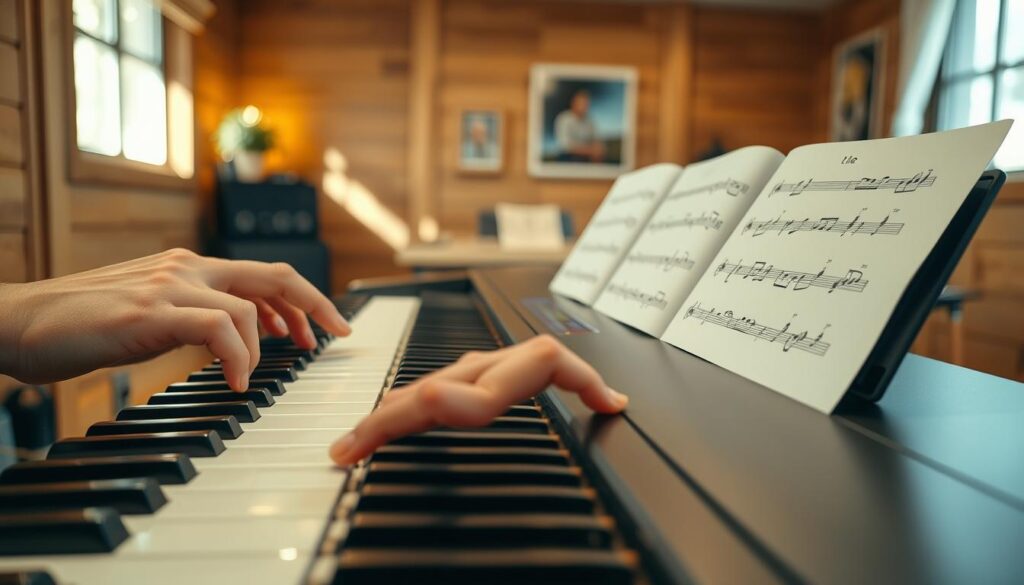
Your main goal is to make those attacks perfect. Not just close, but exactly in sync. This shows that two-hand coordination is all about timing, not just speed.
When you get this right, you’ve built a strong foundation. Then, we add movement. The left hand starts to play flowing patterns.
Different patterns help you grow. Here’s a table showing the basics:
| Pattern Type | Left Hand Role | Right Hand Role | Coordination Focus | Progression Step |
|---|---|---|---|---|
| Static Foundation | Whole-note chord (holds 4 beats) | Single-note melody (one note per beat) | Attack alignment on beat 1 | Absolute beginner |
| Simple Bass Shift | Changes bass note every 2 bars (e.g., C to G) | Repeating 2-bar melodic phrase | Timing the LH change with RH phrase end | Early beginner |
| Anchor & Embellish | Half-note chords (changes every 2 beats) | Melody with occasional harmony note | Synchronizing two attack points per bar | Building two-hand coordination |
| Pulse Keeper | Quarter-note single bass notes | Lyrical, longer melody notes | LH provides pulse while RH sings | Pre-broken chords |
This simple start has a big purpose. It lets you focus on timing. You’re not worried about what to play with your left hand. You’re learning when to play it with your right.
Next, you’ll move to broken chords. The left hand plays a flowing chord sequence. This adds harmony without making it too hard. It’s the next step.
Getting better here isn’t about being fast. It’s about being steady and calm. As one resource says, there are 7 ways to improve hands-together, and starting simple is key.
Think of this as learning the alphabet. You wouldn’t write poetry before learning the letters. This pattern is your A, B, C. Play it until it feels natural.
Broken Chords and Alberti Bass (Slow First)
Let’s make your left hand more like a concert pianist. We’re moving from solid notes to broken chords. This is a party trick.
A block chord is like a skyscraper. A broken chord is like a flowing river. It’s the engine in Mozart’s sonatas and the hypnotic ripple in Coldplay’s “Clocks.” This is where two-hand coordination becomes musical, not just mechanical.
The Alberti bass is a famous broken chord pattern. It’s low note, high note, middle note, high note (like C, G, E, G). This pattern creates a rolling texture that supports the melody.
Your mission is to make this pattern automatic. Start slow first. Your goal is to program a flawless motor loop in your left hand.
This slow practice builds steadiness and rhythmic consistency. It turns the Alberti bass into a heartbeat. It should be so reliable, you can talk while playing it.
Only when your left hand is smooth do you add the right-hand melody. This is the true test of two-hand coordination. Can your left hand keep its steady pattern while your right hand sings a melody? It’s like patting your head and rubbing your stomach—but with feeling.
Master this, and you’ve unlocked the core accompaniment pattern for centuries of music. The left hand becomes a trusted engine, freeing your right hand to truly sing.
Count Aloud + Tap Left Knee Method
Counting out loud at the piano isn’t childish. It’s a smart way to use your voice as a metronome. When your two-hand coordination gets tough, your voice helps your fingers stay in sync.
Saying “one, two, three, four” out loud helps your brain stick to the rhythm. It makes the beat clear. Your voice is like a steady rule in the chaos of finger movements. It’s not silly; it’s science in disguise.
The Tap Left Knee Method is a clever trick. It might look silly, but it works well.
First, walk away from the piano. Sit down somewhere without keys. Tap your right knee on every beat with your right hand. This is your melody.
Your left hand taps your left knee on beats 1 and 3. This is your accompaniment. Count out loud to keep everything in sync.
This method focuses on timing. It removes distractions like pitch and keyboard layout. You’re left with the core of hands together timing.
Isolating the rhythm helps solve the timing puzzle. When tapping becomes easy, you’ve built a strong neural pathway. This coordination is now in your body’s memory.
Going back to the piano is easier. Your hands already know the rhythm. They just need to play it on the keys.
Think of it like learning a dance without music first. Then, add the song. Or rehearse a play without costumes. You master the timing in a simple setting. The piano’s complexity builds on this foundation.
This method shows that most hands together problems aren’t about skill. They’re about too much to think about. The Tap Left Knee Method simplifies the problem. It lets your brain focus on timing.
When you go back to the keyboard, your counting is clear. Your hands move together on purpose. You’re not hoping for sync; you’re directing it with your voice.
This is how you build reliable two-hand coordination. It’s not about endless repetition at the piano. It’s about focused rhythm work away from it. The piano is where you apply this skill. Panic fades, and the rhythm stays.
Hands‑Together in 4 Steps (Speak, Shadow, Slow, Flow)
Trying to play with both hands on a new piece can feel like a diplomatic challenge. Each hand wants to do its own thing, making it hard to coordinate. But with coordination drills, you can turn chaos into harmony.
Don’t just try it and see. That method is messy and often disappointing. Instead, follow a structured four-step method to build two-hand coordination step by step.
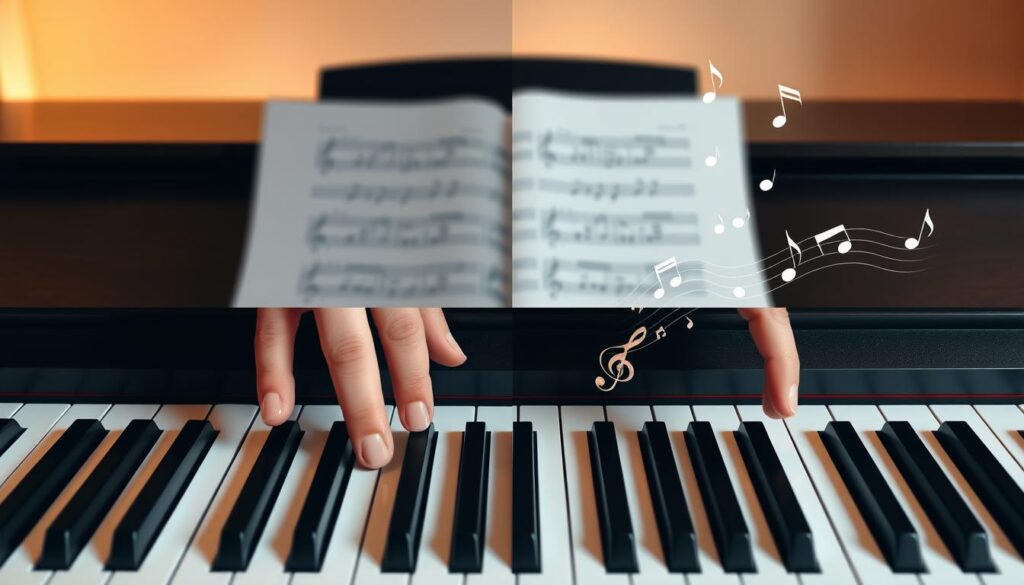
Step 1: Speak. First, your brain needs a plan. Read the score out loud and explain who does what. This step is like getting clear directions before starting a project.
It’s like reading the instructions before you start building. This clarity helps a lot.
Step 2: Shadow. Instead of playing each hand separately, have one hand play while the other shadows. This helps you feel the movement without making sound.
Shadow practice is like a rehearsal for your fingers. It helps them learn their parts before performing together.
Step 3: Slow. Now, play both hands very slowly. This step is all about getting it right, not about speed. If you make a mistake, slow down more.
This slow practice is like weightlifting for your hands. It builds the strength and connection needed for speed later.
Step 4: Flow. After mastering the slow step, you can start playing faster. Increase the tempo a little at a time. Keep the accuracy of the slow practice.
This gradual increase teaches your hands to work together even when it gets harder. The drills become a scientific process, not a test of patience.
This four-step method makes learning to play with both hands less stressful. Each step has a clear goal and outcome. You’re not just practicing; you’re following a precise plan. Your hands learn to work together, creating music through teamwork.
Etudes: 3 Progressive Two‑Hand Mini Pieces
Practicing coordination without music is like learning grammar without writing. Theory and drills are important, but they need to lead to something beautiful. Without that, it’s just building an engine you’ll never hear.
Progressive repertoire is key. These three mini-etudes are your path from abstract to music. Each introduces a new skill to your two-hand coordination. They’re not grand, but they’re music. And that’s what keeps you practicing.
Etude 1: The Foundation of Alignment. Your left hand plays whole-note chords, while your right plays a simple scale. The goal is perfect alignment. It’s like walking straight, teaching your hands to work together.
Etude 2: Introducing a Moving Baseline. Now, the left hand moves with quarter-note broken chords. The right hand keeps its melody. You’re learning to manage a flowing bassline with a steady melody.
This etude helps you move from block chords to arpeggiated figures. Mastering broken chords opens up many accompaniment styles.
Etude 3: Steady Pulse Meets Syncopation. The left hand plays an Alberti bass pattern. The right hand’s melody becomes more adventurous. You’re learning to handle syncopation against a steady pulse.
Your left hand is the steady beat. Your right hand dances around it. This builds the complex coordination needed for real music.
The beauty of this progression is isolating each skill. You tackle one problem at a time. You start with alignment, then managing a moving bass, and end with coordinating rhythmically independent lines.
Using your skills to create music is the goal. It turns practice into a creative journey. These mini pieces bridge the gap from practice to performance, where two-hand coordination becomes your voice.
Common Pitfalls (LH Volume, RH Rush) and Fixes
Learning to play piano smoothly can hit roadblocks. Like when your accompaniment hand feels too big. You’re making progress, then bam – you hit a wall that feels personal.
Let’s look at the usual problems. These aren’t because you’re not talented. They’re because of two-hand coordination issues.
Your hands have different goals. The left wants to be loud. The right wants to be fast. This creates chaos. Here’s how to spot and fix the four most common coordination saboteurs.
| Pitfall | The Symptom | The Surgical Fix |
|---|---|---|
| The Volume Rebellion | Your left hand accompaniment starts banging like it’s auditioning for a metal band. It drowns the melody in a tidal wave of misplaced enthusiasm. | Consciously play LH at a whisper. Imagine it’s providing ambiance, not argument. Practice scales where LH is 50% quieter than RH. Your accompaniment should be felt, not heard. |
| The Right Hand Rush | Your melody line accelerates like it’s late for an appointment. Your steady alberti bass gets left in the dust, creating rhythmic schizophrenia. | Anchor your RH to your counting voice. Make the melody wait for the beat. Use a metronome set painfully slow. The right hand must learn patience, not panic. |
| The Pedal Crutch | You smear the sustain pedal to hide coordination gaps. It creates a beautiful, blurry lie – the musical equivalent of Instagram filters on bad technique. | Remove the pedal entirely. Practice until hands coordinate cleanly without it. The pedal is for color, not camouflage. Reintroduce it only when you can play flawlessly dry. |
| Practice-Induced Tension | Your shoulders migrate toward your ears. Your forearms tighten like suspension cables. You’re not playing piano; you’re conducting stress through your fingertips. | Stop. Breathe. Reset your posture every 5 minutes. Tension is your brain’s way of saying the task is currently too hard. Slow down by 50%. Coordination requires relaxation, not force. |
The left hand volume issue is tricky. It comes from a wrong idea about who’s in charge. Your LH isn’t the star. It’s the supporting actor who keeps stealing scenes.
Try this mental shift: your left hand is the rhythm section. Your right is the lead vocalist. Would you turn the drummer’s volume higher than the singer’s?
For the right hand rush, the fix is counterintuitive. You don’t need to play faster with your left. You need to play slower with your right. Your alberti bass pattern sets the tempo universe. The melody exists within it, not alongside it.
The pedal problem is a classic beginner’s trap. We use sustain like audio Photoshop – blurring the edges of messy technique. But clean two-hand coordination requires transparency. Take the training wheels off.
Lastly, physical tension is the silent killer of progress. Your body tightens when your brain struggles. It’s a biological response, not a moral failing.
Every 10 minutes of practice, perform a posture audit. Are your shoulders relaxed? Is your back straight? Are you breathing? This isn’t yoga. It’s practical neuroscience for better playing.
These fixes aren’t punishments. They’re recalibrations. Your hands aren’t enemies. They’re partners who occasionally need marriage counseling.
Weekly Schedule: 10‑10‑10 Pattern Plan
Ever tried to ‘just practice more’ but saw no progress? Welcome to the 10-10-10 pattern. It’s a smart way to improve skills, backed by science. Say goodbye to long practice sessions that confuse your brain and hands.
This method is based on a simple truth. Being consistent is better than trying hard but sporadically. It’s like precision beats brute force.
So, what’s the magic formula? Spend 30 minutes each day on three focused tasks. It’s not just random playing. It’s about making your brain and hands work better together.
Phase 1: The 10-Minute Programming Session. Start with your hands apart. Play your current piece very slow. This step is about building muscle memory, not music.
Phase 2: The 10-Minute Neural Pathway. Now, play with your hands together slowly. Focus on being accurate, not fast. This builds a strong connection between your brain’s sides.
Phase 3: The 10-Minute Contextualization. Use the pattern in your music. This step connects the practice to real music. It gives your skill a purpose.
This method works because it attacks learning from different angles. It improves your hands working together and applying skills to music.
It also fits how our brains work best. We can’t focus for hours on one thing. The 10-10-10 pattern is like spaced repetition in one session.
Think of it as daily mental updates. You’re not just playing piano. You’re upgrading your brain to handle more.
This method is great because it’s like how we learn basic skills as kids. It’s effective for bilateral coordination activities.
Using this method needs discipline. Set timers for each part. This helps you stay focused and avoid getting stuck on one thing.
It’s easy to see your progress. Each day, you complete three tasks. No more wondering if you practiced enough. You have a clear plan.
This method is perfect for those who love data. It’s about improving skills in a scientific way. You’re not just hoping to get better. You’re making it happen through daily practice.
Mastering two-hand coordination isn’t about talent or endless hours. It’s about using a smart, consistent method. The 10-10-10 pattern is that method. It’s like having a clear path to follow, not just wandering.
Ready Signals: When to Add Pedal
The sustain pedal is like the piano’s auto-tune. It can make sounds beautiful or hide mistakes. Knowing when to use it shows if you’re a skilled player or just pretending.
First, check if your hands can play cleanly. Can you play without the pedal and sound clear and steady? If not, you’re not ready yet. Using the pedal to fix bad playing is like hiding behind words instead of actions. It might seem to work, but it’s not solid.
Being able to play with both hands well is key. The pedal should make your music better, not just fill in gaps. Listen to great pianists like Vladimir Horowitz or Martha Argerich. Their use of the pedal adds to the music, not takes over.
When your hands work well together, you can choose when to use the pedal. It’s about adding depth to your music, not covering up mistakes. Use it to connect different parts of your playing, not to hide bad timing.
Start with a light touch on the pedal. Try using it for a bit, then go back to playing cleanly. Does it make your music better, or does it mess it up? If it’s the latter, you need to practice more. The pedal is a reward for mastering playing with both hands.