One of the biggest challenges for new piano players is learning how to coordinate both hands at the same time. While each hand may feel comfortable playing simple notes individually, combining them can suddenly make even easy melodies feel difficult.
This challenge is completely normal. Piano playing requires the brain to process multiple rhythmic and physical finger movements simultaneously, something that improves gradually with consistent practice.
Fortunately, a few focused exercises can help beginners build hand coordination step by step. These exercises strengthen independence between the hands while developing rhythm, timing, and finger control.
Why Hand Coordination Is Difficult For Beginners
When beginners start playing piano, the brain is still learning how to manage two different hand movements simultaneously. Unlike instruments that focus on a single melody line, piano often requires one hand to play rhythm while the other plays melody.

At first, the hands may instinctively try to move together rather than independently. This happens because the brain naturally mirrors movement between both sides of the body.
With repeated practice, however, the brain gradually learns to separate these movements. According to Harvard Medical School’s research on motor learning and coordination, repeated skill training strengthens neural pathways responsible for complex movement patterns.
In piano playing, this means coordination improves as exercises train the hands to perform different tasks simultaneously.
Exercise 1: Mirror Motion Practice
The simplest coordination exercise begins with both hands playing the same movement pattern.
Place both thumbs on Middle C. Then play the same sequence outward:
| Left Hand | Right Hand |
|---|---|
| C – D – E – F – G | C – D – E – F – G |
Because both hands move in the same direction, the brain quickly understands the motion.
After reaching the fifth note, return to the starting position by reversing the pattern.
| Left Hand | Right Hand |
|---|---|
| G – F – E – D – C | G – F – E – D – C |
This exercise builds familiarity with coordinated movement before introducing more complex patterns.
Exercise 2: Alternating Hand Patterns
Once mirror motion feels comfortable, the next step is learning to alternate between hands.
Play a simple sequence where each hand takes turns:
| Step | Notes |
|---|---|
| 1 | Right Hand: C |
| 2 | Left Hand: C |
| 3 | Right Hand: D |
| 4 | Left Hand: D |
| 5 | Right Hand: E |
| 6 | Left Hand: E |
This pattern forces the brain to switch attention between hands, improving coordination and timing.
Keep the tempo slow and focus on playing each note evenly.
Exercise 3: Simple Melody With Left Hand Support
A common beginner pattern involves the right hand playing melody while the left hand supports with single bass notes.
Try the following pattern:
| Left Hand | Right Hand |
|---|---|
| C | C – D – E |
| G | D – E – F |
| C | E – F – G |
The left hand plays a steady foundation while the right hand moves through a short melody.
This exercise begins teaching the melody-and-accompaniment relationship that appears in most piano music.
Exercise 4: Rhythm Independence Practice
Coordination improves significantly when both hands follow different rhythms.
Start with a simple pattern:
| Left Hand | Right Hand |
|---|---|
| C (hold for 4 beats) | C – D – E – F |
The left hand holds one note while the right hand plays four shorter notes.
Although this looks simple, it trains the brain to maintain separate rhythmic patterns simultaneously.
Practicing slowly helps prevent mistakes and reinforces accurate timing.
Exercise 5: Five-Finger Scale Coordination
The five-finger scale is one of the most useful coordination exercises for beginners.
Place both hands in a five-note position:
| Finger | Note |
|---|---|
| Thumb | C |
| Index | D |
| Middle | E |
| Ring | F |
| Pinky | G |
Play the scale upward with both hands together, then downward.
This exercise strengthens finger independence and improves evenness between hands.
If you’re still developing comfort with keyboard resistance, our guide on weighted vs semi weighted keys explains how different key actions can affect technique and control.
Practicing Coordination Without Frustration
Learning hand coordination requires patience. Beginners often try to play too quickly before the movements feel natural.
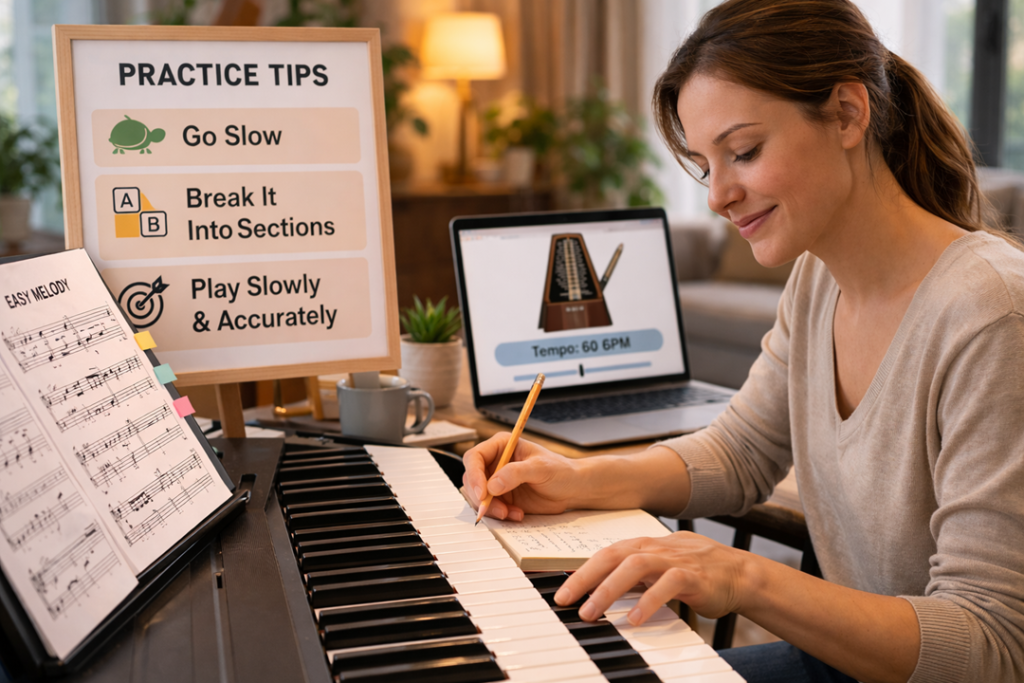
A more effective approach is to practice very slowly at first, allowing the brain time to process each movement.
Breaking exercises into small segments can also make coordination easier to develop. Once each section feels comfortable, gradually connect them together.
The goal is not speed but accuracy and consistency.
Building Long-Term Hand Independence
Hand coordination is not something that develops overnight. Even advanced pianists continue refining independence between both hands throughout their musical development.
The key is steady, focused practice with exercises that gradually increase in complexity.
By practicing coordination regularly, beginners strengthen the skills required for:
- Playing melody and accompaniment simultaneously
- Maintaining steady rhythm
- Controlling dynamics between hands
Over time, movements that once felt difficult become automatic.
With patience and consistent practice, hand coordination transforms from one of the biggest beginner challenges into one of the most rewarding aspects of piano playing.