Ever wonder why some music makes you tap your foot while other sounds just feel like noise? That’s the magic of rhythm – the architectural blueprint of organized sound.
Think of rhythm as music’s heartbeat. It’s the metronomic pulse that separates art from accident. In my own journey, I’ve found that understanding these patterns is like learning the grammar of a language.
Without it, you’re just randomly stringing notes together. We’re talking about the temporal framework that supports melodies and harmonies – the same way a stand-up comedian times their punchlines.
This isn’t just about counting beats. It’s about creating feeling and movement through precise timing. From viral TikTok dances to political debate moderation, rhythm is everywhere.
Let’s explore how these fundamental patterns give music its life and why they matter more than you might think.
Simple Rhythm Patterns Explained
Ever wonder why some piano players sound like they’re having a conversation while others sound like they’re reading a tax code? The secret lies in mastering basic rhythm patterns. It’s the difference between a flowing river and a dripping faucet.
Let’s start with the building blocks. Quarter notes are the workhorses of rhythm – they’re the steady pulse that keeps everything moving. Think of them as the metronome’s heartbeat. Each one gets one full beat in 4/4 time.
Half notes are where things get interesting. They’re the leisurely stroll after the quarter note’s brisk walk. These notes hold for two beats, creating space and breathing room in your music. They’re the musical equivalent of a well-timed pause in a great speech.
Then we have whole notes – the grand pause that makes everything else make sense. These four-beat wonders teach you about musical patience. They’re why “Mary Had a Little Lamb” works so well for beginners.
Here’s the reality check: most beginners treat rhythm patterns like IKEA instructions – they glance at them once and hope for the best. Big mistake. Rhythm is the foundation everything else builds upon.
| Note Type | Beat Value | Sound Analogy | Common Use |
|---|---|---|---|
| Quarter Note | 1 beat | Walking pace | Basic melodies |
| Half Note | 2 beats | Jogging rhythm | Song choruses |
| Whole Note | 4 beats | Deep breath | Song endings |
My personal breakthrough came when I stopped counting and started feeling. Rhythm patterns aren’t math problems – they’re cooking recipes. Follow the steps, use quality ingredients, and you get something delicious.
The 4/4 time signature is your best friend here. It’s the common time that makes sense to our Western ears. Four beats per measure – simple, predictable, and incredibly powerful when mastered.
Think of basic rhythm patterns as Morse code for musicians. Short taps, long holds, and strategic silences create meaning. It’s not just about hitting the right notes – it’s about hitting them at the right time.
Why do so many smart people struggle with simple rhythms? They treat it as an afterthought. But here’s the truth: rhythm separates the amateurs from the artists. It’s what makes music breathe, not just exist.
Interactive Counting Techniques
Counting beats can seem as dull as watching C-SPAN. But, mastering rhythm through counting can be more fun than your favorite podcast.
In my early piano lessons, my counting was like a broken auctioneer. The metronome ticked, and I stumbled. But then, I found interactive counting techniques that made practice exciting.

The vocalization method changed everything. I started saying “one-and-two-and” out loud. This helped my brain and fingers connect better. It’s like solving a problem with your own rhythm.
These techniques are effective for several reasons:
- Multi-sensory engagement combines hearing, speaking, and physical movement
- Creates muscle memory through repetitive patterning
- Builds internal metronome precision
- Transforms abstract rhythm concepts into tangible actions
Moving your body helps you learn better. Tap your foot or nod your head. This makes rhythm feel real, not just in your head.
Advanced piano lessons use counting games that feel like puzzles. Try counting backward or accenting different beats. It’s like solving a rhythmic sudoku while playing music.
These techniques are special because they’re calming yet practical. They help you focus and improve your skills at the same time. Your counting becomes a rhythmic meditation.
Good rhythm isn’t about being perfect. It’s about being consistent and quick to recover. When you miss a beat, get back on track fast. These methods make you resilient through fun, repeatable practice.
Your rhythm journey will change from counting to playing music smoothly. These techniques become second nature. Then, you can focus on expressing yourself, not just counting.
Practice with Metronome
Starting rhythm with a metronome is like learning to drive with a strict instructor. At first, it feels restrictive. But, it teaches you freedom through discipline.
I hated my metronome for years. The relentless click felt like musical waterboarding. But, then my playing improved dramatically. My timing became as precise as a Swiss watch.
Metronomes create tempo consistency like nothing else. They’re the unsung heroes of musical development. That steady pulse becomes your internal clock.
Think of late-night hosts like Stephen Colbert. His timing is flawless. That’s what a metronome teaches you. It’s the difference between amateur and professional rhythm.
Modern apps like flowkey build metronomes into their systems. You get instant feedback on your timing. It’s like having a teacher watching over your shoulder.
Here’s how to make peace with your metronome:
- Start painfully slow—half your desired tempo
- Focus on landing notes exactly with the click
- Increase speed gradually only when perfect
- Use different rhythmic subdivisions (eighth notes, triplets)
The metronome exposes weaknesses you didn’t know existed. It highlights shaky rhythms and rushed notes. This is why starting rhythm with proper tools matters.
Different metronomes serve different purposes. Here’s how they compare:
| Type | Best For | Limitations | Price Range |
|---|---|---|---|
| Traditional Mechanical | Developing internal pulse | Limited tempo range | $20-50 |
| Digital Standalone | Precision and features | Requires batteries | $15-100 |
| App-Based | Convenience and integration | Phone distractions | Free-$10 |
| Smart Metronomes | Advanced rhythm training | Higher cost | $50-200 |
The mechanical metronome has a certain charm. That pendulum swing connects you to centuries of musicians. But apps offer incredible flexibility for starting rhythm practice.
Pop music demonstrates metronome perfection. Listen to any Billboard hit—the beat never wavers. That’s metronome discipline applied to art. It feels organic but is mathematically precise.
Your relationship with the metronome will evolve. From resistance to tolerance to appreciation. Eventually, you’ll feel naked playing without one. That click becomes your musical security blanket.
Starting rhythm training properly saves years of frustration. The metronome is your truth-teller, your timing coach, your rhythmic anchor. Embrace the click.
Video Rhythm Tutorials
Remember when learning piano was like trying to read ancient texts? Now, video tutorials make rhythm learning fun and easy. It’s like having your own Netflix show, but with music.
Platforms like flowkey and BMusician have changed the game. They offer HD videos with multiple camera angles. It feels like you’re getting private lessons from a pro. You can pause and rewind to get it right, something teachers might not always do.
What makes these online piano tutorial platforms so good? They turn music into a visual experience. Watching hands move on the keys while hearing the rhythm helps you learn better than sheet music alone. It’s like the difference between reading a recipe and watching Gordon Ramsay cook.
The best part? These platforms have interactive features that give you feedback right away. It’s like having a digital coach who never gets tired of your mistakes. It’s like having a music fact-checker.
Video tutorials work because they use different ways to learn at the same time. Visual learners see the demonstration. Auditory learners hear the rhythm. Kinesthetic learners can try the movements. It’s a way to learn that works for everyone.
But, not all video tutorials are the same. The internet has many people who are not experts. Make sure to choose reputable sources to avoid learning bad habits.
We’re in a great time for learning music. The right online piano tutorial can teach you complex rhythms quickly. Just remember, the screen is a tool, not a replacement for practice. Now, I have to go practice my Chopin.
Beginner Song Examples
Let’s be honest – nobody starts piano to impress with “Mary Had a Little Lamb.” Yet, I, a grown adult, was playing nursery rhymes like a horror movie soundtrack. My early beginner piano rhythms were more like a hostage situation than music.
But, these simple tunes are actually clever rhythm exercises. They’re like learning grammar before writing novels. They lay the foundation for all music, from Beethoven to Billie Eilish.
- “Twinkle Twinkle Little Star” – A quarter note masterpiece teaching steady pulse
- “Happy Birthday” – A dotted rhythm challenge for players
- “Mary Had a Little Lamb” – An eighth note introduction that unlocks superpowers
Each song builds rhythm patterns like arguments build to conclusions. They’re simple yet complex, making you feel accomplished without overwhelming you.
Playing “Happy Birthday” with correct timing was a breakthrough. The dotted rhythm clicked, making the syncopated bounce between “happy” and “birthday” clear. It was like understanding a cultural reference I’d missed before.
These beginner songs are not childish. They’re cleverly designed to teach your hands and brain to work together. They build the neural pathways for more complex music, like the basic arguments in great speeches.
Mastering these beginner piano rhythms is more than learning songs. It’s building a rhythmic vocabulary. Each pattern becomes a tool for more advanced music, like spotting rhetorical devices in speeches.
So, embrace the nursery rhymes. Analyze them. Master them. Every virtuoso began with simple beats, recognizing the genius in simplicity.
Common Rhythm Mistakes
I’ve turned Beethoven into jazz by mistake more times than most students learn in a year. These errors are not just mistakes; they’re creative takes that make music theorists cry. But why do we keep making them?
Poor tempo consistency is like a political blunder in piano playing. You start well but rush through hard parts. Your minuet turns into a sprint, and Chopin’s beauty becomes panic.
Incorrect counting is like a social mistake in rhythm. At a musical dinner, you clap on the wrong beat. Everyone notices, but no one speaks up, leaving a tense atmosphere.
Physical tension is another issue. A tight grip on the keys makes playing stiff. Your shoulders rise, and you’re not playing piano anymore; you’re doing stress therapy.
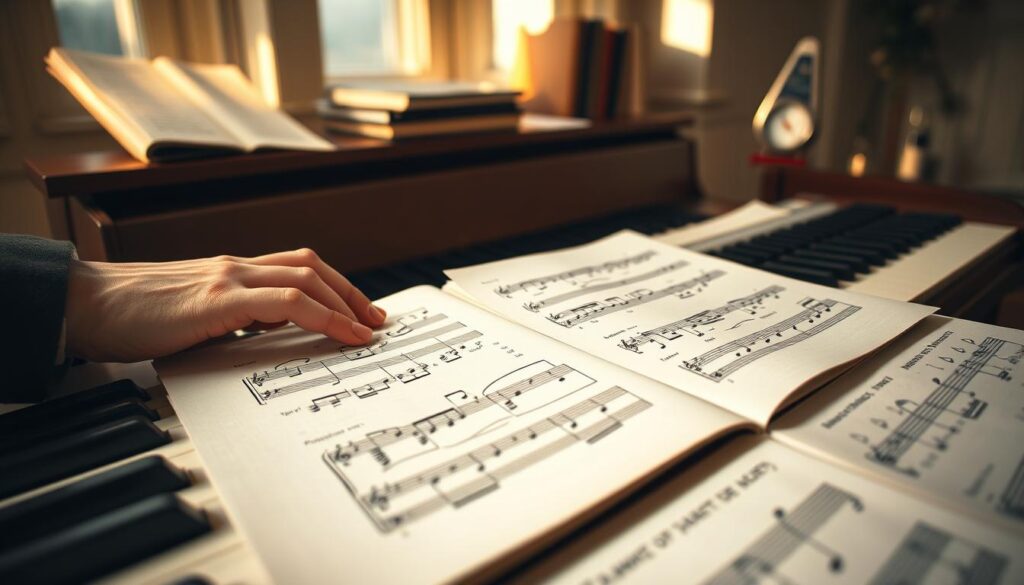
So, how do we fix these rhythm problems? First, we must admit dotted rhythms often confuse us. Learning dotted patterns is key to mastering rhythm.
For tempo issues, practice with a slow metronome. It’s like fact-checking your speeches – it’s boring but essential. For counting errors, say the beats out loud until they feel natural.
Relaxing physically is also important. Lower your shoulders, breathe between notes, and remember, no one’s judging you. Well, maybe your teacher, that competition judge, and your inner critic.
In the end, rhythm mistakes are chances to learn. Analyze them, figure out what went wrong, and avoid similar mistakes in the future. Your audience will appreciate it, and so will Beethoven’s ghost.
Rhythm Reading Resources
In today’s world, we pick our news and music with care. So, why not choose the right rhythm resources for piano lessons? The right tools can turn lessons into something as fun as your favorite podcast.
Apps are like fast food for music learning. Flowkey is like a good takeout spot in a sea of bad ones. It looks nice and actually helps with rhythm, unlike some apps that are as useful as a screen door.
Online platforms like BMusician offer structured piano lessons. They have built-in rhythm curricula, like MasterClass for music. Their lessons make sense, unlike most news algorithms.
Method books are like vinyl records for music learning. They might seem old-fashioned, but they teach rhythm well. These books are your go-to resources, unlike apps that change with updates.
Each resource type fits different learning styles. Some like quick tips, while others prefer detailed lessons. The key is finding what works best for you.
| Resource Type | Best For | Pros | Cons |
|---|---|---|---|
| Apps (Flowkey) | Visual learners & quick practice | Instant feedback, gamified learning | Subscription model, screen fatigue |
| Online Platforms (BMusician) | Structured curriculum seekers | Comprehensive lessons, progression tracking | Requires internet, less flexible |
| Method Books | Traditionalists & focused study | No tech needed, proven methods | No audio feedback, slower pace |
| Hybrid Options | Balanced approach | Best of both worlds, adaptable | Can be expensive, requires discipline |
Modern piano lessons offer a lot of choice. You’re not limited to just one book. You can mix resources like you curate your news feed.
Good resources make practice feel rewarding, not like homework. The right tools don’t just teach rhythm; they make you want to practice more.
Building Rhythm Confidence
Rhythm can seem like a mystery at first. I once struggled with beats, feeling like a politician avoiding a question. But building confidence takes time and effort.
Think of learning rhythm like mastering public speaking. Each practice session brings you closer to being an expert. Set goals and use tools like metronomes for feedback. Focus on being consistent, not perfect.
Laugh at your mistakes. I did, and soon, complex rhythms became easy. This helped me build confidence and overcome anxiety.
Now, I handle rhythms with ease. Remember, confidence is the best guide. Keep practicing, stay committed, and own every beat.