My first keyboard was a 61-key Yamaha, super light. I thought I was making music. But I was wrong.
I was just hitting plastic buttons. Then, I played an old upright piano. The feel of my touch making sound was amazing. That’s when everything changed.
That feeling of resistance and feedback is key. It’s not just a nice feature. It’s what makes a piano different from a video game controller. If you’re serious about learning, this is a must.
This guide aims to help you avoid the mistakes I made. We’ll explore why hammer action is so important.
What Are Weighted Keys?
Let’s get real. Weighted keys aren’t just a fancy feature. They’re a big apology from digital engineers. They’re trying to make digital pianos feel like real ones.
Think about the last keyboard you loved. It had a satisfying click and a bit of resistance. Now imagine that feeling is gone. That’s what it’s like without weighted keys.
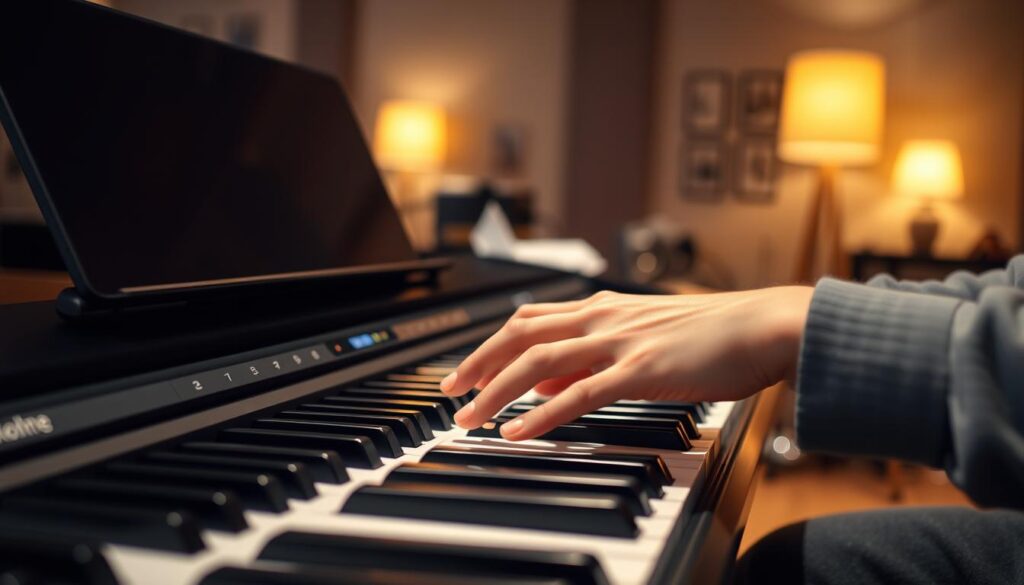
Weighted keys try to mimic the feel of a real piano. When you press a key, it’s not just a simple action. It’s like launching a tiny hammer to hit a string. This gives your fingers a real feel, unlike typing on a screen.
The hammer action is what makes this possible. It’s the clever engineering under the surface. Instead of springs, it uses weighted levers to mimic a real piano’s feel.
This matters because music is more than just notes. It’s about feeling and expression. A hammer action teaches you how to play softly or loudly. Without it, you’re just playing different volumes.
So, when you see “weighted keys” or “graded hammer action,” it’s not just about weight. It’s about feeling and connection. It’s the closest you can get to a real piano without moving it.
In short, weighted keys mix digital ease with acoustic feel. They’re the touch that lets you express your emotions.
Graded Hammer Action Explained
Graded hammer action doesn’t just add weight; it adds intelligence to the keyboard’s touch. It’s like the difference between a monologue and a conversation. One is predictable. The other responds.
Acoustic pianos have a secret. Bass strings are longer and thicker. They need more mass to vibrate. So, those low notes feel heavier under your fingers. The treble keys, with their shorter, thinner strings, are naturally lighter. A graded hammer action replicates this physical reality.
It’s a topographical map of touch. Playing a scale becomes a journey from valley to peak. You feel the contour. This isn’t a gimmick. It’s physics wearing a clever disguise.
Manufacturers call this “fully weighted graded hammer action” for a reason. Each key has individual weight calibration. The left side of the keyboard has a deliberate heft. The right side offers a sprightly response. This graduated system is the industry’s mic drop for realism.
Why does this matter for you? Skipping this feature is like learning to drive in a parking lot. You master the pedals, but you’re utterly unprepared for a hill. Your finger strength and control develop unevenly. A flat, uniformly weighted keyboard teaches your hands a lie.
With true graded hammer action, your technique translates. The subtle push needed for a rumbling low C major chord. The delicate tap for a crystalline high melody. Your muscle memory learns the authentic language of the piano. It’s the closest you can get to an acoustic feel without the tuning bills.
This mechanical simulation is where the forgery becomes a masterpiece. The hammers inside aren’t just weights. They’re actors playing a part, mimicking the inertia and rebound of felt-covered hammers. It’s theater for your fingertips.
So when you see “graded hammer action” on a spec sheet, understand what you’re buying. You’re not just getting resistance. You’re getting a conversation with 300 years of musical engineering. It’s the difference between looking at a flat map and actually hiking the terrain.
Learning Benefits of Weighted Keys
Practicing with key weight does more than teach notes. It builds muscle memory for expression. Your brain learns to connect specific pressure with sounds, creating “touch.”
Light keys are like reading book summaries. You get the story but miss the author’s depth. Weighted keys, on the other hand, require you to read every word. Your fingers learn to play softly or loudly with purpose.
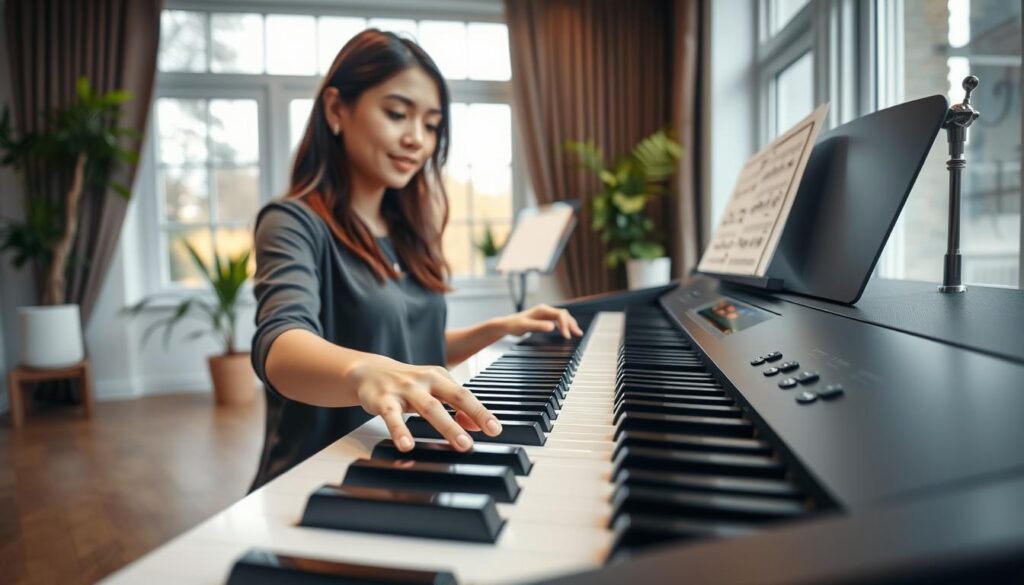
Dynamics are music’s soul. Weighted keys changed how I express music. I now feel the difference between loud and soft playing.
It’s like resistance training for your hands. Each press against key weight strengthens the muscles pianists need. Without this, you hit a technical limit fast.
Muscle memory is key. It lets you play emotionally without thinking. Proper resistance training teaches your fingers to control dynamics.
This training is essential for playing acoustic pianos. It demands even more control.
Learning on a digital piano with weighted action has many benefits. You’re not just learning an instrument. You’re building technique that works across all keyboards.
Weighted keys offer clear feedback, making you more accurate. They teach control and finger independence. This separates casual players from serious pianists.
Without proper key weight, your technique stays underdeveloped. This limits your musical growth. The resistance is actually a teacher.
Different Weight Types Compared
Choosing a key weight is like picking a political party. Each has its own philosophy and fanbase. Let’s look at the options.
Synth-action keys are like a go-kart. They’re light and fast, perfect for quick actions. But, they’re not great for building piano skills.
Semi-weighted keys are a middle ground. They offer a bit of resistance without being too heavy. It’s good for those who play both piano and synth.
Fully weighted keys are like a reliable sedan. They provide a consistent resistance, helping build finger strength. This is key for proper technique.
Graded hammer action is the luxury option. It’s fully weighted and feels like a real piano. It’s great for serious students.
Wooden keys are the top choice. They offer a natural feel and balance. It’s a luxury that adds authenticity to your playing.
Your choice is a big decision. Are you looking for a toy, a tool, or something special? The table below helps you decide.
| Key Action Type | Touch Resistance & Feel | Ideal For | Portability | Typical Price Range |
|---|---|---|---|---|
| Synth-Action | Very light, springy, immediate rebound. Minimal key weight. | Synth players, producers, live performers, absolute beginners on a tight budget. | Excellent (often in lightweight keyboards) | $ – $$ |
| Semi-Weighted | Moderate, uniform resistance. A noticeable step up from synth action. | Hobbyists, keyboardists who split time between piano and other sounds. | Good | $ – $$ |
| Fully Weighted (Plastic) | Substantial, uniform hammer resistance. Builds proper technique. | Serious beginners, piano students, home players seeking authentic feel. | Moderate (heavier build) | $$ – $$$ |
| Graded Hammer Action | Heavy in bass, light in treble. Most authentic piano key weight and texture. | Advancing students, pianists, composers, anyone planning to switch to acoustic. | Low (these are serious instruments) | $$$ – $$$$ |
| Wooden Keys (w/ Graded Action) | Ultra-authentic, organic density and balance. The pinnacle of touch. | Professional pianists, discerning enthusiasts, studio work. | Very Low (premium, often heavy construction) | $$$$+ |
Where do you stand on the spectrum? Knowing about these options is key. It helps you make a smart choice for your music journey.
Transition to Acoustic Pianos
Switching to an acoustic piano without getting ready is like going to Wimbledon with a ping-pong paddle. They look similar, but the rules and demands are way different. That Steinway in the corner is more than just an instrument—it’s a 600-pound kinetic sculpture that teaches you about physics.
Most beginners find out too late: acoustic pianos are complex. They have inertia, escapement, and aftertouch. Your fingers aren’t just pressing keys; they’re launching hammers against strings through a complex system. This is what makes the piano touch so unique—a skill your muscles must learn from scratch.
Weighted keys on digital pianos are like a flight simulator. They help build the muscles needed for an acoustic piano. Without this, you’ll face what I call “acoustic shock“:
- Dynamic Disaster: You’ll either play everything too loud or too soft.
- Speed Wall: Fast passages will be hard because your muscles get tired fast.
- Expression Amnesia: You won’t be able to control how you play or express emotions.
This isn’t just hard—it’s about neural pathways. Years of playing on unweighted keys teach your brain one way. But an acoustic piano speaks a different language. Retraining your muscles is tough, frustrating, and often makes players quit. They blame themselves, but the real problem is their first instrument.
Starting with weighted keys means you’re already learning the basics. You build:
- The finger strength to manage key inertia
- The control for subtle dynamic shading
- The technique for rapid repetition
- The tactile sensitivity for proper piano touch
When you sit at that grand piano, your hands already know the basics. The transition becomes exciting, not humiliating. It’s like upgrading from a sedan to a sports car.
Studies show students who start with weighted keys transition to acoustics three times faster with less frustration. Their piano touch develops right from the start, avoiding the costly “remediation phase” that stalls many aspiring pianists.
Think of it as protecting your musical future. That dream of playing a real piano is about more than sound—it’s about feel. And feel is everything.
Budget Impact of Weighted Actions
At first, a weighted keyboard might seem too expensive. But, it’s often cheaper than the regret you’ll feel later. The initial cost is a small price to pay for long-term savings.
A basic, unweighted keyboard seems cheap at first. You save $200 right away. But, in six months, you’ll realize it’s not worth it. The lack of piano touch holds you back.
This leads to a cycle of buying and upgrading. It’s like buying clothes that are too small. You spend $300, then $800 more for what you should have bought first. This adds up to $1,100. Or, you could spend $600 on a good keyboard and play it for years.
For those on a tight budget, the best choice isn’t always the cheapest. Look for the most piano you can afford. Brands like Yamaha offer good options, like the YDP series, without the high cost of wooden keys.
Guides like trusted buying guides are very helpful. They help you avoid models that focus on features but lack feel. They point you to instruments with better key actions.
Seeing the extra cost as an investment is key. It’s money spent on your musical future. Every dollar on a better key action saves you from future frustration.
The real question is, “Can I afford not to have weighted keys?” Your future self will thank you for choosing quality. This is the true cost: peace of mind, paid upfront.
Testing Key Feel in Stores
Buying a digital piano is like test-driving a car. The brochure is just the start. Your hands are the real judge.
Don’t bring the PDFs. You need to try it out yourself. Look for a store with many models to try.
Be like a forensic analyst. You’re not there to impress anyone. You’re testing the keyboard.
First, make sure the keyboard is on a stable surface. This is important. You can’t test it properly on a wobbly table.
Play the same phrase on three different keyboards. Start with a budget one, then a mid-range, and end with a high-end model like the Yamaha Clavinova CLP-845.
Focus on the feel of the keys. Does the downstroke feel right? Does the upstroke feel quick and positive?
Also, notice the texture of the keys. Do they feel slippery or have a good grip? Your hands will tell you the truth.
| Price Tier | Key Action Type | What to Feel For | Common Test Models |
|---|---|---|---|
| Budget ($300-$600) | Semi-weighted or light action | Springy bounce, minimal resistance, plastic-y feel on return | Casio CDP-S series, Yamaha PSR |
| Mid-Range ($700-$1500) | Graded hammer action | Heavier feel in low notes, lighter in high notes, noticeable pivot point | Kawai ES series, Roland FP series, Yamaha P-515 |
| High-End ($2000+) | Premium wooden hammer action | Subtle mechanical noise, authentic inertia, textured key surfaces | Yamaha Clavinova series, Kawai CA series, Roland LX series |
The table shows a big difference. The feel changes from “springy bounce” to “authentic inertia”. This is what makes a good keyboard.
Ask yourself if the keyboard feels right. Does it feel like an extension of your body? Or is there a delay between your thoughts and the sound?
Trust your hands more than what you read. They know quality better than you think. The right feel makes practice enjoyable.
Top Weighted Key Models Under $1000
Forget about fancy luxuries. The real magic in digital pianos is found under $1000. This is where companies show off their skills, packing great music into affordable packages. It’s the sweet spot where dreams meet reality.
You won’t find wooden keys or the top key weight tech here. But what you are getting is priceless. These pianos are like Honda Accords—reliable, well-made, and honest in their performance.
Yamaha’s YDP (Arius) series leads the pack for a reason. The YDP-145, for example, offers its Graded Hammer Standard (GHS) action at a great price. It has a key weight that changes from bass to treble, giving you the feel you need. It’s a smart compromise for daily practice.
Kawai’s Responsive Hammer Compact (RHC) action is found in models like the KDP-120. It’s similar in philosophy: a scaled-down version of their premium mechanisms. The keybed is heavy, teaching your fingers the right feel.
Here’s what to expect in this price range:
- Graded Actions: Yes, but with simpler mechanisms (GHS, RHC) versus top-tier systems.
- Material: Plastic key surfaces, not wood. The feel is engineered through weighting, not material luxury.
- Build Quality: Solid, but focused on durability for home use.
- Value Proposition: Maximum musical foundation per dollar spent. This is where you build technique.
The magic isn’t in exotic materials. It’s in the calibration. A well-tuned key weight system in a $800 piano can feel more musical than a fancy one. The sub-$1000 market forces designers to be clever, not just expensive.
So, skip the analysis paralysis. Play a Yamaha YDP. Try a Kawai KDP. Feel that graded resistance. Your budget isn’t a limitation here—it’s a filter that separates genuine musical tools from overpriced novelties. The honest truth? This price range contains some of the best learning instruments ever made.
Maintenance of Weighted Actions
Think of your digital piano’s weighted mechanism as a tiny, precise engine. It doesn’t need oil changes, but it does demand basic respect. This isn’t a disposable gadget. It’s the core of your instrument’s personality.
Place it on a stable, level stand—wobbly surfaces are the enemy of consistent practice. Keep drinks at a safe distance; a spilled coffee is a tragedy for electronics. For foldable models like the Yamaha P-125, secure the stand properly before each use. A simple microfiber cloth keeps the keys clean without harsh chemicals.
This stewardship protects your investment in a quality piano touch. That tactile feedback is a conversation. Dust, grime, or physical stress muffle that dialogue. You bought the weighted action for its authentic feel. Basic care ensures that feel remains true, session after session.
There’s no tuning required, unlike a Steinway grand. Your maintenance is simpler: preserve the mechanics. A well-kept keyboard becomes a reliable partner. It won’t introduce frustrating glitches as your skills grow from beginner pieces to complex sonatas. The consistency lets you focus on music, not mechanics.