For new piano players, early success often comes from keeping things simple. Songs that stay within a five-note range are perfect for beginners because they allow the hands to remain in a stable position while focusing on rhythm, finger control, and musical expression.
Instead of jumping across the keyboard, five-note songs encourage players to develop muscle memory and confidence within a single hand position. This approach is commonly used in early piano lessons because it removes unnecessary complexity while still teaching real musical skills.
In this guide, we’ll explore several beginner-friendly songs that can be played using only five notes, helping new pianists build technique while enjoying recognizable melodies.
Understanding The Five-Finger Position
Most beginner piano methods introduce students to a five-finger position. In this position, each finger rests naturally on one key without needing to move the hand.
A common starting position places the right hand on Middle C:
| Finger | Note |
|---|---|
| Thumb (1) | C |
| Index (2) | D |
| Middle (3) | E |
| Ring (4) | F |
| Pinky (5) | G |
This layout creates a comfortable hand shape and allows beginners to play many melodies without shifting position. Learning songs within this framework builds early coordination and improves finger independence.
If you’re still getting comfortable with hand positioning and key resistance, our guide on weighted vs semi weighted keys explains how different keyboard actions can influence early technique development.
Why Five-Note Songs Are Ideal For Beginners
Beginning pianists often struggle with large hand movements or complex finger patterns. Limiting a melody to five notes keeps the focus on control, rhythm, and consistency.
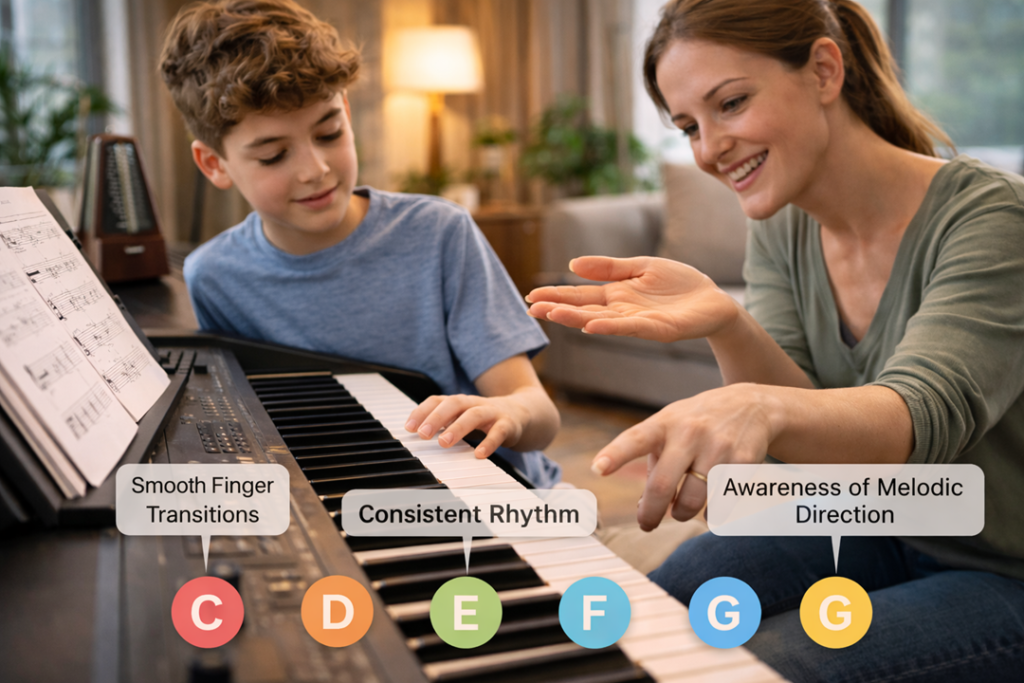
Five-note songs help beginners develop several important skills:
- Smooth finger transitions
- Consistent rhythm
- Awareness of melodic direction
Because the hand remains stable, players can concentrate on playing evenly and accurately rather than worrying about where to move next.
Ode To Joy (Simplified Version)
Beethoven’s famous melody works beautifully within a five-note range when simplified for beginners. The melody moves mostly step-by-step, making it easy to learn and memorize.
| Notes | Finger Numbers |
|---|---|
| E – E – F – G | 3 – 3 – 4 – 5 |
| G – F – E – D | 5 – 4 – 3 – 2 |
| C – C – D – E | 1 – 1 – 2 – 3 |
| E – D – D | 3 – 2 – 2 |
The repeating patterns make this song especially effective for developing finger familiarity with the keyboard.
Mary Had A Little Lamb
This traditional children’s melody is often one of the first songs beginners learn. It uses only three notes initially, which makes it extremely approachable.
| Notes | Finger Numbers |
|---|---|
| E – D – C – D | 3 – 2 – 1 – 2 |
| E – E – E | 3 – 3 – 3 |
| D – D – D | 2 – 2 – 2 |
| E – G – G | 3 – 5 – 5 |
Because of its repetition, this song helps beginners practice steady rhythm and controlled finger movement.
Hot Cross Buns
Another classic beginner melody, “Hot Cross Buns” introduces the concept of descending notes across the keyboard.
| Notes | Finger Numbers |
|---|---|
| E – D – C | 3 – 2 – 1 |
| E – D – C | 3 – 2 – 1 |
| C – C – C – C | 1 – 1 – 1 – 1 |
| D – D – D – D | 2 – 2 – 2 – 2 |
| E – D – C | 3 – 2 – 1 |
This song helps beginners develop even timing and controlled finger pressure, which are important foundations for more advanced playing.
Twinkle Twinkle Little Star (Five-Note Adaptation)
While the full version of this song uses more notes, a simplified version fits easily within a five-note range.
| Notes | Finger Numbers |
|---|---|
| C – C – G – G | 1 – 1 – 5 – 5 |
| A – A – G | (adapted within range if needed) |
| F – F – E – E | 4 – 4 – 3 – 3 |
| D – D – C | 2 – 2 – 1 |
The melody’s gentle pacing allows beginners to focus on smooth phrasing and note transitions.
Practicing These Songs Effectively
Learning simple songs becomes more productive when beginners practice with intention. Rather than playing through the melody repeatedly, try focusing on one short phrase at a time.
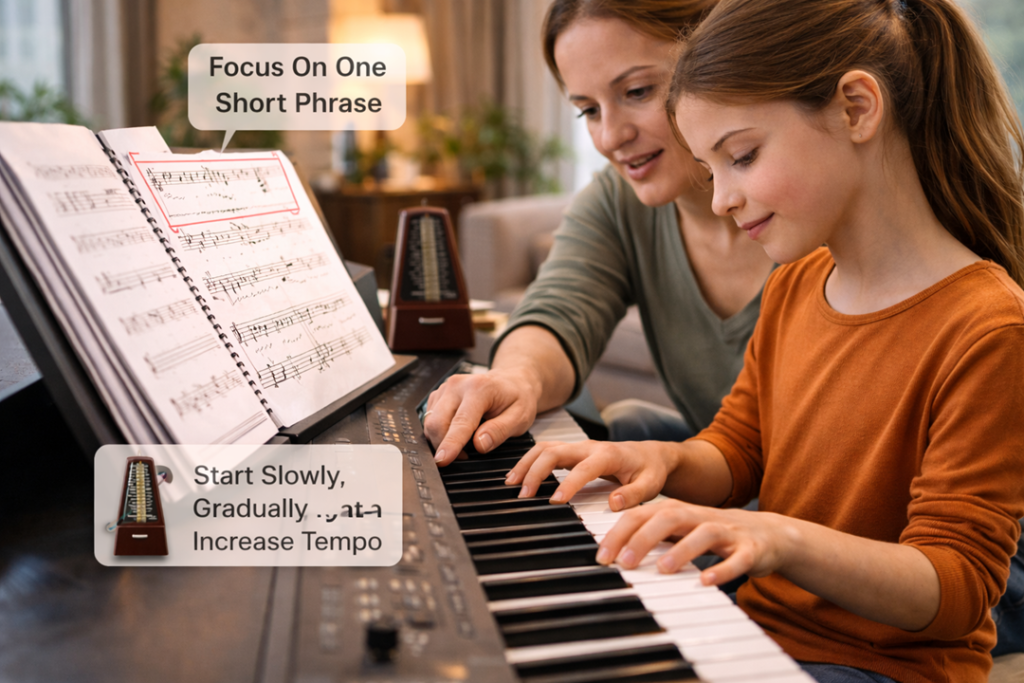
Start slowly and make sure each note sounds clear and even. Once the notes feel comfortable, gradually increase your tempo.
Music educators often emphasize that accurate repetition builds stronger learning than fast playing. According to Yale University’s introduction to music theory, early mastery of rhythm and melodic movement creates the foundation for future musical development.
Even when working with very simple songs, thoughtful practice helps beginners develop strong musical habits.
Turning Simple Songs Into Real Progress
Songs that use only five notes might seem basic, but they serve an important role in early piano education. They teach beginners how melodies move, how rhythm works, and how the fingers interact with the keyboard.
By mastering these simple melodies, new players gain the confidence needed to move on to larger pieces and more advanced techniques.
Sometimes the best progress comes from starting with the simplest possible music and playing it well. As your coordination improves, those five notes will become the building blocks for far more complex songs in the future.