For many beginners, learning a recognizable song early in the process can dramatically increase motivation. Few pieces accomplish this better than “Ode to Joy” from Beethoven’s Ninth Symphony. Its melody is simple, memorable, and perfectly suited for players just starting to explore the piano.
Because the piece relies on stepwise movement and repeating patterns, it allows beginners to focus on finger control, rhythm, and musical phrasing without becoming overwhelmed by complex technique.
In this tutorial, you’ll learn how to play the main melody step by step while developing the skills that help new pianists build confidence at the keyboard layout.
Why “Ode To Joy” Is Perfect For Beginner Pianists
Some beginner songs require large jumps across the keyboard or complicated rhythmic patterns. “Ode to Joy” is different. The melody moves primarily one note at a time, which makes it easier to learn and memorize.
The piece also introduces several foundational musical concepts:
- Reading simple melodic movement
- Maintaining steady rhythm
- Coordinating fingers with minimal hand movement
Because of these qualities, the melody is commonly used in early piano education. The original composition appears in Beethoven’s Symphony No. 9, one of the most recognized works in classical music history. A deeper look at Beethoven’s Symphony No. 9 from Britannica explains why the melody has remained culturally significant for nearly two centuries.
For beginners, learning this melody is both practical and inspiring.
Finding Your Starting Position On The Keyboard
Before playing the melody, locate Middle C on your piano. This key sits near the center of the keyboard and serves as a reference point for many beginner pieces.
Place your right hand in a five-finger position starting on Middle C:
| Finger | Note |
|---|---|
| Thumb (1) | C |
| Index (2) | D |
| Middle (3) | E |
| Ring (4) | F |
| Pinky (5) | G |
This hand position allows you to play most of the melody without moving your hand across the keyboard. For beginners, keeping the hand stable helps develop accuracy and muscle memory.
Understanding The Melody Structure
“Ode to Joy” follows a simple pattern built from small musical phrases. Each phrase repeats a similar structure, making it easier to learn in sections.
Instead of memorizing the entire piece at once, focus on short melodic segments. Once each segment feels comfortable, you can connect them smoothly.
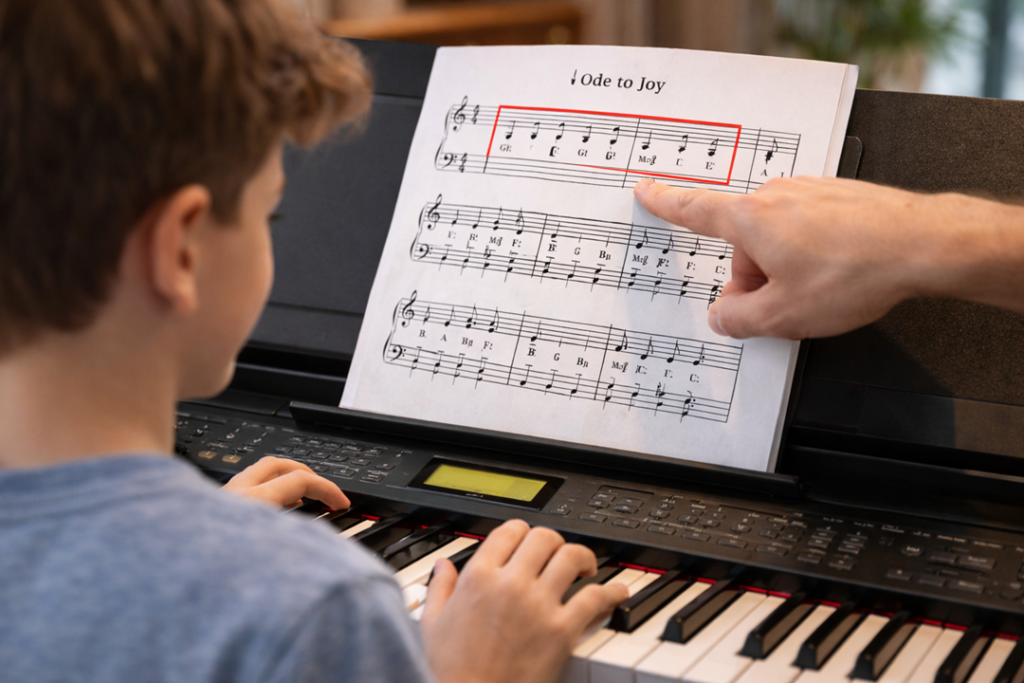
This approach mirrors how many teachers introduce early repertoire. Learning in small sections helps maintain steady progress and reduces frustration.
Playing The First Phrase Step By Step
The opening phrase introduces the main melodic theme of the piece. It moves mostly between three notes, allowing beginners to concentrate on rhythm and finger control.
| Note Sequence | Finger Numbers |
|---|---|
| E – E – F – G | 3 – 3 – 4 – 5 |
| G – F – E – D | 5 – 4 – 3 – 2 |
| C – C – D – E | 1 – 1 – 2 – 3 |
| E – D – D | 3 – 2 – 2 |
Play these notes slowly while maintaining a steady tempo. Focus on pressing each key evenly rather than rushing through the melody.
Beginners often improve faster when they prioritize accuracy before speed.
Connecting The Full Melody
Once the first phrase feels comfortable, the remaining sections follow a similar pattern. Many notes repeat, which reinforces finger familiarity and rhythmic stability.
The key to smooth playing is consistent timing between notes. Try counting each beat quietly while playing.
For players still developing finger control, practicing on a keyboard with realistic resistance can improve stability and accuracy. Our guide to weighted vs semi weighted keys explains how key action influences technique development for beginners.
Practicing With Rhythm And Expression
Even simple songs benefit from musical expression. Once you can play the notes correctly, begin focusing on dynamics and phrasing.

Start by playing slightly louder on the first note of each phrase, then gently relaxing the volume toward the end. This subtle shaping adds musical character without requiring advanced technique.
You can also practice with a metronome set to a slow tempo. Gradually increasing speed while maintaining control builds confidence and consistency.
Common Beginner Challenges
While “Ode to Joy” is approachable, beginners may still encounter a few common difficulties.
The most frequent issues include uneven rhythm and pressing keys too forcefully. These problems usually come from trying to play too quickly before mastering the pattern.
If a section feels uncomfortable, slow down and repeat just two or three notes at a time. Gradual repetition builds familiarity and helps the hands learn the movement naturally.
With patience and steady practice, the melody becomes surprisingly easy to perform.
Turning A Simple Song Into A Learning Tool
The value of beginner pieces extends far beyond the melody itself. Songs like “Ode to Joy” teach foundational skills that apply to more complex music later.
By learning this piece carefully, beginners practice:
- Finger coordination
- Hand positioning
- Rhythmic consistency
- Musical phrasing
These abilities form the basis for nearly every piano style, from classical repertoire to modern pop arrangements.
A First Step Into Real Music
Learning your first recognizable song is an exciting milestone. “Ode to Joy” offers the perfect balance of simplicity and musicality, allowing beginners to experience the satisfaction of real performance early in their piano journey.
With careful practice and steady rhythm, most new players can learn the melody quickly. More importantly, the skills developed while practicing it create a foundation that supports future technique, confidence, and musical expression.
Sometimes the simplest songs become the most important stepping stones in learning the piano.