At first glance, a piano keyboard may look like a long row of alternating black and white rectangles. For beginners, it can feel overwhelming 88 keys stretching across a grand instrument or digital piano. However, the piano key layout is one of the most logically designed systems in music. Once you understand how it works, the keyboard becomes less intimidating and far more intuitive.
Whether you’re just starting lessons or revisiting foundational concepts, understanding the arrangement of black and white keys is essential for reading music, building chords, and developing confidence at the instrument.
The Basic Structure of the Piano Keyboard
A standard acoustic piano contains 88 keys, spanning just over seven octaves. These keys repeat a consistent pattern across the entire keyboard. That repetition is the secret to mastering the instrument.
The keyboard is built around a repeating set of 12 notes. This 12-note pattern includes seven white keys and five black keys. Once you recognize this cycle, you can locate any note instantly, no matter where you are on the keyboard.
Instead of memorizing all 88 keys individually, players learn the pattern of one octave and then apply it across the keyboard.
The Role of White Keys in Music
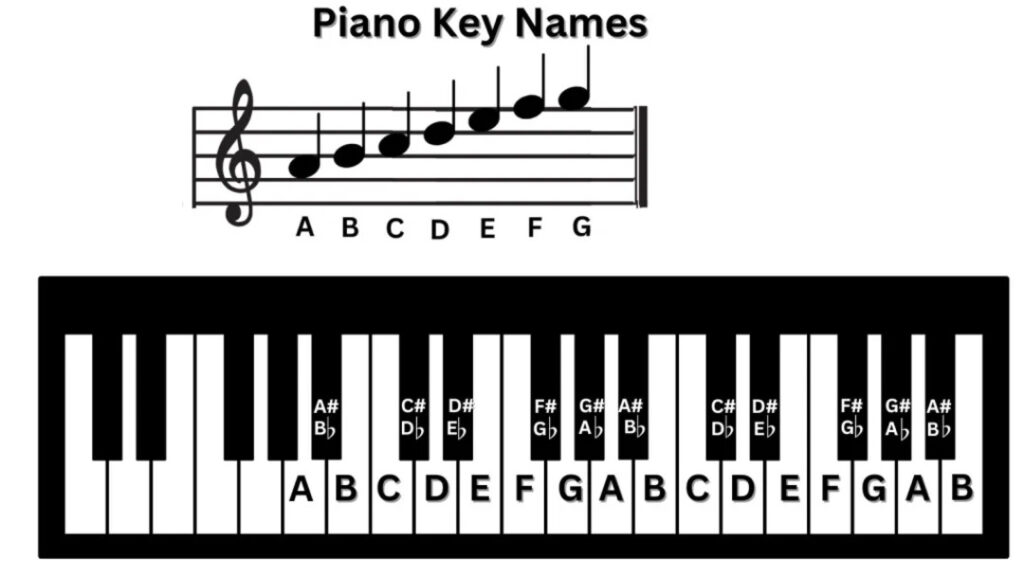
The white keys represent the natural notes of the musical alphabet:
C, D, E, F, G, A, and B.
These seven notes form the foundation of Western music theory. When played sequentially from C to C without using any black keys, they create the C major scale often the first scale beginners learn.
White keys are frequently associated with simplicity because many beginner pieces are written in “natural” keys that rely heavily on them. However, white keys are not inherently easier or more important than black keys. Instead, they provide a visual framework that anchors the keyboard layout.
Understanding where each white key sits helps pianists orient themselves quickly when reading sheet music.
Why Black Keys Are Essential
The black keys are arranged in alternating groups of two and three. This grouping is more than aesthetic it serves as a navigational guide.
Black keys represent sharps (#) and flats (♭). For example, the black key immediately to the right of C is C-sharp (C#). That same key can also be called D-flat (D♭), depending on the musical context.
These keys allow musicians to play in different tonal centers, or “keys,” beyond the natural notes. Without black keys, music would lack harmonic depth and expressive variety.
The visual grouping of two and three black keys also makes it easier to locate specific white keys. For instance, C always sits immediately to the left of a group of two black keys. This pattern repeats across the entire keyboard.
The Concept of the Octave
An octave is the distance from one note to the next note with the same name. On the piano, an octave spans eight white keys, including the starting and ending note.
For example, playing from C up to the next C completes one octave. Within that octave are 12 total keys: seven white and five black.
The octave structure is foundational because it explains why the keyboard pattern repeats. Once you understand one octave, you understand them all. The sound frequency doubles with each ascending octave, which is why higher notes sound brighter and lower notes sound deeper.
Recognizing octave patterns is also crucial for hand positioning and technical exercises.
How the Key Layout Supports Music Theory
The piano is often considered the best instrument for learning music theory because its layout visually represents musical relationships.
Intervals the distance between two notes are easy to see. For example, a major third spans four half steps, while a perfect fifth spans seven. These distances are visually apparent on the keyboard.
Chords become easier to understand because their construction is visible. A C major chord consists of C, E, and G. On the keyboard, you can physically see the spacing between these notes.
The arrangement of black and white keys illustrates the chromatic scale, which includes every half step in music. This visual clarity makes the piano uniquely suited for theoretical learning.
Navigating the Keyboard Efficiently
Beginners often struggle with orientation, especially when playing in unfamiliar keys. However, a few simple strategies make navigation easier:
• Use black key groupings as landmarks
• Identify middle C as a central reference point
• Practice locating octaves quickly
By consistently identifying patterns rather than isolated notes, players develop spatial awareness. Over time, this awareness reduces hesitation and increases fluidity.
Digital vs. Acoustic Key Layout
While the layout of keys remains consistent across instruments, digital pianos sometimes differ in size or key weight. Some keyboards feature fewer than 88 keys, but the pattern remains identical within each octave.
Weighted keys on digital instruments simulate the resistance of acoustic piano keys. Though the feel may differ slightly, the visual and structural layout is the same.
Understanding the layout ensures a seamless transition between different types of pianos.
Why the Layout Matters for Beginners
Many new students underestimate the importance of learning key structure early. However, familiarity with the keyboard layout accelerates progress dramatically.
When students recognize patterns, they spend less time searching for notes and more time focusing on rhythm, dynamics, and expression. This foundation also simplifies scale practice, chord building, and sight-reading.
Even advanced pianists rely on their internalized understanding of keyboard geography. Fast passages and complex compositions depend on instinctive spatial awareness.
Emotional Expression Through Key Choices
The layout also connects directly to musical emotion. Different keys evoke distinct tonal qualities. For instance, a piece in D major uses two sharps, incorporating black keys that slightly alter the tonal color compared to C major.
The physical interaction between black and white keys influences hand positioning, which can subtly affect phrasing and performance style.
In this way, the design of the keyboard contributes not just to structure, but to artistry.
A Logical Design That Stands the Test of Time
The modern piano key layout evolved over centuries, yet its design remains largely unchanged. Its logical repetition, clear visual grouping, and ergonomic considerations make it one of the most efficient musical interfaces ever created.
From beginners learning their first scale to concert pianists performing intricate works, the black and white keys form a unified system that balances simplicity with expressive complexity.
Final Thoughts
Understanding piano key layout is not merely about memorizing note names. It is about recognizing patterns, internalizing structure, and appreciating how design supports musical creativity.
The black and white keys work together to form a visual and tactile map of music theory. By mastering this map, pianists unlock greater confidence, technical accuracy, and expressive freedom.
Whether you’re just beginning your journey or refining your skills, taking time to truly understand the keyboard’s structure will deepen your connection to the instrument and transform the way you approach music.