Let’s be honest. Seeing the piano for the first time can be scary. It looks like a huge test you didn’t study for.
But there’s a secret. It’s actually very logical. The whole thing is based on a simple 12-note pattern. Once you see it, you can’t forget it.
This is like your special key. We’re skipping the boring, note-by-note learning. Instead, we’ll use visual tricks and memory tips to explore the piano.
Your main goal is to become confident in playing any keys. This skill works on big pianos and even phone apps.
This is your first step to becoming a piano player. Let’s start our journey together.
Keyboard Geography 101: Groups of 2 and 3 Black Keys
Your piano journey starts with recognizing the keyboard’s visual rhythm. Ignore the white keys for now. Look at the black keys instead. They’re not just for show.
Every piano, big or small, has the same layout. The black keys come in groups of two and three. This pattern repeats across the keyboard, like a steady beat.
These groups are your key landmarks. The duo marks the start, and the trio follows. This turns the keyboard into a map you can follow. It’s like having a grid system in a new city.
Knowing where you are on the keyboard is key. These black key groups help you find your spot. They act as the keyboard’s own coordinate system.
| Feature | Group of Two Black Keys | Group of Three Black Keys |
|---|---|---|
| Visual Pattern | Tight, close-set duo | Wider, evenly spaced trio |
| Location Role | Marks the territory around C, D, E | Frames the area around F, G, A, B |
| Common Reference | “The dog house” (common teaching analogy) | “The cat’s ears” (common teaching analogy) |
| Orientation Value | Quickly locates middle of keyboard | Helps identify outer register notes |
Learn this layout first. It helps you find notes on the piano easily. The groups become your mental anchors.
This is your basic theory. The black keys aren’t obstacles. They’re your guides. Once you see the 2-3 pattern, it’s hard to ignore. Your keyboard will seem less scary.
Naming the White Keys (A–G) with Visual Landmarks
Let’s move from abstract geography to practical cartography. It’s time to name the white keys. The musical alphabet—A, B, C, D, E, F, G—is a seven-letter loop. But reciting it in order is as useful as alphabetizing your spice rack during a dinner party. We need a system.
Here’s the elegant, almost sarcastically simple rule. Find any group of two black keys. The white key immediately to its left is always C. Always. It’s a universal constant, more reliable than a cable news cycle.
Now, locate a group of three black keys. The white key directly to the left of that trio is always F. With just C and F as your primary landmarks, the entire keyboard decrypts itself.
Think of it as spatial reasoning, not rote memorization. From your anchor at C, the next white key to the right is D, then E. From your anchor at F, move right to G, then A, then B. After G, you wrap back to A. This isn’t about learning letters. It’s about learning a relationship between shape and name.
You’re not memorizing a list. You’re recognizing a pattern. It’s the difference between knowing a politician’s talking points and understanding their actual platform. The pattern repeats across every octave, giving you a grid for the entire keyboard.
So, your mental map now has two fixed coordinates: C-left-of-two and F-left-of-three. Every other white key name is found through simple adjacency. This turns a daunting 88-key mystery into a solvable puzzle. You’ve just moved from tourist to local.
Middle C and Octaves: Finding Notes Anywhere
Forget GPS coordinates. The most important landmark on your musical journey is Middle C. It’s like a Rosetta Stone that translates keyboard geography into musical language.
Every good map needs a “You Are Here” star. On the 88-key piano, this is it. But here’s the first misconception to dismantle: Middle C isn’t dead center. That’s like thinking the Earth’s core is made of cheese—entertaining but fundamentally wrong.
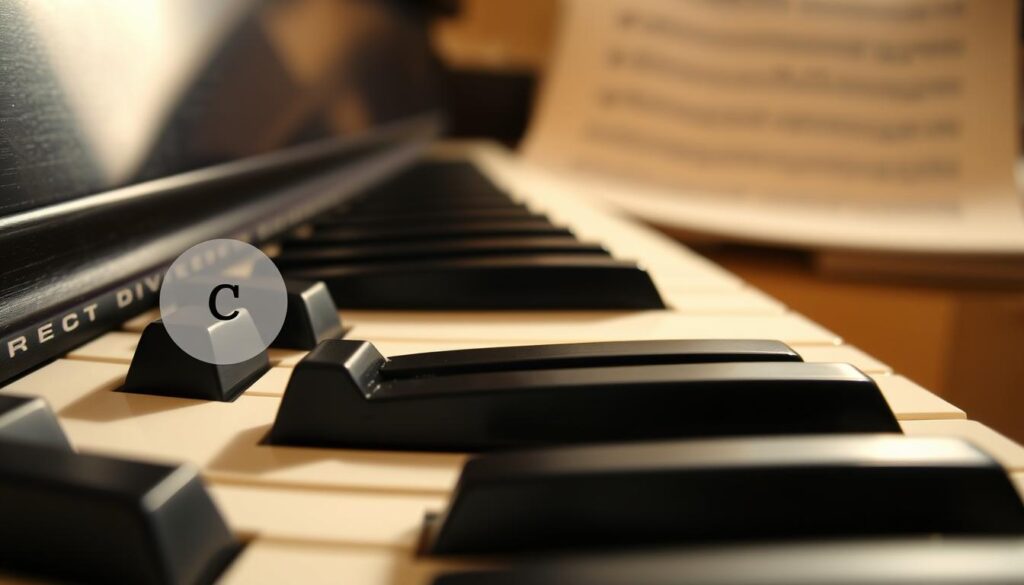
On a full-sized keyboard, find the group of two black keys nearest the physical middle. The white key immediately to its left is your home base. This note, officially designated as C4 in scientific pitch notation, sits slightly left of visual center.
Why does this matter? Middle C is the bridge between the keyboard and written sheet music. It’s the reference point around which beginner music orbits. Think of it as musical Greenwich Mean Time.
Now, let’s talk octaves. An octave is simply the span from one C to the next C. From Middle C (C4) up to C5 is one octave. Down to C3 is another.
Here’s the intellectual shortcut: The keyboard isn’t 88 unique notes to memorize. It’s the same 12-note pattern (7 white, 5 black) repeating at different pitches. Once you know one octave, you know them all.
The table below shows how octaves organize the keyboard landscape:
| Octave Name | Range (C to C) | Characteristics | Middle C Relation |
|---|---|---|---|
| Great Octave (C2-B2) | Lower mid-range | Bassy, foundational tones | Two octaves below |
| Small Octave (C3-B3) | Mid-range | Warm, vocal-like quality | One octave below |
| One-lined Octave (C4-B4) | Contains Middle C | Central reference point | HOME BASE (C4) |
| Two-lined Octave (C5-B5) | Upper mid-range | Bright, melodic region | One octave above |
| Three-lined Octave (C6-B6) | High range | Crystalline, piercing tones | Two octaves above |
Notice something beautiful? The pattern is fractal. Each octave contains the same arrangement of keys. C4 to C5 looks identical to C5 to C6, just higher in pitch.
This means you don’t need to learn 88 individual names. You just need to identify which octave you’re in and apply the pattern you already know. It’s the ultimate cognitive hack.
On a standard 88-key piano, the lowest note is A0. The highest is C8. Middle C sits at the heart of this spectrum. Not mathematically center, but functionally central.
Here’s a practical drill: Find Middle C. Now find every other C on the keyboard. Notice how they all share the same position relative to the black key groups. This spatial consistency is your secret weapon.
Understanding octaves transforms the keyboard from a bewildering grid into a predictable pattern. It turns 88 problems into one solution, repeated. Now that’s what I call efficient learning.
Sharps and Flats: Simple Rules with Real Examples
Welcome to music’s delightful paradox, where every black key wears two hats. This isn’t a design flaw—it’s enharmonic equivalence, music’s elegant solution to contextual naming. Think of it like a person with both a legal name and a nickname used in different circles.
A sharp (♯) raises a note by one semitone, the smallest distance on the keyboard. A flat (♭) lowers a note by that same tiny step. The black key between C and D? It’s one semitone above C, making it C-sharp. It’s also one semitone below D, making it D-flat. Same sound, same physical key, two different names depending on the musical sentence it inhabits.
This dual identity applies to all five black keys. Here’s the complete map of their diplomatic relations:
| Black Key Position | Sharp Name | Flat Name | Semitone Relationship |
|---|---|---|---|
| Between C & D | C♯ | D♭ | Raised C / Lowered D |
| Between D & E | D♯ | E♭ | Raised D / Lowered E |
| Between F & G | F♯ | G♭ | Raised F / Lowered G |
| Between G & A | G♯ | A♭ | Raised G / Lowered A |
| Between A & B | A♯ | B♭ | Raised A / Lowered B |
Notice the two conspicuous gaps in this pattern? Between E and F, and between B and C, there are no black keys. These are natural semitones—white keys already sitting just a half-step apart. The keyboard isn’t missing something; it’s featuring this architectural quirk.
So when do you use which name? Context is everything. If you’re moving upward from C, you’ll call it C-sharp. If you’re descending from D, it’s D-flat. Composers choose based on the key signature and harmonic direction. It’s like choosing “Dr.” versus “Professor” based on whether you’re in a hospital or university.
Think of sharps and flats not as separate notes but as grammatical modifiers. They’re the adjectives of music, describing a note’s temporary position relative to its natural state. This system creates incredible flexibility—the same physical key can serve multiple harmonic functions without clutter.
Master this concept, and you’ve unlocked the logic behind every scale, chord, and progression. The black keys’ identity crisis becomes your strategic advantage.
Quick Memory Hacks and Call‑and‑Response Drills
Theory without practice is like knowing chess rules but never playing. Let’s dive into some brain exercises. These drills are more like games than homework.
Your goal is to build “tactile intelligence”. This means your fingers can find notes without thinking. It’s like knowing streets by heart, not just reading a map.
First, try the White-Key Walk. Start on any C. Play and say each white key aloud until you reach the next C. Then, reverse it. Do this in different octaves.
This drill works because it connects what you hear and feel. You’re not just seeing the pattern. You’re experiencing it. Keep repeating until it feels natural.
Next, do the Black-Key Call-and-Response. Find a friend or use a metronome app. They call out a black key name—”F-sharp!”—and you find it right away.
Use landmarks to help. F-sharp is next to F, and G-sharp is next to G. Remember these groups. This drill improves your reaction time and applies rules under pressure.
Lastly, try the Landmark Leap. Close your eyes and place a finger on any key. Open your eyes and jump to the nearest C or F.
This drill boosts spatial memory faster than looking at stickers. You’re training your hand to navigate by feel. It’s like typing without looking at the keyboard.
These drills turn a 7-day plan into immediate action. Day 1 is the White-Key Walk. Day 2 is Black-Key Call-and-Response. Day 3 is the Landmark Leap.
Together, they connect the keyboard to your nervous system. You stop thinking “Where is G?” and your finger goes there. This skill is key when you’re ready to learn and memorize piano songs fast.
The secret is consistency over intensity. Five minutes of focused drilling daily is better than one long session. See it as a daily puzzle or brain game.
Your fingers will learn the language of the keys. Notes become familiar neighbors, not strangers. That’s tactile intelligence in action. It turns knowledge into instinct.
Hands-On: 10-Minute Note Hunt Game
Alright, theory time is over. This is your musical scavenger hunt. It’s like navigating a keyboard without a map. It’s the difference between reading a travel guide and actually buying the plane ticket.
Set a timer for ten minutes. Your mission is to find and play five notes. Use your new landmarks to guide you—no guessing allowed. Think of them as coordinates for a sonic treasure map.
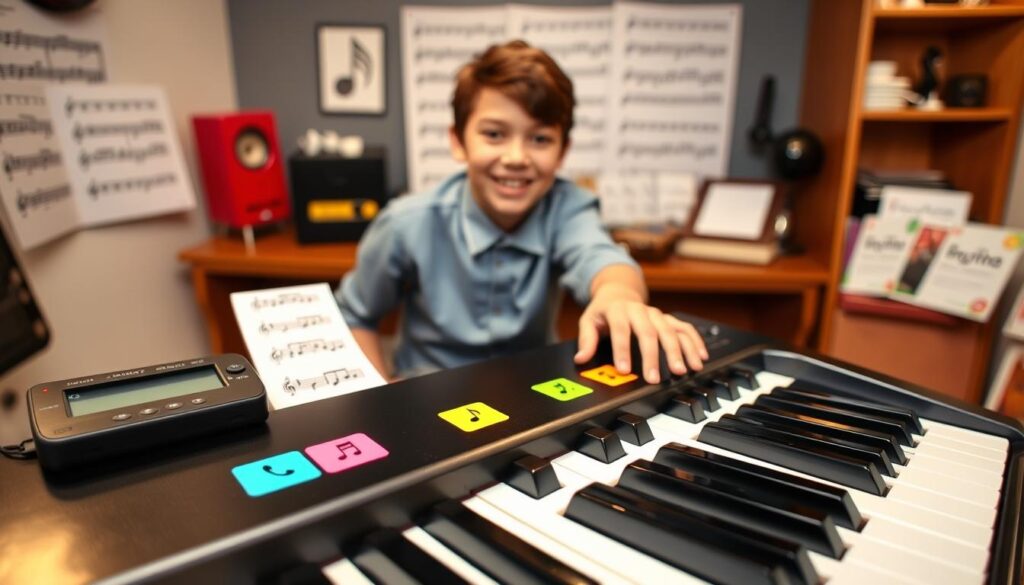
- Find the F that lives in the octave above Middle C. Use Middle C as your launchpad and count up.
- Locate the A-flat closest to your keyboard’s left end. Remember, flats are the left-side black keys. Which group of three does it belong to?
- Play the D that sits snugly between the highest group of two black keys on your keyboard. This tests your pattern recognition at the extremes.
- Identify the note one whole tone (two semitones) above Middle C. Hint: It’s a white key. This moves you beyond simple letter names.
- Find the note a single semitone below the highest E you can play. Is it a black key or a white key? Your knowledge of neighbors is key here.
Ready? Go. The timer adds pressure. It forces you to apply what you’ve learned. When the buzzer sounds, you’ve done the thing.
How did you fare? This game turns navigation into instinct. If you stumbled, no sweat. That just shows you which landmarks need a second look before we level up.
Printable/DIY Keyboard Label Options (Pros/Cons)
Labeling piano keys is like using GPS for your hometown – helpful at first, but eventually you need to learn the streets. This is the great sticker debate. Traditionalists shudder at the thought. Pragmatists see a useful tool. Who’s right?
Let’s analyze this like a sage examining a philosophical paradox. Temporary labels can accelerate initial learning. But, permanent dependency creates a musical handicap. The goal isn’t to memorize stickers. It’s to internalize the keyboard’s geography.
You have four main paths to choose from. Each has distinct advantages and trade-offs. Think of them as training regimens for your brain.
- The “Easy Button” – Pre-printed Stickers
- The Strategist’s Choice – DIY Landmark Dots
- The Transitional Tool – Painter’s Tape Strip
- The Jedi Method – Dynamic LED Labels
Pre-printed stickers offer instant gratification. Every white key gets its letter. You’ll know your piano key names immediately. The downside? Your eyes never learn to navigate. It’s like reading a map with every street labeled in neon. You see the labels, not the terrain.
DIY landmark dots represent tactical intelligence. Place small, removable dots only on every C (blue) and every F (green). These become your anchors. You’re not given the answer. You’re given the coordinates to find it yourself. Minimalist. Elegant. Effective.
The painter’s tape strip is the transitional scaffold. Write “C D E F G A B” on a single strip above one octave. It’s a reference you can peel off in a week. It’s a crutch, but one with an expiration date. Useful for that initial orientation phase.
Then there’s the dynamic LED label system on smart keyboards. Lights illuminate only the keys you need, then vanish. It’s the perfect, ephemeral guide. The ultimate just-in-time learning. The catch? It requires specific, often expensive hardware.
Here’s the sage’s verdict after watching countless students: Use the minimalist landmark method. Label just the C’s and F’s. This gives you anchors without clutter. It supports learning without enabling laziness. You’ll internalize the piano key names through discovery, not decoration.
Remember this principle: Any tool that does the thinking for you eventually weakens your mental muscles. Labels should be temporary training partners, not permanent prosthetics. Start with dots. Graduate to blank keys. Your fingers will learn the way your brain already knows – through practice, not print.
Mini Quiz: Identify 20 Keys in 60 Seconds
Enough reconnaissance. Your mission, should you choose to accept it, is a 60-second key identification sprint. I’m throwing 20 key identifiers at you. Your job is to name the specific note—like “C4” or “F-sharp”—and find it on your keyboard. Think of it less as an exam and more as a diagnostic scan of your mental map.
Ready? Set your timer. Here are your first five targets:
- The white key to the left of the lowest group of two black keys.
- The black key in the middle of the central group of three.
- The note one octave below Middle C.
- The enharmonic equivalent of D-flat.
- The white key immediately to the right of the highest group of three black keys.
This rapid-fire drill tests everything: landmark recognition, octave navigation, and sharp/flat logic. Which ones made you pause? That hesitation is the data point we need.
The full keyboard note quiz is laid out below. Don’t just scribble an answer and move on. The third column is where the real learning happens—it tells you why you might have stumbled.
| Quiz Item (Identify This Key) | Your Answer (Note Name) | Diagnostic Insight If You Missed It |
|---|---|---|
| 1. White key between the highest group of two black keys. | D (highest octave) | Review visual landmarks for the “D in the doghouse.” |
| 2. The black key to the right of F3. | F-sharp / G-flat | Sharps/flats rule: right is sharp, left is flat. Reinforce with call-and-response. |
| 3. The note two octaves above Middle C. | C6 | Octave navigation needs work. Practice “leapfrogging” from Middle C. |
| 4. The white key to the left of the lowest group of three black keys. | F (lowest octave) | Focus on the “F before the three-black-key fortress.” |
| 5. The enharmonic equivalent of A-sharp. | B-flat | Enharmonic concept is fuzzy. Remember: same pitch, two names. |
So, how did you fare? If your brain turned to cognitive spaghetti around question 12, fantastic. That’s the point. This note identification drill isn’t about proving you’re a prodigy. It’s a mirror.
The questions that tripped you up reveal your precise practice coordinates for tomorrow. True mastery of the keyboard isn’t about never getting lost. It’s about knowing exactly how to reorient yourself the moment you do. Now you have the map for that, too.
FAQ
Q: What is the significance of the 2024 US Presidential Election?
A: The 2024 US Presidential Election is a critical event that will determine the future direction of the country. It will shape the nation’s policies, economy, and international relations. The election will also have a significant impact on various sectors, including healthcare, education, and the environment.
Q: Who are the main candidates running for the 2024 US Presidential Election?
A: The main candidates running for the 2024 US Presidential Election include Joe Biden, Donald Trump, and several other notable figures. Each candidate has their own platform and vision for the country’s future.
Q: What are the key issues that will be addressed during the 2024 US Presidential Election?
A: The 2024 US Presidential Election will address a range of key issues, including healthcare, education, climate change, economic policies, and national security. These issues will be central to the campaign and will shape the candidates’ platforms.
Q: How can I stay updated on the latest news and updates about the 2024 US Presidential Election?
A: To stay updated on the latest news and updates about the 2024 US Presidential Election, you can follow reputable news sources, such as CNN, Fox News, and The New York Times. You can also follow the candidates’ social media accounts and official websites for the latest information.
Q: What are the voting requirements and deadlines for the 2024 US Presidential Election?
A: The voting requirements and deadlines for the 2024 US Presidential Election vary by state. It is important to check with your local election office or visit the official website of your state’s election authority to determine the specific requirements and deadlines for your area.
Q: How can I make an informed decision when casting my vote in the 2024 US Presidential Election?
A: To make an informed decision when casting your vote in the 2024 US Presidential Election, it is important to research the candidates’ policies, track their campaign promises, and consider their track records. You can also engage in discussions with friends, family, and community members to gain different perspectives and insights.
Q: What is the role of the Electoral College in the 2024 US Presidential Election?
A: The Electoral College plays a significant role in the 2024 US Presidential Election. It is a system established by the Founding Fathers to ensure that smaller states have a voice in the election process. The Electoral College consists of 538 electors, with each state having a number of electors based on its population. The candidate who wins the most votes in a state typically receives all of that state’s electoral votes, except in Maine and Nebraska, which allocate their electoral votes proportionally.
Q: What are the key dates and milestones leading up to the 2024 US Presidential Election?
A: The key dates and milestones leading up to the 2024 US Presidential Election include the primary elections, caucuses, and party conventions. These events will determine the candidates who will represent each party in the general election. The general election will take place on November 5, 2024.
Q: How can I participate in the democratic process and make my voice heard in the 2024 US Presidential Election?
A: To participate in the democratic process and make your voice heard in the 2024 US Presidential Election, you can register to vote, attend campaign events, engage in discussions with friends and family, and cast your ballot on election day. Every vote counts, and your participation is essential to shaping the future of the country.