Let’s face it. The dream of playing a Chopin nocturne at a party is often crushed by reality. Finding middle C can be tough.
Learning an instrument isn’t just about talent. It’s a deep dive into behavioral psychology.
It’s about setting up rituals in your brain. This isn’t just about music. It’s about mastering any complex skill.
We’ll explore the start of your journey. We’re moving from chaotic excitement to steady progress. Forget the myth of being naturally good.
We’re building a routine, step by step. Your success relies on these practice habits, not talent.
The real work is done daily, not just in lessons. It’s the quiet discipline that turns confusion into clarity. Let’s dive in.
Why Consistency Trumps Intensity
The idea of all-night practice sessions is seductive but useless for skill building. We often admire those who practice for hours on weekends. But your brain doesn’t see it that way.
Your cerebellum, which handles motor skills, is like a lazy but efficient bureaucrat. It only invests in building strong neural paths for regular practice. A single intense practice is like a flash flood, clearing old paths but not creating new ones. Daily practice, even for just 15 minutes, is like a steady construction project.
Practicing for 15 minutes every day is far more effective than a long practice session once a week. Why? Repetition is key. It tells your brain to build a dedicated path for the skill. Intensity sends confusing signals.
This is like the compound interest model of consistent music learning. Intensity is like a lottery ticket. Consistency is like a savings account that grows over time. You wouldn’t ignore your financial future for 11 months. Why ignore your musical growth?
Let’s look at the numbers. Ten minutes of practice daily equals 60 hours a year. That’s a full workweek of learning. Increase it to 30 minutes, and you get 180 hours, like a month-long course.
The temptation for quick results is strong. But consistent practice is what truly pays off. It’s not about willpower but about creating a good system. Your brain responds to regular practice, not one-off efforts.
So, are you choosing flash floods or steady growth? Your fingers will show you the answer before your ego does.
How to Start a Practice Habit
The secret to a lasting piano habit is not in grand resolutions. It’s in the simple act of sitting down after your morning coffee. You’re not building willpower. You’re building a system.
The goal is to make the first step so effortless. This way, resistance becomes irrelevant.
Your first mission is to break down the phrase “practice piano.” It’s a vague, terrifying monolith. Replace it with a micro-goal: “Sit on the bench for five minutes after my first cup.” That’s it.
The act of sitting, with the instrument in front of you, almost always leads to playing. This is the psychological equivalent of giving the boulder a tiny nudge so gravity does the rest.

Next, make your environment work for you. This is basic choice architecture. If your keyboard is buried in a closet or tucked behind a sofa, you’ve already lost the battle before it begins.
Your most critical practice routine tip is to create a permanent, inviting setup in a low-traffic zone. Make it the path of least resistance.
Now, let’s talk timing. Intensity is the enemy of consistency. Your initial sessions should be short—15 to 20 minutes is a heroic start. One source recommends connecting practice to an existing part of your daily routine, like after homework or before dinner.
This tactic, called habit stacking, leverages neural pathways you’ve already paved.
So, what do you actually do during those minutes? Pilfer from the pros. Have a stupid-simple warm-up sequence that acts as your cognitive on-ramp. It signals to your brain, “We are now in Piano Mode.” A personal routine I follow aims for 30 minutes minimum, and it always starts with this non-negotiable warm-up:
- Two minutes of slow, mindful scales (C Major is a friendly start).
- Two minutes of a simple Hanon exercise (finger independence).
- One minute playing a chord progression I know well.
This isn’t about motivation; it’s pre-commitment. You’ve decided the “what” before you even sit down, eliminating decision fatigue. The table below breaks down these friction-reducing tactics into a actionable blueprint.
| Tactic | What It Does | Real-World Example |
|---|---|---|
| Permanent Setup | Reduces physical and mental friction to start. | Keyboard on a stand, bench ready, light on, in a quiet corner. |
| Micro-Goal | Makes the initial action feel trivial and achievable. | “Play one scale” or “Sit for five minutes.” |
| Habit Stacking | Anchors the new habit to an established one. | Practice immediately after your morning coffee or evening tea. |
| Pre-committed Warm-up | Creates a ritual that triggers focus and eliminates “what should I do?” panic. | Always start with 5 minutes of C Major scale and a simple exercise. |
The architecture of your practice habit is more important than the hours you log at first. By designing your environment, hijacking your existing routines, and having a default warm-up, you transform practice from a daunting task into an automatic part of your day. The best practice routine tips are the ones you don’t have to think about.
Using Reminders and Cues
The secret to regular piano practice isn’t just about discipline. It’s about setting up your daily space. Our choices are often influenced by our environment, not just our willpower.
Think of it as training yourself to respond automatically, like Pavlov’s dog. But instead of salivating, you’ll be ready to play arpeggios. This is called habit stacking.
Experts say to link practice to something you already do every day. This could be right after your morning coffee or before dinner. Or maybe it’s after your evening walk.
When practice is part of your daily routine, it feels natural. The cue makes it easy, removing the need to decide if you should practice. Your brain just knows what to do.
Don’t rely on chance. Use a phone reminder with a fun label. Or leave your sheet music out the night before. These are environmental cues that guide your actions.
This isn’t about losing control. It’s about making smart choices. In a world full of distractions, a good cue is a powerful tool. It turns your intention to practice into a simple, automatic part of your day.
Small Actions for Big Progress
Our culture loves the overnight success story, but the piano keyboard tells a different story. We dream of the big breakthrough, the viral hit, and the perfect performance. But piano progress is about small, steady steps.
Think of it like fixing a complex code. Finding the error in measure 12 is like a detailed search. Playing the whole sonata from the start might feel like a big effort, but it’s not always effective. The real work is in the small details.
There are two key steps. First, learn songs one hand at a time. This helps your brain process new information better. Mastering each hand separately makes playing together smoother.
Second, play slowly. Really, really slowly. Use a metronome to keep a steady pace. This methodical approach is key to consistent music learning.
Your goal is to focus on one tricky measure at a time. Drill it, dissect it, and think about it when you sleep. This approach may seem small, but it leads to big progress over time.
This mindset turns practice into a focused mission. It builds confidence by solving real problems. These small, daily efforts add up to real skill, making your practice routine stronger. They are the foundation for building a consistent piano practice routine that lasts.
Habit Tracking Apps and Printables
Forget willpower; the modern musician’s secret weapon is a set of digital tools. These tools help turn chaos into consistent progress. Data is your most loyal ally in this battle.
Your smartphone is a paradox. It’s a distraction machine but can also be a taskmaster. A metronome app imposes discipline. A sight-reading app offers endless drills.
Simple practice routine tips are often the best. An old-school, analog habit tracker can be more powerful than any digital notification. Crossing off a day feels rewarding, unlike any digital badge.
When you go digital, choose wisely. Use one or two tools consistently. Think of it as building a scholar’s toolkit:
- Sight Reading Factory or Teoria for theory and reading drills.
- Musescore for a vast library of sheet music.
- Platforms like Liberty Park Music, Piano With Jonny, or Playground Sessions for structured video curricula.
- And of course, the irreplaceable live teacher for human feedback and accountability.
The lesson isn’t to find a magic shortcut. It’s to use technology for structured, accountable repetition. For pure tracking, a dedicated practice tracker like Go Practice Music can turn your phone into a focused logbook. The best practice routine tips always point back to this: tools exist to serve the habit, not the other way around.
Dealing With Off Days
Off days are a normal part of learning piano. They happen when your fingers feel stiff and your mind is foggy. Instead of giving up, it’s important to take a closer look.
Start by figuring out if the problem is physical or mental. Ask yourself if you’re tired, hungry, or dehydrated. Sometimes, a simple snack can help. Other times, it’s a mental block or boredom with the same old scales.
When you’re feeling off, lower your goals for the day. Instead of trying to master a difficult piece, aim to play a simple scale well. Or, listen to a professional recording of the piece you’re learning. This approach is not about giving up; it’s about adjusting your strategy.
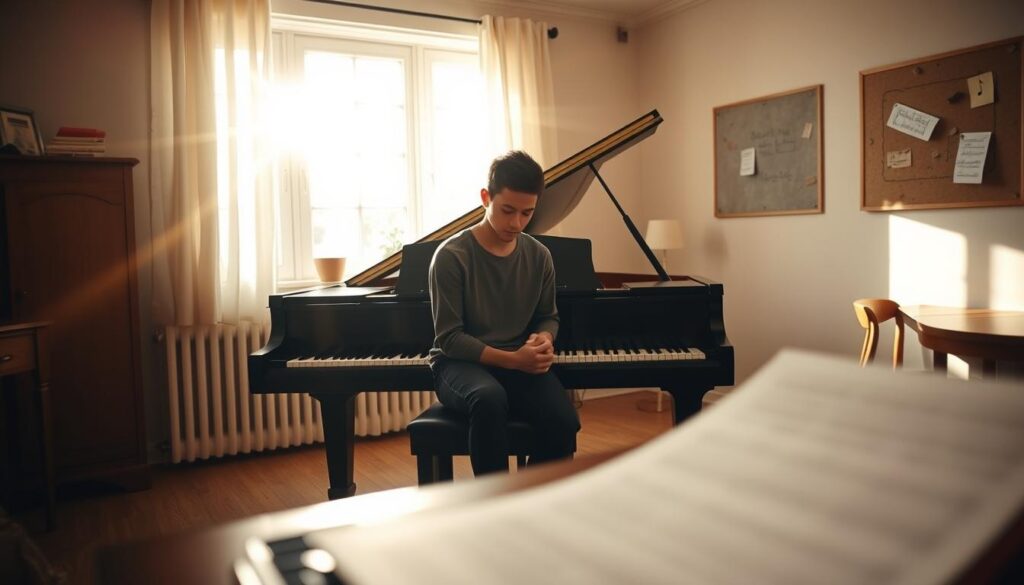
It’s wise to stop practicing when mistakes start to pile up. Trying to force a difficult passage can make your mistakes worse. Taking a break can help prevent bad habits from becoming permanent.
Think of an off day as just one part of your journey. One bad session doesn’t define your progress. The goal is to keep practicing, even if it’s just for a few minutes. Showing up is what matters.
Learning music is not always easy. It has ups and downs, like any journey. Your off days are the lows, but they make the highs more rewarding. They teach you patience and resilience, essential for any musician.
So, when you’re feeling stuck, don’t fight it. Lower your goals or take a break. Your practice routine will be ready for you tomorrow. Remember, an off day is not a failure; it’s a chance to recharge.
Encouragement for New Musicians
Picking up an instrument in adulthood is a bold move. It’s a choice to create actively in a world that loves passive scrolling. This choice deserves respect.
Learning piano is a long-term commitment, not a quick fix. It’s about building a new skill slowly. Your progress is unique, and what matters most is enjoying the music.
The hard parts of learning are what make it valuable. The gap between your dreams and your playing is where the real learning happens. Each practice session makes you more disciplined and patient.
Technique and songs will come with time. But the real reward is the person you become. You become someone who shows up and keeps going.
| Learning Stage | The Common Myth | The Actual Reality | The Essential Mindset |
|---|---|---|---|
| Beginner | You need “natural talent” to start. | You need curiosity and a willingness to sound bad. Progress is non-linear and messy. | Embrace the awkward phase. It’s where all great musicians began. |
| Intermediate | Practice means perfecting songs from start to finish. | Practice is targeted problem-solving. Isolate the hard two bars. Slow it down. Repeat. | Quality of focus beats quantity of time. Fifteen minutes of deliberate work is gold. |
| Advanced | Mastery means no more struggle. | Mastery is refining nuance and expression. The challenges just get more interesting. | The plateau is a teacher, not a prison. It signals a need for a new approach. |
Look at the table above. Notice how the reality column is less about flash and more about gritty, consistent music learning. The myth column is what culture sells you. The reality column is where the art actually lives.
This path of consistent music learning is a political act in an attention economy. You are reclaiming your time and your focus. You are building a skill that can’t be taken away. The metronome’s tick is a promise: be here now, and you will improve.
So, on the days you feel stuck, remember this. You are not just learning piano. You are practicing a philosophy. You are learning how to learn. You are building a legacy of patience in an impatient world. Keep showing up. The music—and the musician—are waiting.
FAQ
Got questions? Let’s clear the air in the practice room.
How long should you really practice? Think of your brain as a sponge. It absorbs more in short, frequent sessions. Twenty focused minutes a day is better than a long weekend session. Consistency is key.
What if I keep screwing up the same measure? Slow down and focus on the problem. Play the tricky two notes slowly and with great care. Remember, mistakes are just data to fix.
Is using a metronome soul-crushing? Only if you think rhythm is too strict. The metronome is there to help, not judge. Start slow and let it guide you.
How do I not quit when I sound terrible? Look at progress over weeks, not days. A bad practice is just a blip. Trust the long-term trend.
The best practice routine tips are straightforward. They help you stay focused and consistent. Short, smart practice always pays off. Now, go make some disciplined music.