Many beginners believe that learning piano requires hours of daily practice. In reality, consistency matters far more than duration. A focused ten-minute session can produce meaningful progress if each minute has a clear purpose.
For busy students, professionals, or parents juggling multiple responsibilities, a short routine removes one of the biggest barriers to learning. Instead of waiting for the “perfect” block of time, a structured routine makes practice manageable and sustainable.
This simple ten-minute practice framework focuses on finger technique, rhythm, and musical understanding, giving beginners a balanced starting point without overwhelming their schedule.
Why Short Practice Sessions Can Be Surprisingly Effective
Short practice sessions work because they encourage high concentration and repetition without mental fatigue. Beginners often struggle more with focus than with time. When practice stretches too long, attention drops and mistakes increase.
Ten minutes forces you to stay engaged. Each exercise has a clear goal, and the entire session remains manageable even on busy days.
Professional teachers often recommend frequent short sessions rather than occasional long ones. According to the practice principles used in music education research, deliberate and focused repetition produces stronger long-term skill development than passive playing.
In other words, a short routine done daily often outperforms a long session done once a week.
The Structure Of A 10 Minute Practice Routine
A well-balanced routine should touch three key areas:
- Physical technique
- Rhythm and coordination
- Musical application
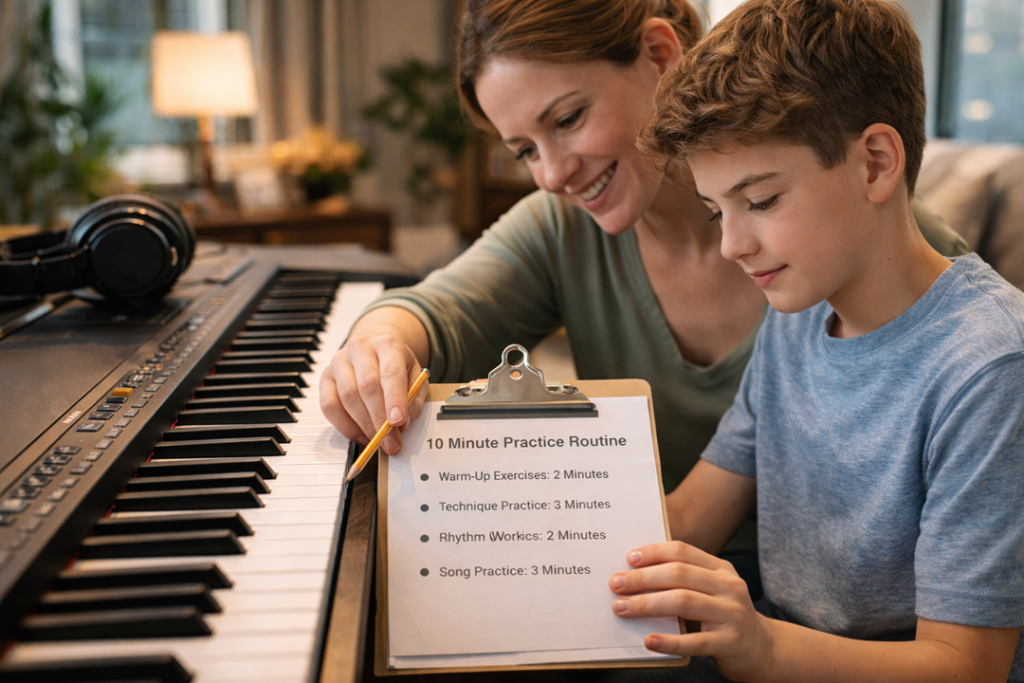
The goal is not to master everything in one session, but to reinforce foundational skills consistently.
| Practice Segment | Time | Purpose |
|---|---|---|
| Warm-Up Exercises | 2 Minutes | Build finger coordination and comfort |
| Technique Practice | 3 Minutes | Strengthen control and accuracy |
| Rhythm Work | 2 Minutes | Improve timing and steady tempo |
| Song Practice | 3 Minutes | Apply skills to real music |
This structure ensures beginners develop the fundamental abilities required for long-term progress.
Step 1: Warm Up Your Fingers
Start every session with simple finger movement exercises. Even experienced pianists warm up before playing, because it prepares the hands for coordinated movement.
A good beginner warm-up involves playing a five-finger scale pattern slowly and evenly. Place your right hand on middle C and play the sequence C–D–E–F–G and back down.
Focus on:
- Relaxed hand position
- Even key pressure
- Smooth transitions between notes
This brief exercise wakes up your fingers and prepares your brain for focused practice.
Step 2: Build Technique With Simple Patterns
Technique practice strengthens the muscles and coordination required for accurate playing.
Use a short scale or finger exercise that encourages independence between fingers. The goal is not speed, but clean, controlled movement.
For example, practice alternating between two nearby notes slowly, maintaining consistent pressure and rhythm. Over time, this improves both finger strength and precision.
If you’re unsure how different key actions affect technique development, our guide on weighted vs semi weighted keys explains why realistic resistance can improve control during practice.
Step 3: Practice Rhythm With A Metronome
Rhythm is one of the most common challenges for beginners. A metronome helps develop a stable internal sense of timing.
Set a slow tempo and practice clapping or playing a simple note pattern in time with the beat. Focus on keeping each note evenly spaced.
Even two minutes of metronome work can dramatically improve musical accuracy over time.
Many music educators emphasize rhythm practice early because timing forms the backbone of musical expression. This overview of musical rhythm fundamentals from Berklee College of Music explains why consistent timing is essential for every instrument.
Step 4: Apply Everything To A Simple Song
The final portion of your practice session should involve real music. Even beginners benefit from applying technique to short melodies.
Choose a simple piece or beginner song and play it slowly, focusing on accuracy rather than speed. If a section feels difficult, isolate just two or three notes and repeat them carefully.
Over time, this approach builds both confidence and familiarity with the keyboard.
Even a few minutes spent on a song keeps practice enjoyable and reminds you why learning piano is rewarding.
Consistency Matters More Than Duration
Ten minutes may seem small, but repeated daily it becomes powerful. Over one week, that routine adds up to more than an hour of focused practice.
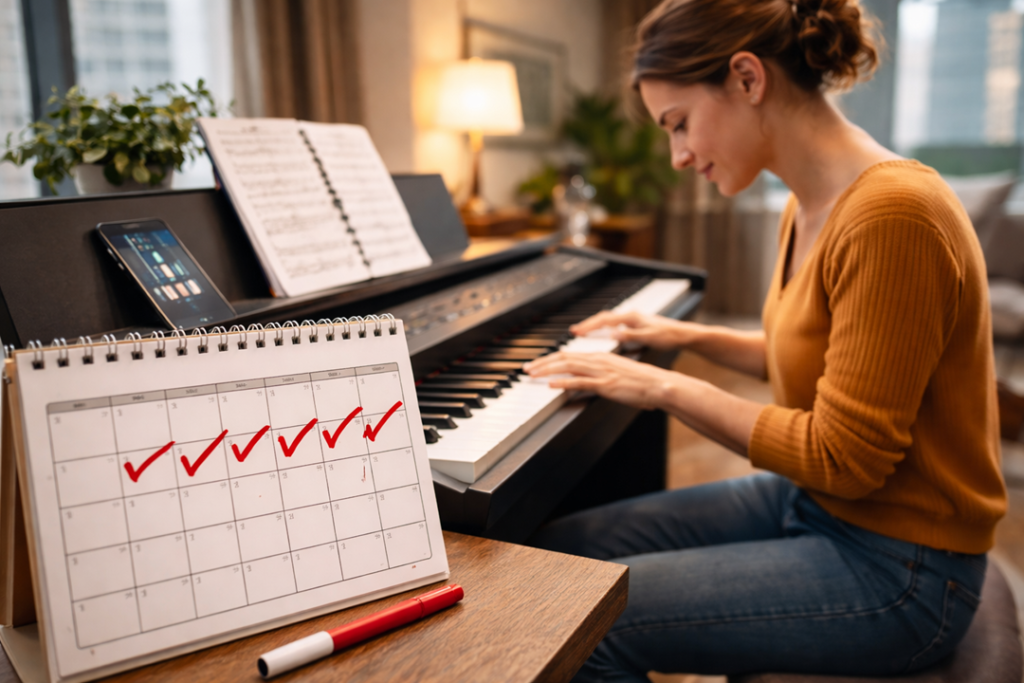
Progress on the piano comes from repetition and patience. Short sessions make it easier to build the habit of sitting down at the instrument regularly.
Many beginners quit not because the instrument is difficult, but because practice feels overwhelming. A manageable routine removes that pressure and keeps motivation strong.
Turning Small Sessions Into Real Progress
As your skills grow, your practice time may naturally increase. But the structure of this routine remains useful even for intermediate players.
Short sessions can serve as:
- Warm-ups before longer practice
- Skill maintenance on busy days
- Focused technique drills
The key lesson is simple: consistent, intentional practice always beats occasional long sessions.
By committing to just ten minutes a day, beginners build the habits that eventually lead to confident, expressive playing.