The journey from “Chopsticks” to Chopin is not straightforward. It’s more like a Jackson Pollock painting. You’ll face frustration, doubt, and moments of pure joy.
Staring at the keys after failing the tenth scale can be tough. It feels like your fingers are against you. Learning skills is a battle, and drive often falls first.
But, what if determination isn’t enough? It’s about changing your mindset. Seasoned teachers suggest using visualization. They also remind us that mastering piano takes patience.
Now, apps with AI can make practice fun. They give instant feedback, turning practice into a game. So, is your motivation issue really about the piano? Or is it how you approach learning?
The Importance of Motivation for Beginners
Starting at the piano feels like a tough boot camp, not a dreamy journey. The excitement wears off quickly. You’re left with hard practice and the sound of mistakes.
Motivation is key to keep going. It’s like starting a fire. Without it, you won’t get far.
Having a clear goal is important. It could be playing “Clair de Lune” perfectly or just getting through “Happy Birthday” without trouble. Keep this goal in mind when practice feels hard.
Getting motivated to practice is hard because you need to see progress first. But progress is small and hard to notice. This makes it tough to keep going.
Tracking your progress is essential. It gives you a sense of achievement and keeps you motivated. Without it, you might lose interest quickly.
The Anatomy of Beating Practice Fatigue
To overcome practice fatigue, focus on small victories. It’s about creating a system that helps you succeed, not just relying on willpower. Here are some common problems and how to solve them.
| Motivation Killer | Why It Happens | The Fix (Beating Practice Fatigue) |
|---|---|---|
| The “Invisible Progress” Trap | Your brain doesn’t see daily small improvements. It feels like you’re not getting anywhere. | Use objective tracking: record 30 seconds of a piece every Friday. Compare monthly. The visual/audio proof is undeniable. |
| Monotonous Practice Routine | Doing the same exercises every day can be very boring. | Gamify it. Set a timer for 10 minutes of scales, then reward yourself with 5 minutes of playing a fun song you love. |
| Unrealistic Goal Setting | Setting too high goals, like mastering a Chopin nocturne in a week, is unrealistic. | Set small goals. This week, play the first four measures of a simple song cleanly at 60 BPM. Celebrate that win. |
| Lack of Immediate Feedback | Practicing alone means you don’t get feedback or encouragement. | Create accountability. Use an app like Simply Piano for real-time feedback, or send a clip to a supportive friend every week. |
Fueling the Fire: From Philosophy to Action
The “never give up” idea is not just about endurance. It’s about being smart and overcoming your own doubts. To beat practice fatigue, use your goals and track your progress.
Your goal, like impressing your family or reaching a personal milestone, gives you a reason to keep going. Tracking your progress shows you’re getting closer to your goal. Together, they create a clear path forward.
Motivation for beginners is delicate but can be built. It’s about celebrating small wins and seeing how far you’ve come. When you notice real improvement, that’s when the fire starts. And that fire can last a lifetime.
Common Roadblocks and How to Overcome Them
The journey to mastering the piano is not easy. It’s more like navigating a bumpy road. Your piano motivation tips won’t help if you don’t know what’s holding you back. Usually, it’s a combination of three main obstacles.
The first hurdle is the Plateau of Perceived Inertia. You’re working hard, but it feels like you’re getting nowhere. It’s like running on a treadmill that doesn’t go anywhere. The truth is, you’re making progress, even if you can’t see it. It’s like roots growing before a plant sprouts.
Instead of comparing yourself to others, compare yourself to who you were yesterday. This helps you see how far you’ve come.
The second challenge is the Slog of Technical Grind. Your fingers might feel like they’re not listening to you. This is when motivation can be hard to find. The good news is that improving finger speed and independence takes time.
It’s like watching continents move slowly. The key is to practice with precision. Focus on a small part of the music and practice it slowly until it becomes easier.
The third obstacle is the Milestone Mirage. Practicing without a goal can be demotivating. It’s like sailing without a destination. You’ll just get tired and frustrated.
Setting clear goals helps. Promise to play a piece for your family or friends. This creates a sense of accountability. We usually do better when we know others are counting on us.
Overcoming these challenges is not just about solving problems. It’s the hard work that makes other strategies work. It’s like clearing the land before you build a house.
Building a Fun Routine: Gamification, Challenges, Rewards
Your brain loves games. It’s time to use that to your advantage at the keyboard. Let’s change how we think about “practice.”
Most routines are boring. They’re like a never-ending list of tasks. Scales for ten minutes, theory for five. It feels like work, not fun.
Gamification changes everything. It makes practice exciting. It’s not about making music silly. It’s about making progress feel rewarding.
See how different it is in the table below:
| Aspect | Traditional Practice | Gamified Practice |
|---|---|---|
| Mindset | Duty & Discipline | Challenge & Play |
| Measurement | Vague “getting better” | Clear Levels & Progress Bars |
| Reward | Distant future mastery | Immediate achievement unlocks |
| Consistency Trigger | Guilt | Curiosity (“What can I unlock today?”) |
To start, try small challenges. Can you play a C major arpeggio cleanly at 80 BPM three times? That’s Level 1. Beat it? You’ve unlocked Level 2: 90 BPM. It turns improvement into games you can win.
Make challenges fun and rewarding. Practice five days and get the “Weekend Warrior” achievement. Your reward? An hour to play your favorite movie theme. The fun is in earning it, not just getting it.
Apps like MuseFlow get it right. They use progress bars and celebration screens. Seeing a bar fill up feels great. It makes learning piano visible and rewarding.
First, keep your piano out and ready. A piano in the living room invites you to play. It’s like the difference between a treadmill and a hike.
Make your routine fun and exciting. For more ideas, check out these addictive piano games. The goal is to make playing piano the best part of your day. When it’s fun, motivation comes naturally.
Community & Social Accountability
Ever tried to motivate yourself to practice when the only audience is a dusty metronome? That’s where community and social accountability come in. Going it alone is like a desert trek—vast, quiet, and prone to mirages of quitting. The most effective hack for beating practice fatigue isn’t a new app or a fancier keyboard. It’s people.
Think of it as peer pressure for your own good. Data from seasoned learners consistently points to one piece of advice: find your tribe. This isn’t touchy-feely stuff. It’s a tactical move.
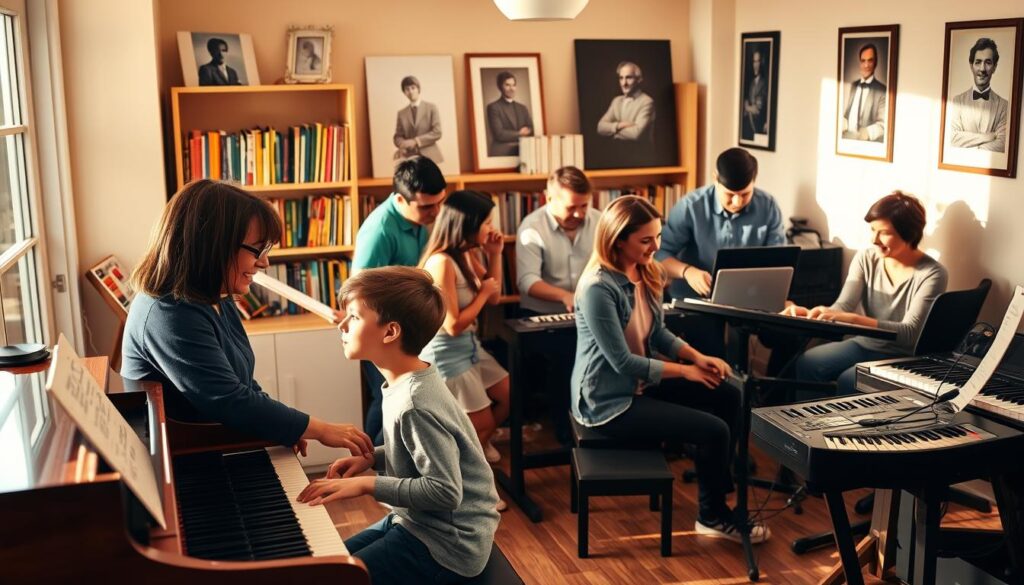
Online forums like Reddit’s r/piano are digital campfires. You can post a video of your shaky left-hand arpeggio and, instead of judgment, get a chorus of “sounded exactly like me last Tuesday!” This communal vulnerability is a powerful antidote to isolation. Suddenly, your struggle isn’t a personal failure. It’s a shared, almost universal, phase.
The first source takes this concept offline. It suggests participating in a concert or a small playing group. Here’s the psychological trick: the mild, healthy terror of a pending performance does wonders for focus. That scale you’ve been avoiding? It becomes urgent when you know three other people will hear it next week. Your motivation shifts from an internal, flickering flame to an externally stoked fire.
You’re no longer just letting yourself down. You’re potentially letting down your duet partner or the organizer who put you on the list. This is social accountability in its purest form.
| Type | Platform / Event | Key Benefit for Beating Fatigue | Best For |
|---|---|---|---|
| Online Communities | Reddit (r/piano), Discord servers, Facebook groups | 24/7 access to empathy, advice, and shared misery. Normalizes struggle. | Those with irregular schedules, introverts, or learners in remote areas. |
| Offline Groups | Local recitals, piano meetups, community center classes | Tangible pressure and immediate feedback. The thrill of live connection. | Social learners, those needing a deadline, and people craving in-person inspiration. |
| Hybrid Models | Structured online challenges with live-streamed recitals | Combines flexible access with the deadline of a performance. | Tech-savvy learners who want both community and a concrete goal. |
So, which path is right? The table isn’t about choosing one. It’s about realizing you have options. The online route offers constant, low-stakes support. The offline route provides a jolt of adrenaline that can power weeks of practice. Many successful students use both.
The core mechanism is the same: you externalize your “why.” Your reason to sit down and drill that Chopin etude isn’t just for you anymore. It’s for the forum you promised an update to. It’s for the group you don’t want to embarrass yourself in front of. This transforms discipline from a grim internal duty into a social contract.
In the end, beating practice fatigue is about outsourcing some of your willpower. Let the community be your co-pilot. The metronome keeps the time, but your people keep you showing up.
Finding Inspiring Music
Forget ‘Für Elise’ for a moment. What music actually makes you stop and listen? That’s your real starting line. The best piano motivation tips are simple: learn the music you love, not just what you’re supposed to learn.
Practicing scales is like eating broccoli. It’s good for you, but nobody loves it. The secret? Mix it with something you enjoy.
Your favorite synth line or a haunting film theme? That’s your fuel. As one source says, “if you love what you play, it never feels like a chore.” This isn’t just about fun; it’s a smart move. Passionate practice builds patience you never knew you had.
Targeting your “white whale” is another bold strategy. That one piece you think is too hard—like Beethoven’s Moonlight Sonata or Debussy’s Clair de Lune. It might not teach theory efficiently. But it’s a great motivator.
This connects you to the heart of playing. You’re not just doing exercises. You’re unlocking a language of emotion. It’s about expression, not just perfection.
To make this work, start a personal inspiration playlist. Listen closely. What makes you feel something?
Then, break it down with your teacher or an app. Start with the first four measures. Master the left-hand pattern. This turns a big challenge into small, exciting wins.
When you practice because you want to, finding time becomes easy. This is the core of piano motivation. It turns practice into a special time with music that touches your soul.
Dealing with Frustration & Plateaus
Frustration is a normal part of learning piano. It’s like a fee your brain pays for new skills. When you hit a wall, it’s time to pause and figure out why.
Is the problem technical, like a tricky chord? Or is it because your brain is too full? Finding out what’s causing your frustration is the first step to moving past it.
Looking at the facts can help too. Feeling like you’re not getting better might be an illusion. Tracking your progress with tools like a notebook or app can show you the truth.
Seeing how far you’ve come can make plateaus seem less daunting. For example, if you used to struggle with a simple scale but now play it well, you’ll see progress. This proof can keep you motivated.
Real-time feedback is also key. It’s like having a coach correct you as you play. Tools like AI-powered piano teachers offer this instant help.
They help you avoid bad habits by correcting mistakes right away. This keeps your learning efficient and helps you stay motivated.
So, how do you apply this in your daily practice? The table below shows common frustration causes and how to tackle them.
| Frustration Symptom | Root Cause Analysis | Data-Driven Solution |
|---|---|---|
| “My hands won’t cooperate!” | Likely a technical muscle memory gap. The brain knows the notes, but the fingers haven’t built the neural pathway. | Isolate the problematic 2-4 measure section. Use a metronome at 50% speed. Log daily speed increases in your tracker. |
| “I sound worse than yesterday.” | Common cognitive illusion. Often due to fatigue, distraction, or increased self-critical listening. | Record a 30-second clip of the piece. Compare it to your recording from one week prior. The objective audio rarely lies. |
| “I’ve been stuck on this song for weeks.” | Skill consolidation plateau. Your brain is moving knowledge from short-term to long-term memory. | Shift focus. Practice a different, easier piece for 2-3 days. Return to the original. You’ll often find a leap in proficiency. |
| “I keep making the same mistake.” | Ingrained error loop. Without immediate correction, the mistake becomes the default pattern. | Employ real-time feedback tools. An app that highlights wrong notes as you play them breaks the loop instantly. |
Don’t be afraid of plateaus. They show your brain is solidifying skills. Feeling stuck means you’re building strength for the next step.
Use data and feedback to guide you. This approach helps you stay motivated in the long run. It turns frustration into a stepping stone, not a barrier.
Real Student Stories
What if the secret to unstoppable practice isn’t a method, but a meaning? Two student stories reveal the answer. We often treat motivation like a finite resource, a battery that depletes with each scale. But these narratives flip the script.
Meet Sarah. A beginner-intermediate player, she hit the wall every musician knows. Scales were a snooze. Simple pieces felt like artistic baby food. Then, she decided to learn Beethoven’s “Moonlight Sonata,” first movement. Her late father used to play it.
By every standard method, it was too hard. She attacked it at a glacial pace, bar by painful bar. But the difficulty became the feature, not the bug. Each tiny victory—a clean arpeggio, a smooth transition—was a tribute. Her motivation became armor-plated. Ordinary practice fatigue couldn’t penetrate it.
Sarah’s story isn’t about talent; it’s about alchemy. She transformed a technical challenge into an emotional quest. That’s a masterclass in beating practice fatigue.
Then there’s Alex. He was seduced by the liquid moonlight of Debussy’s “Clair de Lune.” His teacher advised against it. Too advanced. Too impressionistic. Alex dove in any way.
The piece schooled him. It demanded a feather-light touch, a nuanced pedal technique, and phrasing that breathed. He learned these complex skills not from a dry exercise, but through sheer desire to recreate that shimmering soundscape.
His motivation was pure aesthetic hunger. The tedious work of mastering voicing and dynamics became a delicious puzzle. For Alex, the grind of practice was reframed as a treasure hunt. This is another potent strategy for beating practice fatigue.
So, what’s the common thread? Both students connected their practice to a powerful, personal “why.” For Sarah, it was memory and legacy. For Alex, it was beauty and sonic aspiration. When your reason is profound, the daily “how” stops feeling like a chore.
Fatigue thrives on abstraction and repetition. It withers under the heat of personal significance. Your next breakthrough might not be in a new practice app, but in asking yourself: what piece means something to me? Find that, and you’ve found your blueprint.
FAQ
Struggling with doubt? Let’s clear things up fast with a quick Q&A. Think of this as your last briefing on key piano motivation tips.
I never have time to practice. Should I cancel my lesson? Canceling is a big mistake. Your lesson, online or in-person, keeps you on track. Show up. Focus on making progress, not being perfect.
How do I know if I’m actually improving? Your own judgment can be off. Trust the facts. Use a metronome to check your speed. Record yourself every month. Real data shows you’re getting better.
Is it bad to learn pieces that are too hard for me? Trying something tough can be good. It can make you more determined. Just make sure to balance it with easier songs. This helps you stay motivated and avoid getting stuck.
Can an app really replace a teacher for motivation? An app can’t replace a teacher, but it can help a lot. A good app keeps you on track with constant feedback. It’s like having a personal coach always with you.
What’s the one non-negotiable tip? Make sure you enjoy practicing. Find the fun in it. Whether it’s a favorite song or a challenge with a friend, keep the joy alive. Now, go make music.